

Scientists in Australia have begun testing two potential coronavirus vaccines in “milestone” lab trials.
The vaccines, made by Oxford University and US company Inovio Pharmaceutical, have been cleared for animal testing by the World Health Organization.
Australia’s national science agency will assess if the vaccines work, and if they would be safe for humans.
The first human trial took place in the US last month, but skipped a stage of animal testing.
There are several other vaccine developments occurring around the world at the moment at extraordinary speed.
But Australia’s Commonwealth Scientific and Industrial Research Organisation (CSIRO) says its tests will be the first comprehensive pre-clinical trials of the vaccines to use an animal model.
Researchers said the speed and level of global co-operation that led to this stage had been unprecedented.
“Normally it takes about one-to-two years to get to this point and we’ve in fact shortened that to a period of a couple of months,” Dr Rob Grenfell from the CSIRO told reporters on Thursday.
How will it work?
In the past few days, the CSIRO team has inserted vaccine samples into ferrets – small, furry mammals which have been proven to contract the coronavirus in the same way humans do.
Sars-CoV-2 is the virus which causes the disease Covid-19. There are at least 20 vaccines in development around the world.
The CSIRO is testing two options selected by a global consortium overseeing most of this research, the Coalition for Epidemic Preparedness Innovations.
One option, developed by the University of Oxford, is a vector vaccine. It uses a “defective” virus to introduce the proteins of the coronavirus to the immune system and induce a response.
“But they’re not able to replicate… so there’s no possibility of becoming ill through this particular vaccine,” said Prof Trevor Drew, director of the Australian Animal Health Laboratory in Victoria, where the testing is being carried out.
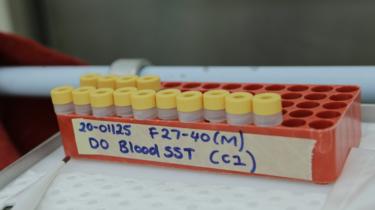 There are two potential vaccines being tested at this stage
He described the other vaccine – from Inovio – as “rather different but nonetheless exciting”.
It is designed to encode certain proteins of the coronavirus to the immune system, prompting the body’s cells to generate those proteins before the immune system reacts to them.
“It’s very important to take a multi-pronged approach to this,” said Prof Drew. “It gives us the best chance of success.”
How soon could we get results?
The first results from the animal tests could be revealed as early as June, the scientists said.
If successful, the vaccines could then be moved into clinical trials that could be conducted at labs elsewhere.

At that point, the race to get the medicine into the general market could be accelerated, but experts warn it would still involve a minimum 18-month timeline to meet regulatory tests and standards.
The Oxford University vaccine, for example, is also being tested by another lab on a separate animal to comply with US regulations.
“All of the [vaccine] candidates actually have a multitude of other companies and organisations involved because no single organisation can actually produce a vaccine,” said Dr Grenfell.
But he said he was “optimistic” about the work, given the level of global collaboration.
“This is a true collaboration across academic, public, and also private sectors to in fact actually achieve success at this point,” he said.




Kosi’s emergence on the Afrobeat scene feels both familiar and fresh. Rooted in a childhood shaped by gospel music and choir rehearsals, his sound carries the discipline and soul of his church background. But, there’s also a raw edge, drawn from the streets of Festac, Lagos, that gives his music a grittier, lived-in texture. The blend is strikingly obvious as you’d hear a voice trained in harmony and a message born of hustle.
The artist’s approach to songwriting is intentional, pulling from personal experiences and everyday realities rather than chasing empty trends. It’s this mix of vulnerability and confidence that has quickly earned him attention within Lagos‘s music circles, even though he has just a few releases. Kosi is already making a case for himself as a voice that can stand out in the crowd, honest, grounded, and undeniably Afrobeat.


A man places a Russian national flag on a balcony of a residential building in Lysychansk, eastern Ukraine, which is now territory under the control of the self-described Luhansk People’s Republic
As the Russia-Ukraine war enters its 132nd day, we take a look at the main developments.
Here are the key events so far on Tuesday, July 5.
Fighting
- Ukraine’s President Volodymyr Zelenskyy said his troops have “no alternative” but to “push back and destroy the offensive potential” of Russian forces, as the battle moves from Luhansk to nearby Donetsk.
- Ukrainian forces that retreated from Lysychansk are now holding the line between Bakhmut and Sloviansk, preparing to fend off a further Russian advance, Luhansk governor Serhiy Haidai said.
- President Vladimir Putin congratulated Russian troops on “liberating” the eastern Ukrainian region of Luhansk.
- At least 345 children have died in Ukraine as a result of Russia’s invasion and 644 have been wounded, the prosecutor general’s office reported.

Diplomacy
- Swedish Prime Minister Magdalena Andersson met Ukraine’s president in Kyiv, with the two parties signing a joint statement on defence and energy cooperation.
- Russian foreign minister Sergey Lavrov will fly to Hanoi on Tuesday for a two-day visit to Vietnam before heading to a G20 meeting later this week in Indonesia, the Vietnamese government said.
- Zelenskyy thanked the International Olympic Committee (IOC) for supporting a ban on Russian teams and athletes competing in most Olympic sports.
- Putin did not congratulate President Joe Biden on the United States’ Independence Day on July 4 due to “unfriendly” relations, the Kremlin said.
Economy
- Ukraine needs $750bn for a recovery plan, Prime Minister Denys Shmyhal told a Ukraine Recovery Conference hosted by Switzerland.
- Ukraine is holding talks with Turkey and the United Nations to secure guarantees for grain exports from Ukrainian ports, Zelenskyy said.
- Britain said it would on Tuesday introduce new economic, trade and transport sanctions on Belarus over its support for Russia’s invasion of Ukraine, and also sanctioned six Russians it said were spreading disinformation.
- Belarus said it was freezing foreign shareholdings in 190 Belarusian companies, including the software engineering company EPAM Systems and Lukoil Belarus, in response to Western sanctions.

Race plays key factor in a society where 10 percent of population owns more than 80 percent of wealth, World Bank says.
South Africa is the most unequal country in the world, with race playing a determining factor in a society where 10 percent of the population owns more than 80 percent of the wealth, a World Bank report has said.
“South Africa… is the most unequal country in the world, ranking first among 164 countries,” the Washington-based institution said Wednesday in a report, Inequality in Southern Africa.
Almost three decades after the end of apartheid, “race remains a key driver of high inequality in South Africa, due to its impact on education and the labor market,” it said.
When race is considered as a factor in income disparities, the report added, “its contribution to income inequality amounts to 41 percent, while contribution of education is reduced to 30 percent.
“The legacy of colonialism and apartheid, rooted in racial and spatial segregation, continues to reinforce inequality.”
The country’s neighbours that make up the rest of the Southern African Customs Union – Botswana, Eswatini, Lesotho and Namibia – established in 1910, all finish higher on the list of the most unequal countries in the world.
In the region, women earn on average 30 percent less than men with the same level of education with the pay gap as wide as 38 percent in Namibia and South Africa.
The uneven distribution of agricultural land is also a factor driving inequality, especially in rural areas.
In Namibia, 70 percent of the 39.7 million hectares (98.1 million acres) of commercial agricultural land “still belong to Namibians of European descent”, the World Bank said.
The report was produced before the COVID-19 pandemic and its authors used the Gini coefficient – an indicator of income inequality – to rank countries.
-
 Audio10 years ago
Page – Day Break Everywhere Burst
-
 Audio5 years ago
Shadykarz – Forever
-
 Audio10 years ago
Juniorboy ft. 9ice – IRAPADA
-
 Entertainment Gists5 years ago
Ex-Beauty Queen, Sandra Benede Shares Sexy Photo
-
 Audio5 years ago
Simi – Happy Birthday ft. Adekunle Gold, DeJa
-
 Audio5 years ago
Ruger – Bounce
-
 Mixtapes4 years ago
Mixtape: DJ DimpleNipple – The Best Of Amapiano Thrills
-
 Editorials3 years ago
Sa’eedah Imam On Creating Her Imprint In The Nigerian Music Industry As An Emerging Creative Writer