
Health
40 Year Old Paralyzed Man Walks Again Using New AI implants That Connect His Brain With Spinal Cord


A 40-year-old man whose legs were paralyzed in a cycling accident 12 years ago can now walk thanks to implants in his brain and spinal cord.
In 2011, a cycling accident left Gert-Jan Oskam, with paralysed legs and partially paralysed arms, after his spinal cord was damaged in his neck. But these days, Oskam is back on his feet and walking, thanks to a device that creates a ‘digital bridge’ between his brain and the nerves below his injury.
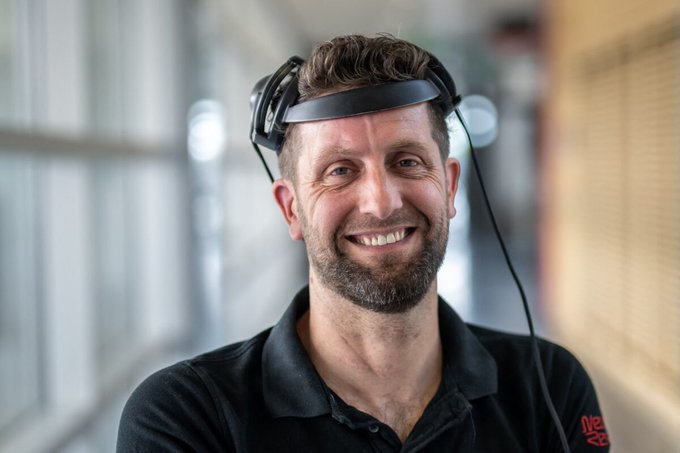
The implant which works with Artificial intelligence has been life-changing, says Oskam.
“Last week, there was something that needed to be painted and there was nobody to help me. So I took the walker and the paint, and I did it myself while I was standing,” he says.
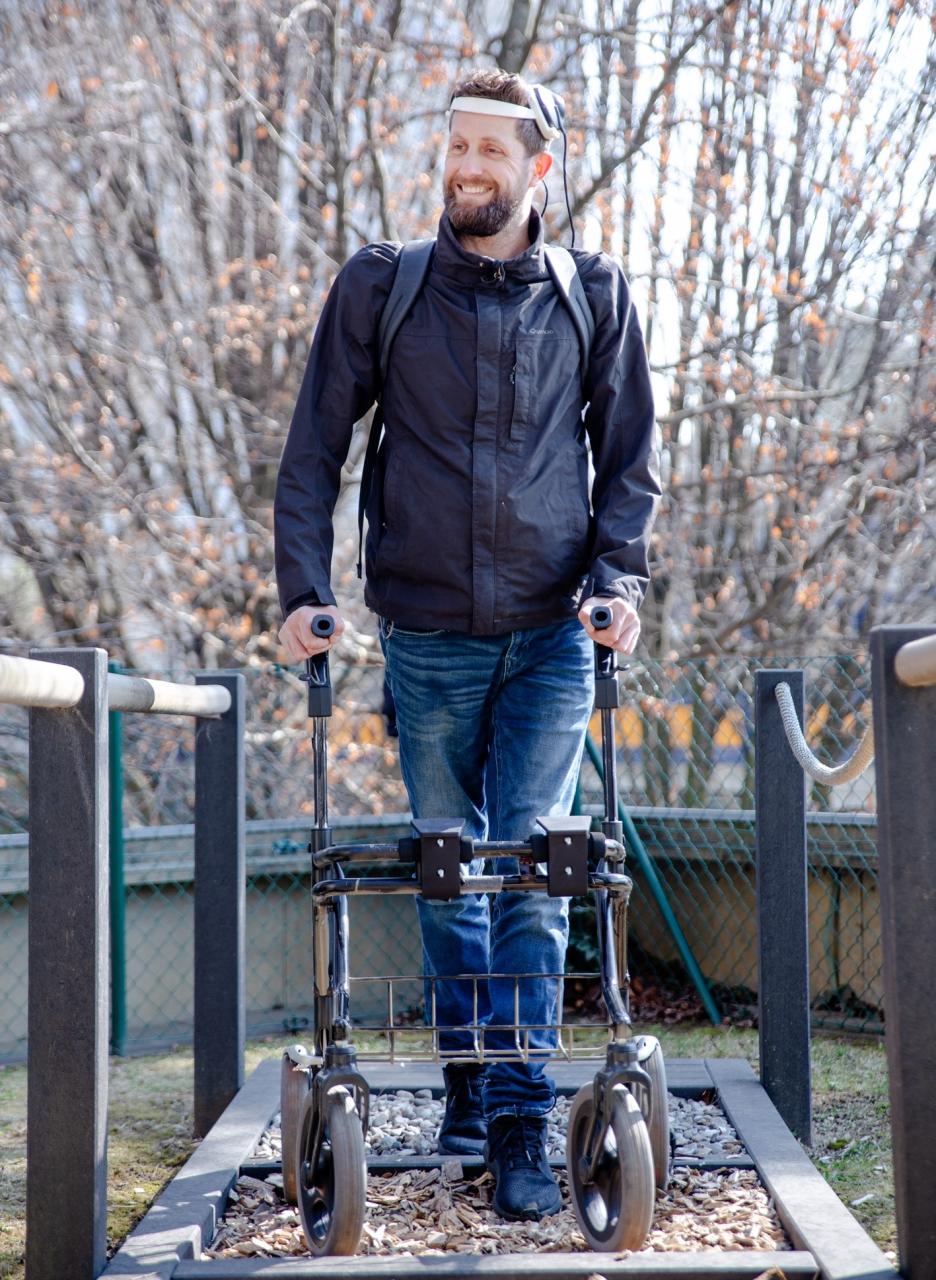
The device called a brain–spine interface — builds on previous work2 by Grégoire Courtine, a neuroscientist at the Swiss Federal Institute of Technology in Lausanne and his colleagues. In 2018, they demonstrated that, when combined with intensive training, technology that stimulates the lower spine with electrical pulses can help people with spinal-cord injuries to walk again.
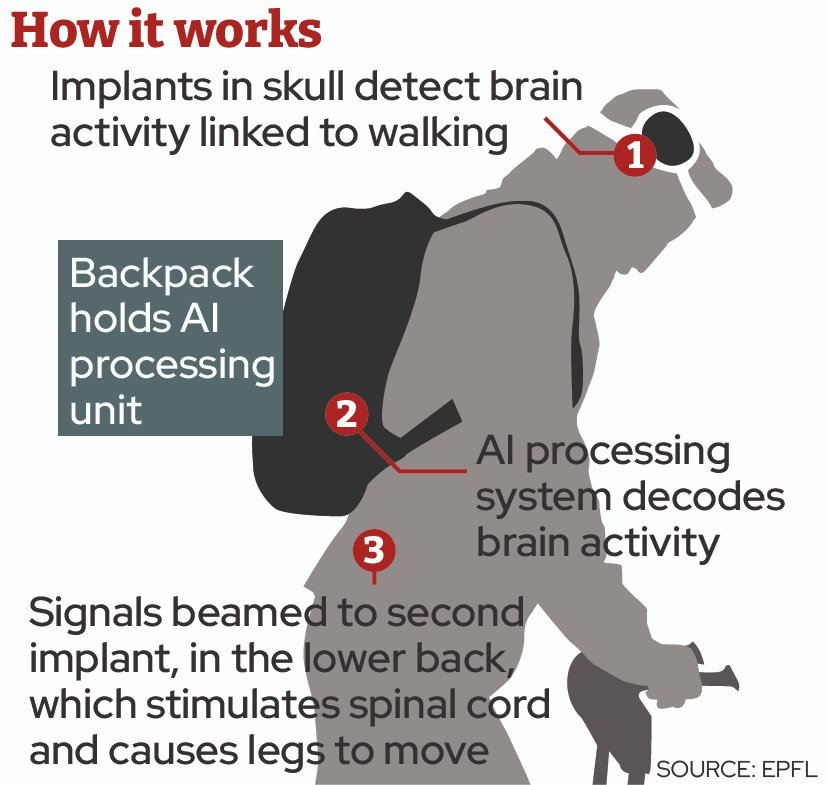
Oskam was one of the participants in that trial, but after three years, his improvements stagnated. He got a new system that makes use of the spinal implant that Oskam already has, and pairs it with two disc-shaped implants inserted into his skull so that two 64-electrode grids rest against the membrane covering the brain.
When Oskam thinks about walking, the skull implants detect electrical activity in the cortex, the outer layer of the brain. This signal is wirelessly transmitted and decoded by a computer that Oskam wears in a backpack, which then transmits the information to the spinal pulse generator.
The previous device “was more of a pre-programmed stimulation” that generated robotic stepping movements, says Courtine. “Now, it’s completely different, because Gert-Jan has full control over the parameter of stimulation, which means that he can stop, he can walk, he can climb up staircases.”
“The stimulation before was controlling me and now I am controlling stimulation by my thought,” says Oskam. “When I decide to make a step, the simulation will kick in, as soon as I think about it.”
After around 40 rehabilitation sessions using the brain–spine interface, Oskam had regained the ability to voluntarily move his legs and feet. That type of voluntary movement was not possible after spinal stimulation alone, and suggests that the training sessions with the new device prompted further recovery in nerve cells that were not completely severed during his injury. Oskam can also walk short distances without the device if he uses crutches.
Bruce Harland, a neuroscientist at the University of Auckland in New Zealand, says that this continued improvement in spinal function is great news for anyone with a spinal-cord injury, “because even if it’s a longer-term chronic injury, there’s still a few different ways that healing could happen”.
“It’s certainly a huge jump” towards improved function for people with spinal-cord injuries, says neuroscientist Anna Leonard at the University of Adelaide in Australia. And, she says, there is still room for other interventions — such as stem cells — to improve outcomes further. She adds that although the brain–spine interface restores walking, other functions such as bladder and bowel control are not targeted by the device. “So, there’s certainly still room for other areas of research that could help progress improvements in outcomes for these other sort of realms,” she says.



Minister of Science Technology and Innovation, Adeleke Mamora, has announced that his ministry has developed sickle cell and venom vaccines.
Speaking on Monday, December 12, at the 10th edition of the PMB Administration Scorecard Series (2015-2023), Mamora said the ministry achieved the use of local herbs for the production of drugs for sickle cell as the country had a high number of people with sickle cell anaemia, Daily Trust reports.
Also announcing some of the achievements of his ministry, Mamora added;
“There is also the development of an anti-venom vaccine, an anti-penic that reduces fat in the body.
“The Ministry, through Raw Materials Research and Development Council’s programme on development of the dairy sector, introduced the technology of increasing daily milk yield from our cows from 1-1.5 litres of milk per cow to over 15 litres per cow in a day.
“The National Space Research and Development Agency is working to establish a Space Museum and Planetarium that is expected to realise about N30 billion, boost tourism activities, provide 5000 direct jobs; 20,000 indirect jobs and improve the teaching of STI.
“Our future is full of optimism as long as we keep faith and leverage on the enormous power of STI coupled with demand-driven R&D programmes and projects.
“The fourth industrial revolution will register Nigeria’s presence and effective participation if we sustain and escalate current commitment and interest in research and innovation as principal push factors for technological advancement.
“We need courage, discipline and focus on fundamental principles of the culture of result-based management logical framework where all policy implementation efforts will produce outcomes.”

The Nigeria Tobacco Control Alliance (NTCA) has said that an estimated 28, 000 people die in Nigeria annually, due to tobacco use, while warning that compliance of regulations on other substances that contain tobacco like Shisha and snuff is at an all time low.
Speaking at a press conference in Abuja on Tuesday, November 8, Akinbode Oluwafemi, Chairman, of NTCA, said recent survey showed increase in the compliance level on cigarette packs, but a reduction in compliance level of snuff and shisha.
“As an Alliance, we have continued to work to strengthen the gains made so far on the policy. Therefore, as recently as October 2022, we commissioned a survey to ascertain the compliance level of the policy on all tobacco products in the country. The survey was carried out in Ekiti, Adamawa, Cross River, Abia, Abuja and Kano.”
“When results from this survey were compared with results from a similar survey we conducted in 2021, the results showed a significant increase in the compliance level on cigarette packs, with an estimated 90% compliance.”
“However, it is deeply concerning to find out that other tobacco products such as snuff and shisha (which has become notoriously popular among young people) have no graphic health warnings and still carry the outdated text warnings. The compliance level of this group of tobacco products is estimated to be below 10%”, he said.
“We therefore call on the Nigeria Police Force, Federal Ministries of Health and Environment, the National Security and Civil Defense Corps and all agencies charged with monitoring and enforcing of the National Tobacco Control Act to wake up to their responsibilities.
“Enforcement agencies must particularly monitor and enforce the policy on all tobacco products, not only on cigarette packs.”
“Also, policy implementation cannot continue to be centered in the Federal Capital Territory, Abuja, and Lagos. A good policy is not only good for urban centres. There is need to take enforcement of the graphic health warnings policy to Nigeria’s hinterlands to ensure compliance. We note that it is possible that non-compliant products may be moved far inland where enforcement is low or non-existent”, he said.
Health
Nearly 20 Million Nigerians Are Infected With Hepatitis B Or C – Minister of Health, Osagie Ehanire

Minister of Health, Osagie Ehanire has said that nearly 20 million Nigerians are infected with Hepatitis B or C.
Speaking at the launch of the national strategic framework for viral hepatitis and the flag-off ceremony of a nationwide hepatitis awareness campaign, in commemoration of this year’s World Hepatitis Day themed ‘Bringing Hepatitis Care Closer to You’ on Monday July 25, Osagie noted that there is very low awareness about the infections.
The infections according to the Minister are under-reported, under-diagnosed and under-treated; while stigma and discrimination against those infected also posed challenges.
Daily Trust reported that the World Health Organisation, Nigeria Representative, Walter Kazadi Mulombo, said in Africa, Nigeria had one of the highest burdens of viral hepatitis with a national hepatitis B prevalence rate of 8.1 per cent and a hepatitis C prevalence rate of 1.1 per cent among adults aged 15-64 years.
Mulombo added that by introducing the hepatitis B birth dose and the pentavalent vaccine into routine childhood immunization schedules in 2004, Nigeria is contributing to the global achievement of the reduction of hepatitis B infections in children.
Oliver Stolpe, Country Representative of the United Nations Office on Drugs and Crime, said to effectively raise awareness about hepatitis care, the focus should be on vulnerable and hard-to-reach populations such as people injecting drugs as well as people in custodial centres and other closed settings “because the prevalence of HCV is higher in prisons compared to the general populations”.
-
 Audio10 years ago
Page – Day Break Everywhere Burst
-
 Audio5 years ago
Shadykarz – Forever
-
 Audio10 years ago
Juniorboy ft. 9ice – IRAPADA
-
 Entertainment Gists5 years ago
Ex-Beauty Queen, Sandra Benede Shares Sexy Photo
-
 Audio5 years ago
Simi – Happy Birthday ft. Adekunle Gold, DeJa
-
 Audio5 years ago
Ruger – Bounce
-
 Mixtapes4 years ago
Mixtape: DJ DimpleNipple – The Best Of Amapiano Thrills
-
 Editorials3 years ago
Sa’eedah Imam On Creating Her Imprint In The Nigerian Music Industry As An Emerging Creative Writer