

Mide Ajayi is a tenacious mind, a unique creative who’s ambitious, God fearing and kind. Besides his interesting personality,

Mide Ajayi is a talent manager with a daring sense of humor and the owner of Superbold magazine as well as founder of District Youths.

He is the second son of a family of 7 from the western part of Nigeria, that is very passionate about giving back to the society and creating opportunities for others around him to thrive; hence the vision behind his latest project- District Youth.

District Youth is an initiative set to create platforms, opportunities that will inspire and connect the visionary youth on a journey of self discovery and personal development built with acquired skills that will prepare the youths for the future.
Quickie: learn more about District Youth here.
When asked; what made you start District Youth?
He said;
“Growing up, I saw episodes where people around me wanted to learn a skill but were unable to afford it, because the cost of learning the skill was almost as much as what the families needed for support. That broke my heart even more…
So when I was in ss2, I thought to myself;
I want to be my own boss.
And I began to actively seek out opportunities that would enable me achieve this goal, eventually I graduated high school and got admitted into higher institution.

As we all know, the Nigerian educational system isn’t such a firm one and we had to deal with a lot of strikes while in school, during that infamous 6 months strike,
I got myself into working with different people in the industry which gave me a lot of platforms to start my career and Superbold professionally.

Quickie: Superbold is digital magazine with three printed editions. See their lastest feature with Steff London Here.
“I believe the youths hold the key to unlocking Nigeria’s economic potential and that is why I created this initiative District Youth so Youths can connect, network, be inspired and motivated to be the change they wish to see in their future. And this is not a task for only one man or a handful, it is a collective effort.
Therefore I urge everyone who has the capability to make this platform thrive to join me and make the youths great again.
MIDE’S CLOSING REMARK

Quickie: Incase you missed our last blogpost, you can catch up here.
Photography: @Tobiajayiphotography & @Teocrisphotography
Until another share,
Sláinte…


Source: msjlifestyle.com


General News
“The Bandits Are Fulani From Nigeria And Other Neighbouring Countries” – Emir of Bungudu Recounts His 32 Days Experience in Kidnappers’ Den


The Emir of Bungudu, Zamfara State, Alhaji Hassan Attahiru, has recounted his experience in kidnappers’ den.
The monarch who regained freedom on Saturday, October 16, 2021, after 32 days of captivity, was kidnapped by bandits alongside his police orderly along the Kaduna-Abuja highway while they were travelling to Abuja on September 14.
In an interview with Daily Trust, the Emir narrated how he was kidnapped, the involvement or exploitation of banditry by traditional leaders, politicians, government employees, and security agents, among other issues.
When asked how the problem of banditry started in his domain and Zamfara in general, the monarch said that it began with attacks on Fulani communities; and reprisals were also made.
“But a lot of times, when Fulani or herders’ communities (not all the herders are Fulani) were attacked, they had nobody to protect them or even anywhere to lay their complaints. That is why they had no option than to seek a way of taking revenge,” he said.
“In most cases, it is where revenge was taken that news was made, and because of the nature of those they took revenge on, especially in more densely populated areas, you had collateral damage along the line. They knew who they were going to attack, but others who came in contact in the line of fire or so were also affected.
“That’s what happened from the beginning, on a small scale until it grew to a larger scale, where more people were involved from both sides and more vicious attacks were done. To our understanding, that’s how it started.
“I remember there was a time, at the beginning in my domain before I assumed the throne, my predecessor always warned communities against reprisals. When they were reporting it to the traditional authorities and others, things didn’t get as bad as they are now. That is one aspect
“The second aspect is the involvement of foreign herders in our communities. Foreign herders came as far as Guinea and Mali into this area. They had the culture of violence, which they introduced to our communities.
Thirdly, some of our youths went to the South, got into some bad habits, came back and introduced it to our communities. To my understanding, these are some of the things that brought about these attacks.
There is also the issue of failure of leadership amongst us. There is the failure of not effectively addressing the issues in a multifaceted and all-inclusive manner. I think that issue is persisting.
“I think the issue of foreign herders has been controlled, to a large extent. However, in the last few months we have been seeing some of them coming in, and we have been reporting them accordingly. That is my understanding of the issue.
Q: Some of you traditional authorities are accused of exploitation, which contributed to this problem; what do you say to this?
“If you are talking about the involvement or exploitation of the situation by traditional leaders, it became bad not more than 11 or 12 years ago; prior to that, things were going on well. And the authority of traditional rulers was eroded since 1976. But it is said that for years, traditional rulers have been exploiting the situation.
“The issue of exploitation by traditional rulers is not done in isolation. A lot of these things were done with politicians and government officials. In most cases, the role of traditional rulers was only symbolic; maybe some of them took advantage of what the other ones were doing to gain from their situation.
“But I assure you that prior to when traditional rulers had authority, it wasn’t like that. They held all the herders and other communities in high esteem because the institution benefitted from peace and tranquility, as well as the growth and prosperity among these people.
“On the issue of traditional rulers exploiting the situation, wherever there are people, there are always bad eggs. Substantially, I think the role of traditional rulers in making the situation as bad as it is, as far as what I am seeing, is largely minimal.
Q: In the last 11 or 12 years that this violence has become almost uncontrollable, how has it affected the people in this domain?
“Without any fear of contradiction, our people’s source of income has diminished by more than 80 per cent because the area affected by this insecurity is the heart of prosperity in my domain.
“We have at least 80 per cent of where food is grown and where herders operated peacefully in those days. We have at least 80 per cent of them that have been affected in almost absolute terms, whereby they could hardly do anything. If they cooperated with some of the bandits and were able to grow, they could barely get what they could feed themselves and their families with.
“You could say the lifeline of our people has been rearing of livestock and farming, so, as long as that has been affected, certainly, you know we have been affected. I am not counting the countless lives. Nobody can give a figure of the people who have been killed or displaced because no serious assessment has been done.
Q: How do you feel as a leader seeing the devastation caused by this violence on the people
“Certainly, it is heartbreaking, to say the least. It is not only that we are always exposed to insecurity, our bond with our people has been a very strong one. By the time you hear that a place has been attacked, it is a place and people you know and have related with. There are not stories. It is worrisome. The sorrow we feel and emotional situation people have been pushed into cannot really be adequately explained.
“You have been battling this problem at home, then suddenly, on the highway your convoy was stopped and you were abducted; how did you feel on that day?
“Anybody who knows what is happening in the country, especially in the area where I became a victim, knows that it could happen to anybody. When it happened, of course there must be the initial shock, but along the line, I lived with the situation.
“I must admit that I only got some courage from the Almighty. I am sure it is thanks to the prayers that a lot of people had been doing for me that I was able to have control of myself. Throughout the period of captivity, I don’t think there was a day I knew the feeling of stress.
“I was telling some of my people that the fear and worry they were put into were more than what I was feeling. And it was understandable because I was in a certain situation and you people were in an uncertain situation. So I wasn’t surprised.
Q: Can you recall how it happened?
“Like everybody else has been explaining, you were on your way and suddenly, people started shooting and your driver tried to maneuver, but others came from behind and attacked and picked up people, killed a couple of others and took you into the bush, walked for about two days, then you were taken to their camp.
“I spent 30 days in their camp, apart from the two days we used in walking to that place. And it was during the rainy season, so it was raining day and night. That was why I said the strength some of us had must have only come from God. I was not the only person, there were few others, including young women in my group. We all went through; thanks to God.
Q: How was the camp where they kept you; was it an open field or like a village?
It was an open field.
Q: Did they keep people in some huts?
“I wouldn’t want to compromise some situations, so I wouldn’t want to go into very deep specifics, but it was an open place. They had the advantage of maybe hearing and seeing people from there. The people who kept watch over their victims were different from those who went for operations.
“These are young and illiterate people who were into drugs and other things. Those who were a little bit older were the ones who would go and scavenge for victims.
Q: How did it feel facing uncertainty, especially because this could turn either way for you if there was an attempt to rescue you?
“It is thanks to the Almighty Allah that things went well. I don’t know how we got the courage, but I really had faith that God had ordained whatever was going to happen, so I didn’t get much bothered.
“I didn’t have time to think, but I was always praying and hoping for the best. I was also encouraging those who were with me. There were a couple of young people and a lot of people from the surrounding villages who were captured and brought there. I tried to encourage people to always have faith in God. So I didn’t have much worry while I was there.
Q: Were your captors Fulani?
“Substantially, they were Fulani from Nigeria and some from neighbouring countries. I knew that some of them were from Niger. Some of them even had training outside the country because the way they were speaking, they were Fulani of all dialects. We had somebody who understood Fulfulde very well, so he used to tell us the difference among dialects because our knowledge of the language was very small. Of course there were others from the surrounding villages, who they conquered and recruited into their activities.
Q: What was their motivation; did they speak of any agenda or religion?
“Certainly, there was no religious agenda. To me, it has turned out to be purely criminal, but what drove them into it could be something else. Many of them were driven into it because they lost all their means of livelihood and became victims of torture by security agencies, some of them for crimes they committed, others without committing any crime. According to them, they lost everything they had, so they had no option than to go into the bush and engage in crime. But it has passed that stage.
Q: Do you think some religious organisations may have trained them?
“I don’t have any reason to believe that, but of course there were talks amongst them of people from Boko Haram coming and allowing them to work with them. While we were there, they were mourning one of their leaders, who they said was killed by the Boko Haram group. That was the much I could hear about an incident of religion.
Q: The issue of vigilante has been on for a while, I mean the Yan-sa-kai; do you think it is a solution or a factor actually fueling the crisis?
“There has to be a very comprehensive approach to solve this situation. Each group you bring out has its own ills; we have bad eggs from all areas. Just like traditional rulers, the Yan-sa-kai also has bad eggs; even security agents have bad eggs. So there has to be a comprehensive collaboration so that we can utilise every strength we have.
“Certainly, there is a role the Yan-sa-kai could play. There are also those we call Yan banga. Those in Yan-sa-kai are largely on their own; they normally don’t even listen to us, but we have some level of control over the Yan banga.
“We have traditional artisans, the Entori, the other people who had their way among the community that could be used. So there really has to be full concentration to face this menace.
“I always plead that all the potentials we have are utilised so that this problem could be solved. Of course I am not only talking about attacking and finishing the bandits, there is a social approach that has to be taken.
“We have lost our farmlands and herding environment. And these were places that employed millions of people, apart from other benefits. We need to find a way of restoring these things. And that is the only thing that will make people go back and have a legitimate means of livelihood instead of engaging in banditry. It is not going to be easy, but I assure you that if there is effective synergy among all the concerned people, I am sure we can solve this problem in no distant future.
Q: Are there some bandits that should be given an opportunity to repent?
“Of course, opportunity should be given to any criminal who wants to become a good person. If we don’t do that we are even negating what the Almighty has ordered us to do. But it has to be done in a very controlled manner. If anybody wants to repent, what is he going to do? Where are the weapons he had? Where is his family? Where was he staying before joining banditry? What was he doing? And how would he integrate?
“This is because it should be total repentance. A lot of them had places they were living with their families and doing some vocations. As long as we do that, it would go a long way in solving the situation, but we have to be very cautious about that.
Q: In summary, what would you say we should do to get out of this problem?
“There are so many things. Although there is no easy way, largely, we have to really look backwards and inwards. How were we living before now? Who was where and doing what? How do we restore our means of livelihood? We really have to look back, use traditional rulers and others and see how much we could recover about what had been sustaining people.
“Some of the people in the bush really had no formal education, so we have to look at how we could integrate them and give them some education. By the time we continue doing that, then within some time I think we should be able to solve the situation.
“And there is this issue of people in privileged positions that are involved in economic gains. I think they should face the law because as long as people are taking part in these things and they are left unpunished, certainly we will not see the end of this. We have to take action, whether they are traditional rulers, security agents, politicians or government employees. Anybody caught should face the law.
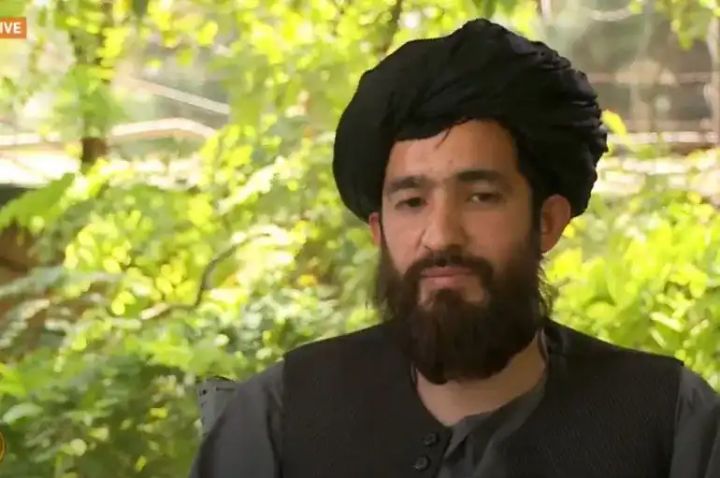
Abdul Qahar Balkhi, from the Taliban’s Cultural Commission, has spoken exclusively to Al Jazeera’s Charlotte Bellis.
Abdul Qahar Balkhi from the Taliban’s Cultural Commission has spoken to Al Jazeera in the group’s first official interview since the armed group took over Kabul a week ago.
Balkhi revealed his face for the first time on Tuesday at the Taliban’s first press conference, during which he translated for spokesman Zabihullah Mujahid. He remains without an official title, as his role is one of many still to be decided in the new government.
The Taliban leader said the group wants to move forward and hopes stakeholders – both domestic and international – can cooperate on common interests.
On government formation
Abdul Qahar Balkhi: The consultations are ongoing, and of course it is going to be an inclusive system.
The talks include whether the capital will remain in Kabul or move to [the group’s birthplace] Kandahar.
On the chaos at Kabul airport
Balkhi: We are in talks and we have a relationship, a working relationship, with the Americans about the security arrangement.
The outside checkposts are in our control, and inside is under the control of the US forces, and we are in constant contact with one another.
On the lack of trust between people in Kabul and the Taliban
Balkhi: It is very unfortunate for people to be rushing to the airport the way they are at the moment.
Because we have announced a general amnesty for everyone in the security forces from the senior to the junior level… this fear, this hysteria that has taken place is unfounded.
On the swift takeover of Kabul
Balkhi: The developments were so fast that all people were taken by surprise.
When we entered Kabul, and it was not planned because we announced initially that we do not want to enter Kabul, and we want to reach a political solution before entering Kabul and making a joint and inclusive government. But what happened was that the security forces left, abandoned their places, and we were forced to ask our forces to enter and take over security.
On governance and women’s rights
Balkhi: The point of intra-Afghan talks was precisely that we come to an agreement about what those rights actually entail.
Islamic law is known to everyone and there are no ambiguities about the rights of women, the rights of men, not only women but also the rights of men and children. And right now we’re in a situation that hopefully during the consultations there will be clarifications about what those rights are.
On the reported targeted killings and harassment of government and civil society figures
Balkhi: Our foremost priority is the discipline in our own ranks, and not enforcing laws on others but enforcing it on ourselves first and then giving it an example for the rest of society to follow suit. So we’re the first ones and our members, if they are involved in such things, [they] will be the first to be prosecuted.
On the group being labelled ‘terrorists’
Balkhi: I don’t think people believe we are terrorists. I think it’s just “the war on terror”, it was just a term coined by the United States and anyone [who did] not fall in line were labelled terrorists.
Entertainment Gists
My Mom Hides in My Room To Smoke Weed With Me When Her Mom Comes Around – Singer, Seun Kuti Reveals [Video]

Singer, Seun Kuti has narrated how his mother would hide in his room to smoke weed with him whenever her mum comes around.
In an interview with Nicole Abebe and Moet Abebe, the singer revealed that his mother did this because his grandmother didn’t know she smokes.
Seun also disclosed that he will always tell his mother to “go deal with her mum as his own mother knows he smokes”.
Watch the video below……..
-
 Audio10 years ago
Page – Day Break Everywhere Burst
-
 Audio5 years ago
Shadykarz – Forever
-
 Audio10 years ago
Juniorboy ft. 9ice – IRAPADA
-
 Entertainment Gists6 years ago
Ex-Beauty Queen, Sandra Benede Shares Sexy Photo
-
 Audio5 years ago
Simi – Happy Birthday ft. Adekunle Gold, DeJa
-
 Audio5 years ago
Ruger – Bounce
-
 Mixtapes4 years ago
Mixtape: DJ DimpleNipple – The Best Of Amapiano Thrills
-
 Editorials3 years ago
Sa’eedah Imam On Creating Her Imprint In The Nigerian Music Industry As An Emerging Creative Writer