
News
Why Serena Williams Has Never Been Defined By Chase For Margaret Court’s Grand Slam Record


In Serena Williams’ lengthy essay announcing her impending retirement, she addressed the inescapable record – Margaret Court’s 24 Grand Slam singles titles.
Williams won her 23rd title at the Australian Open in 2017. In the five years since, the subject of Court’s record has followed her everywhere. The American has been asked about it in almost every news conference. Pundits discussing her legacy have dissected the subject at length.
“There are people who say I’m not the GOAT [Greatest of All Time] because I didn’t pass Court’s record, which she achieved before the ‘Open era’ that began in 1968,'” Williams wrote.
“I’d be lying if I said I didn’t want that record. Obviously, I do.
“But day to day, I’m really not thinking about her. Maybe I thought about it too much, and that didn’t help.”
Williams has never allowed herself to be defined by this record. She is far more than just a number.
And it has been argued that Court’s record does not accurately represent the changes in professionalism in tennis.
BBC Sport takes a closer look at the record that Williams, in her own words, “shoulda, woulda, coulda” have broken.
What are the numbers?
Williams won her first major singles title at her home Slam with victory in the 1999 US Open. She would win the final one in Melbourne 18 years later, and while eight weeks pregnant.
Court’s first singles Slam also came on home soil when she triumphed at the Australian Open in 1960, with her last coming in New York in 1973.
| Where did both players win their titles? | ||
|---|---|---|
| Grand Slams | Margaret Court | Serena Williams |
| Australian Open | 11 | 7 |
| French Open | 5 | 3 |
| Wimbledon | 3 | 7 |
| US Open | 5 | 6 |
Court is one of just five women to have won a calendar Grand Slam, winning all four majors in 1970. That also came in a season where she won 21 of 27 tournaments and 104 of 110 matches.
Williams has held all four Grand Slam titles at the same time twice in her career – first in 2002-03 and again in 2014-15, with the feat nicknamed the ‘Serena Slam’ – but missed out on a calendar Slam in 2015.
Court was dominant at the Australian Open with 11 titles there, while Williams has lifted trophies seven times at both Melbourne and Wimbledon.
Different era, different record?
Williams alluded to the central issue herself in her essay – Court won the majority of her major titles before the Open era.
The Open era refers to any time after 1968, when Grand Slam tournaments allowed professional players to compete alongside amateurs.
Before the professionalisation of the sport, most majors were contested by amateurs. Because the Grand Slams did not offer prize money, the top players, seeking financial security, would compete in private events, meaning the best players did not always compete at the majors.
Court won 13 of her 24 titles during the amateur era. Many have argued that the opposition during this period would not be the highest standard it could be. Additionally, players would skip travelling to the Australian Open, where Court was so dominant, even into the late 1980s because of travelling costs and the lengthy distance.
None of this is to undermine Court’s achievements on a tennis court. But there will, for a considerable period, have been easier draws for Court because of the top players missing tournaments, particularly at home.
As Slam draws expanded and more players turned professional throughout the years, it naturally became more difficult to win. Chris Evert and Martina Navratilova won 18 major titles each between 1974 and 1990. Steffi Graf went four better between 1987 and 1999 to set an Open era record.
Williams has broken that record. She has played against Graf, sister Venus, Kim Clijsters, Maria Sharapova, Monica Seles and Lindsay Davenport, to name a few. She holds a winning record against all of these multiple Grand Slam champions.
As these women played in a purely professional era, it could be argued that this is the standard that Williams, too, should be held to.
When has Williams come close?
Williams has been within touching distance of Court’s record on a number of occasions.
- US Open 2015 – In a loss that she later says broke her heart, the American went down 2-6 6-4 6-4 to Roberta Vinci in the semi-finals. Williams was aiming for a calendar Slam and led 2-0 in the decider before being beaten by the unseeded Italian.
- Wimbledon 2018 – Williams had dropped just one set at SW19 as she reached her first final since returning from maternity leave. Facing Angelique Kerber, Serena was broken in the opening game of the match and could not find her way back in as Kerber won 6-3 6-3.
- US Open 2018 – With her opponent Naomi Osaka playing in her first Slam final, Williams was the strong favourite. But in a final dominated by Osaka’s clean hitting and Williams’ outburst at umpire Carlos Ramos, which sparked controversy for months afterwards, the Japanese player triumphed 6-2 6-4.
- Australian Open 2019 – Playing Karolina Pliskova in the quarter-finals, Williams had overturned a first-set deficit and led the deciding set 5-1. However, after rolling her ankle, Williams squandered four match points and six games in a row as Pliskova prevailed 6-4 4-6 7-5.
- Wimbledon 2019 – Reaching another final on her best surface, Williams was steamrollered 6-2 6-2 by Simona Halep in 56 minutes, with Halep hitting just three unforced errors in the match.
- US Open 2019 – Once again facing a first-time Slam finalist at Flushing Meadows, Williams fought back from a double break down in the second set but suffered a fourth consecutive Slam final loss as Bianca Andreescu won 6-3 7-5.
Ultimately, does it matter?

The number 24 has hung over Williams’ head since her return from maternity leave.
Speaking after the 2021 Australian Open, where she reached the semi-finals, Williams admitted beating the record was “frankly the only reason I’m still playing”.
“It’s definitely on my shoulders and on my mind. I think it’s good to be on my mind. I think it’s a different burden on my shoulders because I’m used to it now. It’s more relaxing,” she said.
Her former coach Patrick Mouratoglou also said Williams was “not as obsessed with 24 as most people in the tennis world” but conceded it was the only reason she came back to the sport after a near-death experience in childbirth.
In an interview since announcing she would be stepping away from tennis, Williams said she had “already broken the record” – she has, after all, won more majors than any man or woman in the Open era.
Roger Federer previously said Williams is “one of the greatest, if not the greatest tennis player of all time,” regardless of gender, while Mouratoglou made the case that Williams will go down as the greatest in spite of Court’s record.
Since her retirement, Court has sparked huge controversy because of her views on gay marriage and LGBTQ+ rights, with figures such as John McEnroe arguing that her stance undermines her on-court achievements.
Williams has for a long time been a figure who transcends her sport. She and sister Venus have dominated a historically white sport, dealing with racism along the way and inspiring a new generation of players who are reaping the rewards of the paths they forged.
In Williams’ final Australian Open appearance, her husband wore a T-shirt with an image of her and ‘Greatest Female Athlete’ splashed across the front, with a cross through the world female. The message was clear.
What makes someone the greatest of all time? Is it statistics? The mark they make on their sport, on and off the field? Or is it, simply, the way they make somebody feel?
Williams has thrilled, astonished, amazed, at times infuriated but overall delighted an entire generation of people. She is the name that non-tennis fans will recognise, the one who people want to see on the biggest stage and who they see as having changed her sport for the better.
Does not winning 24 Grand Slams in singles undermine that?
“I showed up 23 times, and that’s fine,” she said. “Actually, it’s extraordinary.”




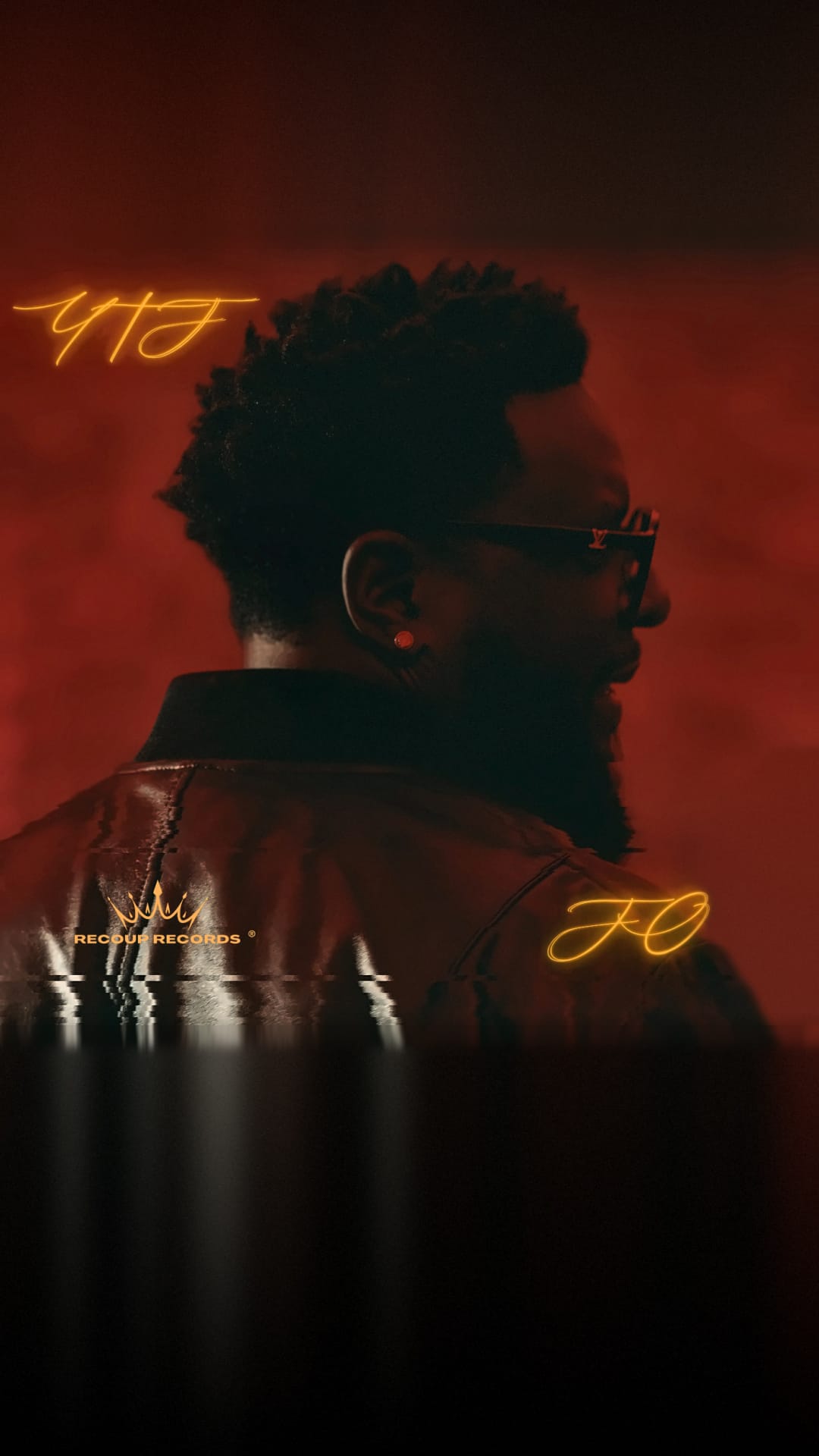

Josh2Funny’s Album Has Fans Talking — But Should He Stick To Music Or Skits? 😂🎶

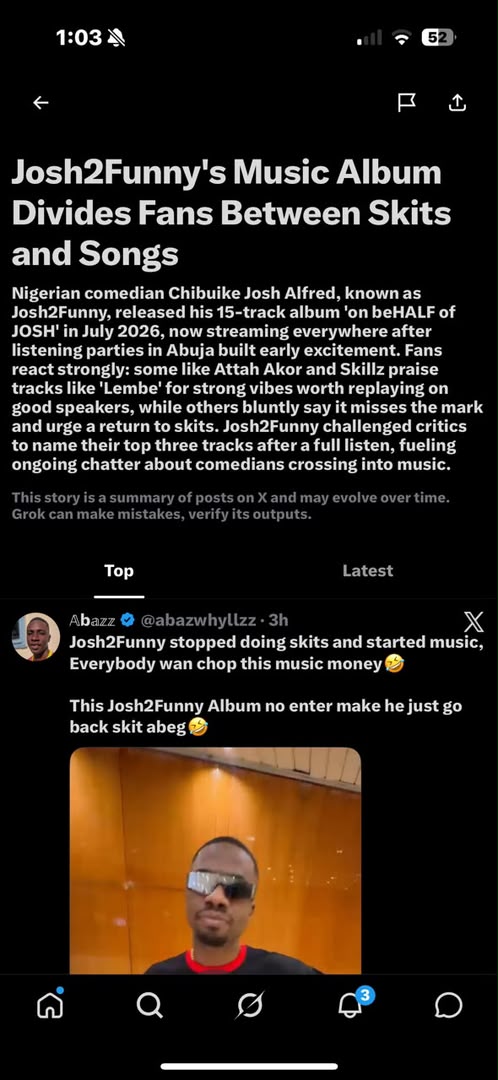
Nigerian comedian and content creator Josh2Funny has taken his comedy game into music, and Nigerians are definitely having something to say about it.
The comedian released his 15-track album, “On Behalf of Josh,” on July 10, 2026, but instead of fading away after release, the project has continued to generate conversations on X.
And the big question now is:
Should Josh2Funny continue with music or go back to skits? 😂
Fans have been divided. While some listeners openly criticized the album and told him to return to comedy, others found songs they genuinely enjoyed.
One X user joked:
“Josh2Funny stopped doing skits and started music, Everybody wan chop this music money 😂”
Another simply said:
“This Josh2Funny Album no enter make he just go back skit abeg 😂”
But then came “Lembe.” 🔥
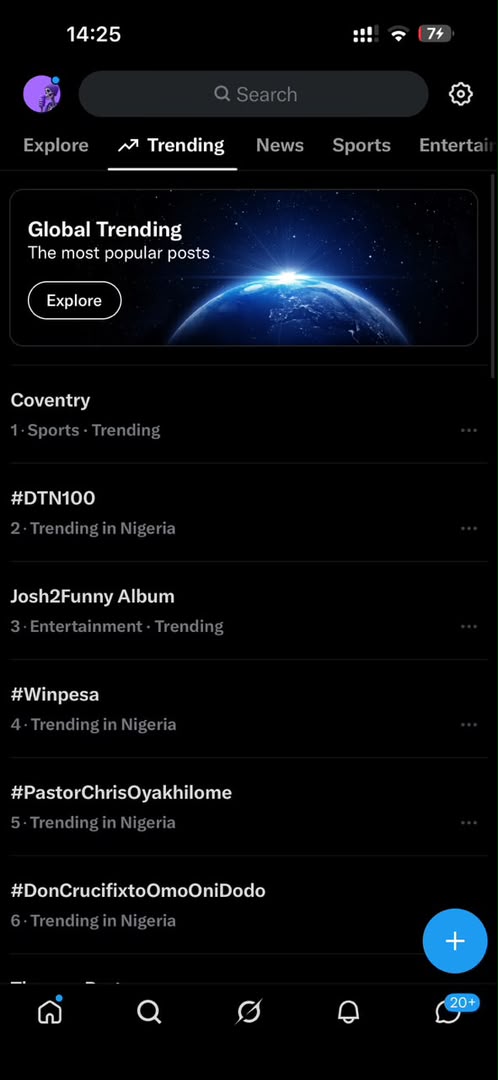
The track caught fire on X and eventually became a trending topic in Nigeria. The #LembeChallenge also gained momentum as creators began jumping on the song.
Josh2Funny later announced ₦1 million for winners of the challenge, giving the song another major push.
And it didn’t stop there.
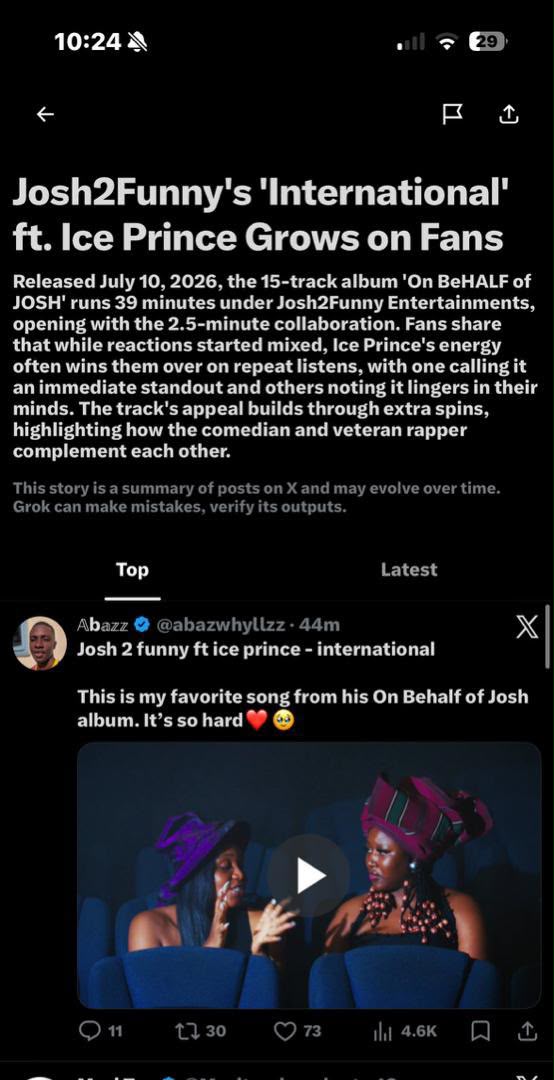
‘INTERNATIONAL’ FT. ICE PRINCE ALSO TRENDED
On another day, “International” featuring Ice Prince generated its own buzz on X.
One fan even called it their favourite song from the album, while praising the collaboration. The post itself pulled thousands of views, showing that people weren’t only talking about Lembe.
From album criticism to trending songs and challenges, “On Behalf of Josh” has kept Josh2Funny’s name in the conversation.
Whether you love the album or think he should return to skits, one thing is clear:
Josh2Funny has succeeded in getting Nigerians talking. 😂🔥
So, let’s settle this once and for all:
Should Josh2Funny continue with MUSIC 🎶 or return to SKITS 😂?
Music or Skits? Drop your answer! 👇


East Ham, East London — 8 August 2026: The vibrant Igbo community in the UK came together for an unforgettable evening of entertainment, culture and social connection at Igbotic Game Night, one of the biggest social gatherings celebrating the Igbo community in the United Kingdom.
Among the night’s standout moments was an electrifying performance by Afrobeats artist Obeena, who took the stage and immediately captured the attention of the crowd.
Obeena delivered performances of two of his hit songs, “Wara Wara” and “Banging,” bringing his energetic sound and distinctive stage presence to the event. From the opening moments of his set, fans responded with excitement, singing along, dancing and enthusiastically supporting the artist.

His performance of “Wara Wara” created an instant connection with the audience, while “Banging” took the energy to another level. Obeena’s ability to engage the crowd transformed his set into one of the most memorable entertainment moments of the evening.
Held in East Ham, East London, on 8 August 2026, Igbotic Game Night provided a unique platform for members of the Igbo community to celebrate their heritage while enjoying music, games and social interaction. Events such as this continue to play an important role in bringing together Nigerians and the wider African diaspora in the UK.
For Obeena, the performance was another opportunity to showcase his growing artistry and connect directly with fans. His energetic delivery, stage confidence and ability to command the audience demonstrated why his live performances continue to attract attention.
By the end of his set, Obeena had left the crowd amazed and added another memorable chapter to his journey as an Afrobeats artist. His appearance at Igbotic Game Night was not simply a performance—it was a celebration of Nigerian music, culture and community.
With performances like this, Obeena continues to demonstrate his ambition to take his sound beyond the studio and onto major stages, connecting with audiences through music, energy and an unmistakable African identity.
Igbotic Game Night brought the Igbo community together. Obeena gave them a performance to remember.
-
 Audio10 years ago
Page – Day Break Everywhere Burst
-
 Audio5 years ago
Shadykarz – Forever
-
 Audio10 years ago
Juniorboy ft. 9ice – IRAPADA
-
 Entertainment Gists6 years ago
Ex-Beauty Queen, Sandra Benede Shares Sexy Photo
-
 Audio5 years ago
Simi – Happy Birthday ft. Adekunle Gold, DeJa
-
 Audio5 years ago
Ruger – Bounce
-
 Mixtapes4 years ago
Mixtape: DJ DimpleNipple – The Best Of Amapiano Thrills
-
 Editorials3 years ago
Sa’eedah Imam On Creating Her Imprint In The Nigerian Music Industry As An Emerging Creative Writer