

This is an updated version of an article originally published in May 2019.
“Ask not what Trans-Dniester can do for you – ask what you can do for Trans-Dniester.”
We’re driving down Andriy Smolensky’s favourite street. It’s the only one in Tiraspol that doesn’t cause his Land Rover to bounce and rattle over potholes and broken concrete.
“They’ve used a new technology to make it like this,” he says, almost proudly. “I could drive up and down it all day.”
The tiny de facto republic of Trans-Dniester – sometimes known as Transnistria – is a place frozen in time.
In its capital Tiraspol, the hammer and sickle motif of the former USSR is proudly displayed on billboards and government buildings. A huge statue of Lenin looks on from a plinth outside parliament, a mark of the pride and nostalgia the city feels for its Soviet past.
The present brings pride, too.
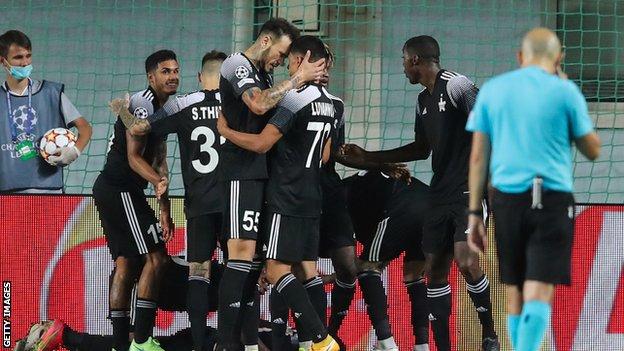
On Tuesday night, the city’s football club – FC Sheriff Tiraspol – pulled off one of the biggest Champions League shocks of all time, beating 13-time European champions Real Madrid.
This is their first season in Europe’s biggest club competition – and two games into the group stage they have a 100% record after an earlier win over Shakhtar Donetsk.
As Sheriff step into the unknown, so too does elite European football. This is the first time the Champions League has been played in one of Europe’s ‘unrecognised’ de facto republics.
In international law, Trans-Dniester, a thin sliver of land on the border with Ukraine, belongs to the Republic of Moldova, a country formed in 1991 as the Soviet Union was collapsing.

In 1992, Russian-backed forces fought a separatist war here. When it was over, close to a thousand people had been killed, and the land east of Moldova’s Dniester river had seceded to form a self-declared new state that remains unrecognised by the international community.
Trans-Dniester takes its ‘independence’ from Moldova seriously. It uses its own currency, the Trans-Dniestrian rouble, which cannot be obtained or exchanged anywhere else in the world, and which sits outside the international banking system. In Tiraspol, phone signals from Moldova don’t register, despite the ‘border’ being only 20km away.
The territory has a reputation for corruption, organised crime and smuggling. American foreign policy think-tank the Carnegie Endowment for International Peace described it as “a haven for smugglers”.
Millions of dollars of contraband are believed to have been moved across its border with Ukraine in recent years. Yet in Tiraspol, buildings are crumbling and the roads are cracked. The capital is a picture painted in Soviet grey.
Smolensky used to work here as a broadcaster, transmitting Russian-funded German-language programmes to Europe and the United States that “spread the message” of what Trans-Dniester is trying to achieve.
Before that, he was employed by the territory’s biggest private firm, the Sheriff Company. He worked on immigration papers for overseas signings at the company’s football club, FC Sheriff Tiraspol.
The Champions League debutants have played in Moldova’s football league since 1999. They are kings ruling over a peasant land. The Sheriff Company annual turnover is almost double the state budget, and it funds the club directly from its vast wealth reserves. The rest of Moldovan football is impoverished by comparison.
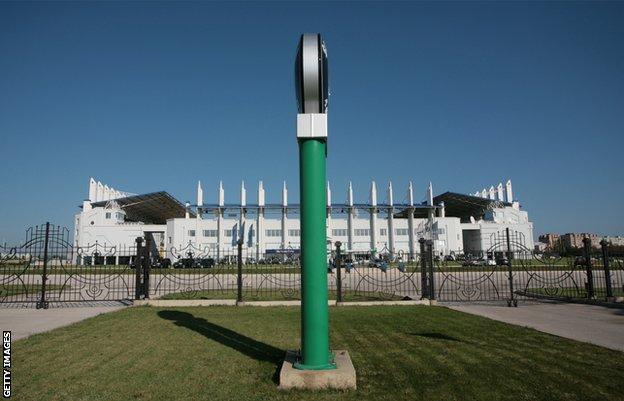
While the rest of the top division play on sports pitches rented from municipal authorities, Sheriff’s home is a specially constructed $200m (£154m) arena on the outskirts of Tiraspol. They have won 20 of the 22 league titles they have contested.
The name Sheriff is synonymous with power in Trans-Dniester. The Sheriff Company was founded in 1993, ostensibly as a charity with the aim of providing financial assistance to veterans of the local state police in the immediate post-Soviet era.
Today, it dominates everything from food retail to banking, from the media to politics. While nominally a private business concern, in December 2020 it won an overwhelming majority in the local parliament through its political party, Obnovlenie – Renewal.
There is no formal connection between the Trans-Dniestrian government and FC Sheriff, but its position of political and economic strength is steadfastly secure.
But the football club haven’t always had things their own way. Petr Lulenov is a member of the Trans-Dniestrian Football Federation. He says that, before victory in this season’s Champions League qualifiers, Sheriff’s blueprint for European success had been failing for years.
“It was the business model of the club to sign foreign players from South America and from Africa, add to their value and then sell them to Russian clubs,” says Lulenov.
But owing to the weakness of the domestic league and the subsequent lack of competition, the model wasn’t sufficient for raising players’ standards.
“It was also hoped that teams from Russia and Ukraine would come and use the club’s facilities and that that would help create big football rivalries,” says Lulenov. “But it isn’t the way it’s turned out. The football club is run at a massive loss.”
Instead of transfer fees, the current squad have shown their value for Sheriff on the pitch. Of the XI that started their Champions League play-off first-leg win against Dinamo Zagreb, 10 had been signed since the end of the club’s previous European campaign 12 months earlier.
Sheriff have rarely relied much on local talent, but a recent relaxation in the Football Federation of Moldova’s regulations regarding homegrown quotas has freed the club up to pack out their squad with signings from abroad. In 2019, the club had 11 Moldovan passport-holders on their books; this season, it’s just six. Two of them are backup goalkeepers, while another two are fringe players fresh out of the club’s academy.
Instead, the team is a patchwork of nationalities and cultures. The Champions League squad features players from Malawi, Trinidad & Tobago, Uzbekistan, Ghana, Brazil, Luxembourg and Peru. Taken in the context of Trans-Dniester’s unusual political status, there is little sense in which Sheriff truly represent Moldova.
Speaking to ordinary people on either side of the Dniester river, the view seems to be that the partition of the country serves nobody but the political elite.
That is a position echoed by authorities in Ukraine. Yulia Marushevska, head of the Odessa regional customs division, said in 2016: “[The situation] is suitable for contrabandists, and for high-ranking officials in Chisinau and Kiev.
“This is a matter of political will, both for the Ukrainian authorities and for the Moldovan authorities.”
Since the crisis in Ukraine that began in 2014, there has been a tightening of border controls. In July 2017, a customs post, jointly operated by Ukrainian and Moldovan authorities, was set up at the border village of Pervomaisc-Kuchurgan.
The European Observatory on Illicit Trade (Eurobsit) estimates that 70% of the illegal trade passing through Trans-Dniester had previously entered and exited at this crossing, on its way to and from the Ukrainian city of Odessa.
Meanwhile, a 2014 free-trade agreement between Moldova and the European Union included Trans-Dniestrian businesses in its scope, and exports have since swung dramatically away from Russia and towards Moldova and the West.
It seems despite 29 years of deadlock, there are signs of greater co-operation.
“This conflict is not totally frozen, rather it is a conflict of frozen solutions,” says Octavian Ticu, a historian and former minister in the Moldovan government.
“Moldovans have interests with Trans-Dniestrians, they deal well together in business.”
Outside of the capital, football does what it can to soothe the horrors of the past.
In the town of Bendery, just a few kilometres inside the Moldovan border but under Trans-Dniestrian control, a military roadblock manned by khaki-clad soldiers beckons cars to a crawl as they flow in and out of town.
A mounted tank points its barrel triumphantly at the overcast sky. Along one side Cyrillic lettering bears a call to arms: За родину! – For the homeland!
Situated on the banks of the Dniester, this is a city of the crossfire.
Alexandru Guzun was due to play for Bendery club FC Tighina against FC Constuctorul the day a simmering conflict broke out into war. The date was 2 March 1992.
“Can you imagine the shock of arriving in a city you know well and seeing bombs exploding in the streets?” he says.
Guzun was due to meet with his team-mates at a hotel before travelling together to the club’s Dynamo Stadium home ground. That isn’t the way it worked out.
“The hotel was right on the river. Because of where it is located, with Tiraspol only a few kilometres one way and the Moldovan soldiers coming from the other, we were physically in the middle of the fighting.”
Once inside the hotel, it quickly became clear that there was no way out. With bombs and shells exploding around them, Guzun and his team-mates took the only route open to them – downwards.
“We took everything we could down to the basement. Everything we needed to live. We would take it in turns to go up to the first-floor hotel restaurant to get supplies and take them back down for everyone. We were trapped there for three days,” he said.
“On the second day of the siege, some pacifists who were on neither the Moldovan nor the Trans-Dniestrian side, came to the hotel. They erected a white flag from the top floor. These guys lived underground with us.
“We found out since that an agreement was reached between the two parties for a ceasefire to allow people inside the hotel to escape. I don’t believe that could have happened without the guys who came with the white flag.
“But we still had to make it from the hotel over the bridge. Just because a ceasefire has been agreed, it doesn’t mean no-one will shoot at you. Nobody would have investigated. The bridge was full of bullet holes.”
Guzun left FC Tighina at the end of that season to move to Ukraine. Most of his team-mates followed. It took years for the city to recover from the distress suffered in the first half of 1992. A ceasefire in July that year brought the conflict to an end.
Back in Tiraspol, FC Sheriff’s power is so entrenched they are unlikely to be surpassed by their impoverished rivals in the Moldovan league any time soon.
Last season’s Divizia Nationala title was wrapped up with 32 wins from the 36 games and just a single defeat, as the team romped home by a 16-point margin.
A stale, uninteresting dominance prevails in the league. The hope now is that the Champions League and the visits of Real and Inter Milan will inject some much-needed excitement into the predictable spectacle of Sheriff’s annual title processions.
“The football club will never collapse,” says Lulenov. With a TV-rights windfall from Uefa pending and the on-going backing of the Sheriff behemoth, he is probably right. But still the roads in Tiraspol are cracked.
“Peace and prosperity, that’s all we want,” says Smolensky, swerving to avoid another gaping hole in the ground.
“When you have that, everything else takes care of itself.”







Josh2Funny’s Album Has Fans Talking — But Should He Stick To Music Or Skits? 😂🎶
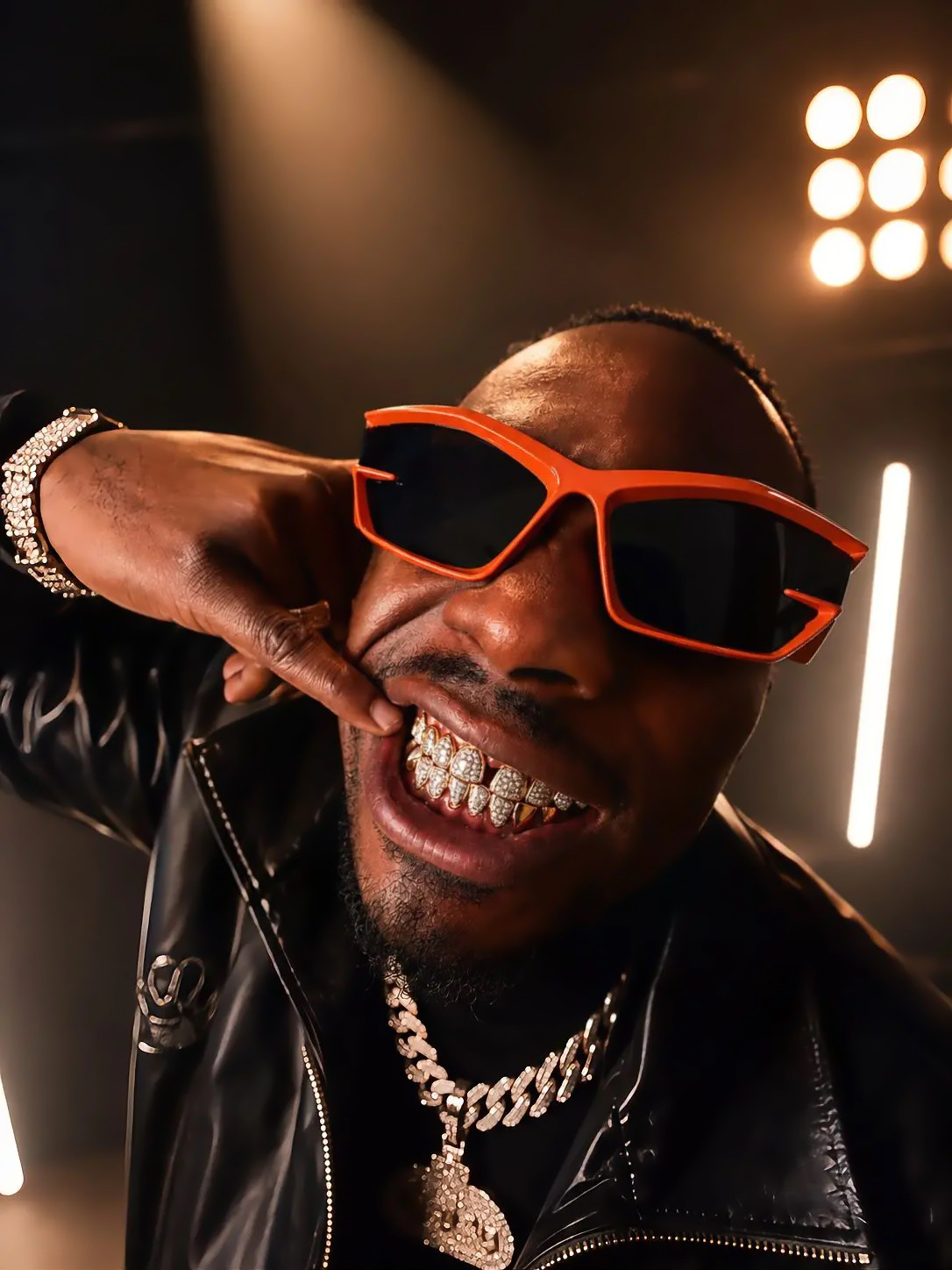
Nigerian comedian and content creator Josh2Funny has taken his comedy game into music, and Nigerians are definitely having something to say about it.
The comedian released his 15-track album, “On Behalf of Josh,” on July 10, 2026, but instead of fading away after release, the project has continued to generate conversations on X.
And the big question now is:
Should Josh2Funny continue with music or go back to skits? 😂
Fans have been divided. While some listeners openly criticized the album and told him to return to comedy, others found songs they genuinely enjoyed.
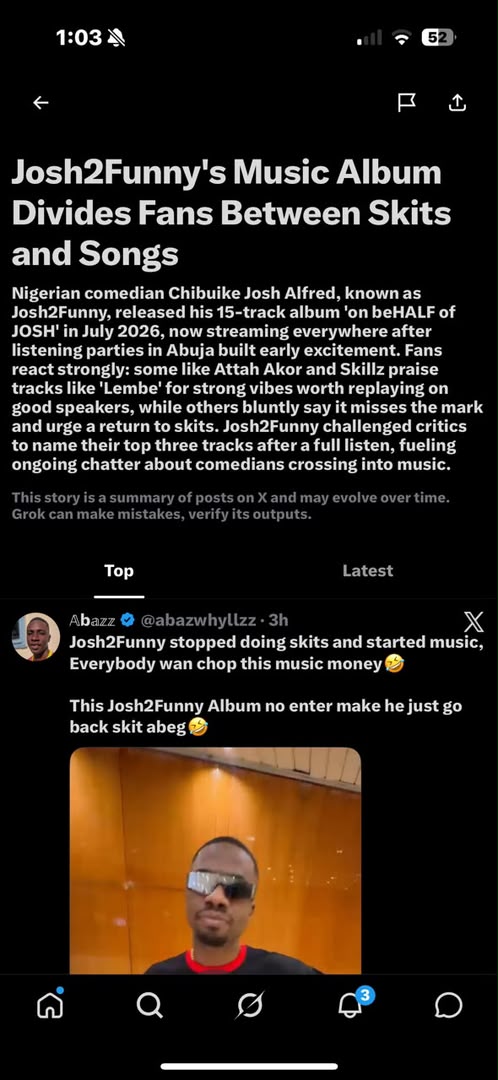
One X user joked:
“Josh2Funny stopped doing skits and started music, Everybody wan chop this music money 😂”
Another simply said:
“This Josh2Funny Album no enter make he just go back skit abeg 😂”
But then came “Lembe.” 🔥
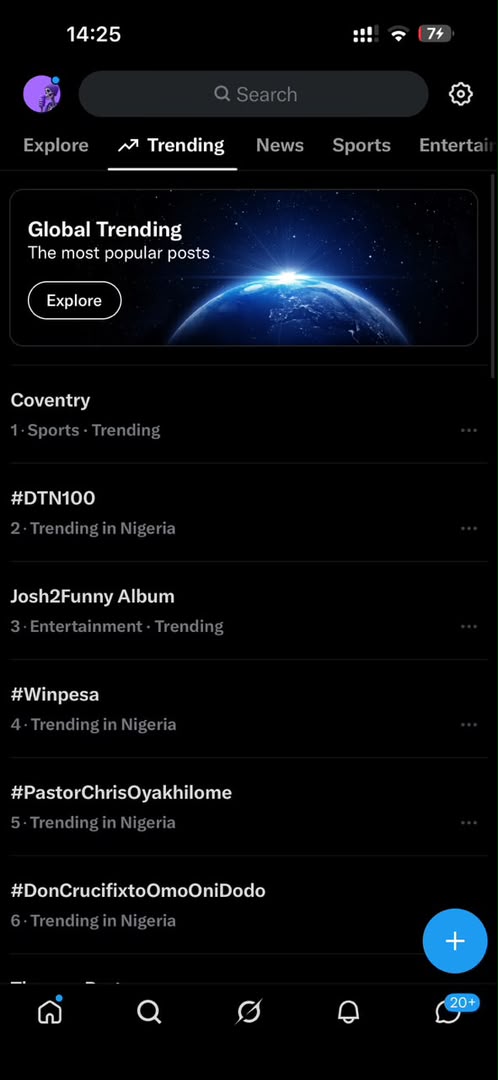
The track caught fire on X and eventually became a trending topic in Nigeria. The #LembeChallenge also gained momentum as creators began jumping on the song.
Josh2Funny later announced ₦1 million for winners of the challenge, giving the song another major push.
And it didn’t stop there.
‘INTERNATIONAL’ FT. ICE PRINCE ALSO TRENDED
On another day, “International” featuring Ice Prince generated its own buzz on X.
One fan even called it their favourite song from the album, while praising the collaboration. The post itself pulled thousands of views, showing that people weren’t only talking about Lembe.
From album criticism to trending songs and challenges, “On Behalf of Josh” has kept Josh2Funny’s name in the conversation.
Whether you love the album or think he should return to skits, one thing is clear:
Josh2Funny has succeeded in getting Nigerians talking. 😂🔥

So, let’s settle this once and for all:
Should Josh2Funny continue with MUSIC 🎶 or return to SKITS 😂?
Music or Skits? Drop your answer! 👇

RUAN-Badkid.96 is a Nigerian recording artist whose music refuses to live inside a single genre. Blending Afrobeat, Afrofusion, trap, hip-hop, melodic rap, R&B, and global influences, he creates records that move effortlessly between raw street energy, soulful storytelling, and infectious melodies. Whether delivering hard-hitting bars, emotional love songs, or rhythm-driven African records, his sound is defined by authenticity rather than limitation.
Inspired by both African culture and international music, RUAN-Badkid.96 embraces the confidence and ambition of global hip-hop while staying deeply connected to his roots. His lyrics explore love, heartbreak, betrayal, friendship, social injustice, hope, and the everyday realities of life. He doesn’t create music to follow trends, he creates music to reflect truth, emotion, and human experience.
Behind his fearless image is an artist who believes in kindness, equality, justice, and genuine human connection. His appearance may be intimidating, but his message is rooted in compassion and authenticity. Every record carries a piece of his journey, proving that strength and vulnerability can exist in the same voice.
For RUAN-Badkid.96, music is more than entertainment, it’s a language, a testimony, and a lifelong mission to connect with people through honesty, versatility, and unforgettable sound.
Entertainment Gists
Meet the Man Who Turned Hype Into a Science: Emmy Blaq, Nigeria’s G.O.A.T. of Hype


If you have ever been at a Nigerian event and found yourself on your feet before the main act even stepped on stage, there is a good chance a hype man was responsible. But not just any hype man. Emmy Blaq, born Ikechukwu Emmanuel Chima and raised in Auchi, Edo State, has spent the last few years quietly becoming the most talked-about name in that profession, and the Nigerian press has taken notice. Punch, Vanguard, The Guardian Nigeria, The Nation, and Independent Newspaper have all sat down with him, and every conversation leads back to the same thing: this man does not just make noise; he makes moments.
What makes Emmy Blaq different is the journey behind the energy. Before the stages, the collaborations with Waje on her “Waje 2.0” album, DJ Consequence, and DJ Kaywise on the massively streamed “Joor Party Mix” series, he was repairing generators, cutting hair, and sewing clothes in Auchi. His first professional hype gig happened at a local fast food spot called Valchi, and the crowd response that night changed everything. He told The Nation directly: “My passion for entertainment and desire to make people happy led me into the craft.” Punch also captured his bigger mission when he said that hype men deserve more than what they currently earn, a statement that sparked a real conversation across Nigerian entertainment circles.
With over 1.7 million TikTok followers, 23.6 million TikTok likes, a viral “Wife Material” challenge that landed on Pulse Nigeria’s top ten social media moments of 2021, and an international performance at the Cameroon International Music Festival that Cameroonian media described as electrifying, Emmy Blaq is not building toward something. He is already there. The G.O.A.T. of Hype is not a title he gave himself and hoped would stick. It is one the rooms keep confirming every single time he grabs the mic.
-
 Audio10 years ago
Page – Day Break Everywhere Burst
-
 Audio5 years ago
Shadykarz – Forever
-
 Audio10 years ago
Juniorboy ft. 9ice – IRAPADA
-
 Entertainment Gists6 years ago
Ex-Beauty Queen, Sandra Benede Shares Sexy Photo
-
 Audio5 years ago
Simi – Happy Birthday ft. Adekunle Gold, DeJa
-
 Audio5 years ago
Ruger – Bounce
-
 Mixtapes4 years ago
Mixtape: DJ DimpleNipple – The Best Of Amapiano Thrills
-
 Editorials3 years ago
Sa’eedah Imam On Creating Her Imprint In The Nigerian Music Industry As An Emerging Creative Writer