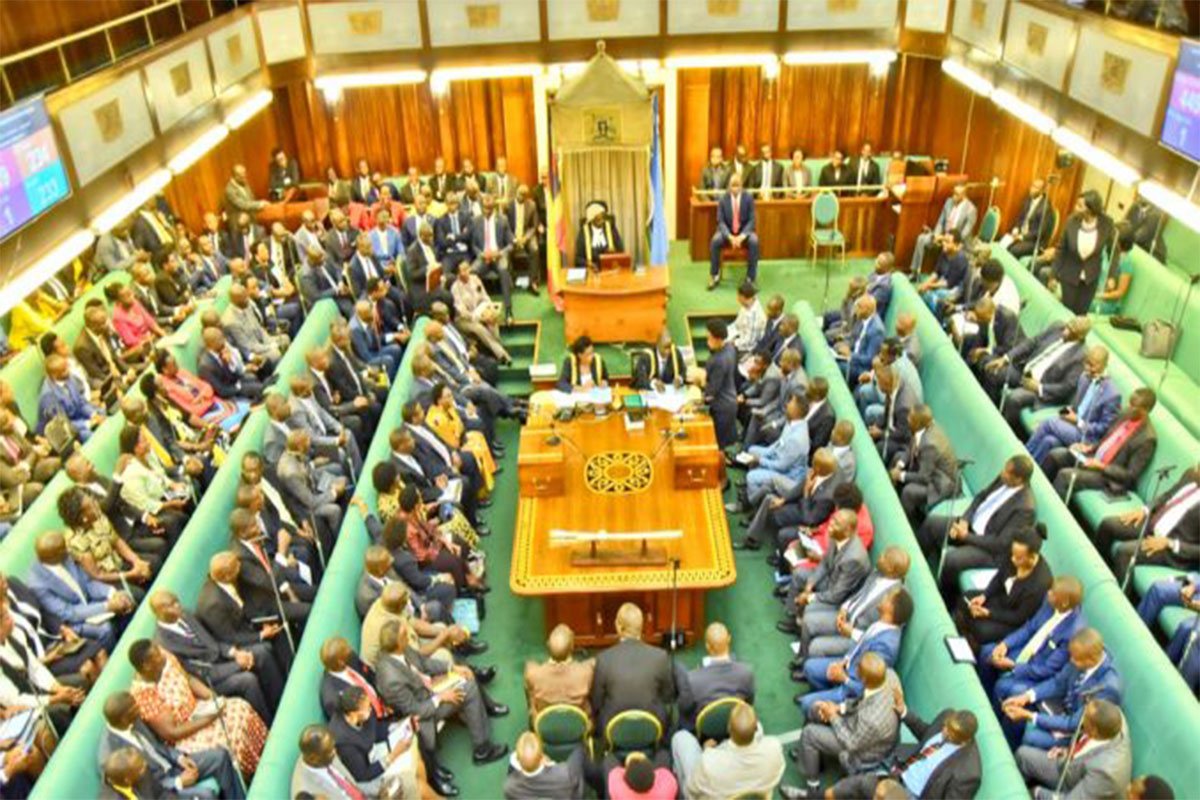
Connect with us

Face masks showing presidential candidates in Uganda - Bobi Wine, left, and Yoweri Museveni, right

Bobi Wine, left, is among challengers to long-time leader Yoweri Museveni, right

Ugandan pop star-turned-opposition presidential candidate Bobi Wine has cut short a live interview with a Kenyan radio station, saying the military was raiding his home.

“I can see soldiers beating my security guard,” he said, before putting the phone done.

The incident comes two days before Ugandans vote in a general election following a campaign marked by violence which has killed dozens of people.

President Yoweri Museveni is seeking his sixth elected term in office after 35 years in power.

The 76-year-old faces 10 challengers, most notably Bobi Wine.

Human rights groups have accused security forces of using excessive force to break up opposition rallies during the campaign. But the government says the strong measures are necessary to ensure people comply with a ban on large crowds imposed to tackle the coronavirus pandemic.

Here are the five things you need to know about the crucial vote:

1. The man who wants 40 years in power

President Museveni is one of the longest-serving presidents in Africa. He and his National Resistance Movement came to power in 1986 at the end of a five-year war, and have led Uganda ever since.

His supporters praise him for bringing relative peace and prosperity to the country, and in particular for his policies on health. He helped limit the spread of HIV, and more recently his harsh lockdown – which closed schools and business, banned vehicle movement and imposed mandatory public mask use in May – is credited with tackling the coronavirus pandemic.

According to Johns Hopkins University, Uganda has recorded fewer than 40,000 infections and around just 300 deaths from the illness.
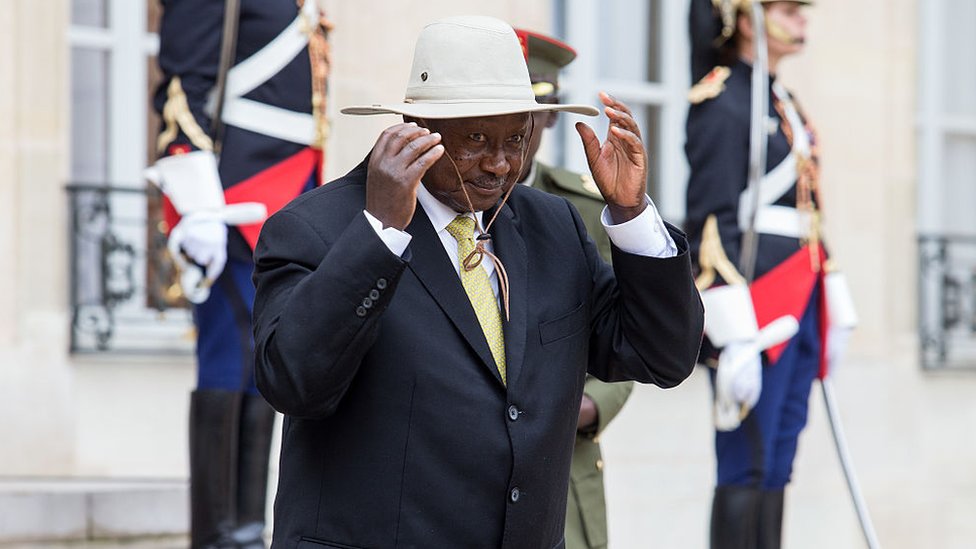
President Yoweri Museveni of Uganda wearing a hat on a visit to France
If he wins the election President Museveni will be on course for 40 years in power

But while he was once hailed in the West as one of the new generation of African leaders, his critics accuse him of turning into another authoritarian leader.

Mr Museveni has no designated successor within his party, and in 2017 signed a law removing a presidential age limit of 75, allowing him to run again for the presidency.

A woman in a mask in front of a mural
Uganda’s general election

14 January 2021

  • 18.1m people have registered to vote
  • 11 candidates are running for president
  • 1 of the candidates is a woman, Nancy Kalembe
  • 5 elected terms so far for Yoweri Museveni
  • 50% plus 1 votes needed for a candidate to avoid a run-off election
  • 529 MPs will also be elected

Source: Uganda electoral commission

1px transparent line

He has seen off a number of challengers to his rule over the years, notably long-time opposition leader Kizza Besigye, who was arrested numerous times and decided not to run again for the presidency in 2021.

While Mr Museveni maintains a large support base, especially in rural areas, he is facing increasing opposition over rising inequality and his rigid control over the country.

2. The pop star challenger

One of 10 candidates challenging him for the presidency this year is musician Robert Kyagulanyi Ssentamu, known by the stage name Bobi Wine.

Affectionately referred to as the “ghetto president”, the 38-year-old became an East African musical superstar in the early 2000s before switching to politics and winning a seat in parliament in 2017.

Bobi Wine is seen as the biggest challenge to Mr Museveni’s rule and has mobilised many young people who have not previously been involved in politics. He has sharply criticised the president in the past and accused him of “fearing the people”.

The president has not taken this challenge lightly. He has accused Bobi Wine of being a foreign agent of those “who don’t like the stability and independence of Uganda” and said that opposition figures are misleading young people to get involved in violence on the campaign trail.

Bobi Wine has been arrested several times since he became involved in politics. He has spoken of a “revolution” against Mr Museveni. He has posted on Twitter using the hashtag “WeAreRemovingADictator”.

3. The generation gap

Part of Bobi Wine’s popularity comes down to his age. At 38, he is just half as old as President Museveni, in one of the youngest nations on earth.

According to the CIA World Factbook Uganda has the second-lowest median age worldwide, of just 15.7 – only Niger is younger.

A Bobi Wine supporter at a presidential rally in Uganda, November 2020
Bobi Wine has a broad support base among young voters
Museveni supporters at a rally, December 2020
But Mr Museveni remains a popular figure across the country

The “ghetto president” grew up in a slum in the capital, Kampala. His background and his efforts to promote social justice in his country through his music and as a politician have endeared him to this younger, more urban generation.

But Bobi Wine has also surprised authorities by drawing big crowds of supporters in rural areas – thought to be a bastion of support for President Museveni.

4. Covid crackdown

Tensions are high, and the campaign has been marred by serious violence, which has left dozens killed and hundreds more arrested.

Officials have cited measures brought in to tackle the Covid-19 pandemic for their efforts to break up political gatherings. But Human Rights Watch has alleged that security forces are using these regulations “as a pretext to violate rights and clamp down on the opposition and the media”.

Protests after the arrest of Bobi Wine in November 2020
This election campaign has been marked by a wave of political violence

Bobi Wine himself was arrested last November for allegedly breaching Covid measures. His detention sparked protest which led to a wave of arrests and left dozens dead, mostly allegedly shot by the security forces.

Afterwards, Security Minister Elly Tumwine pointed to the fact that 11 security personnel had been injured and said “police have a right to shoot you and kill you if you reach a certain level of violence”.

“Can I repeat? Police have a right to shoot you and you die for nothing…. do it at your own risk.”

Bobi Wine has since taken to wearing a bullet-proof vest and helmet on the campaign trail.

At the end of last year he halted his campaign after a number of his team were injured as security forces dispersed one of his political rallies. He later told broadcaster CNN he had survived several assassination attempt.

5. Uganda’s role in the region – and beyond

A country of more than 42 million people, Uganda is surrounded by Kenya, South Sudan, Tanzania, Rwanda and the Democratic Republic of Congo.

It has one of the highest refugee populations worldwide, hosting some 1.4 million people from neighbouring countries.

Map
1px transparent line

Some are watching the political unrest in the country with concern, and worry about what could happen after the vote. There has never been a peaceful transfer of power in Uganda and it is not clear what would happen if Mr Museveni were to lose, and what the military would do.

The president announced a shake-up of the armed forces in November, bringing in the former head of Uganda’s operations in Somalia, Maj Gen Paul Lokech, as deputy inspector general of police to coordinate security forces around the capital during the election period.

The European Union has chosen not to send observers to the election this year – reportedly because Ugandan officials have ignored advice from past observers to make polling more fair – meaning there will be less international scrutiny.

Recent Posts

Temmy Dreddz – Jẹjẹ

Published

on

Blow Money Records proudly announces the release of “Jẹjẹ,” the latest single and official music video from Nigerian Afro-fusion artist Temmy Dreddz.

Produced by the talented OxDBeat and visually brought to life by Kore Culture with breathtaking scenes filmed in South Africa, Jẹjẹ is a refreshing Afrobeats record that celebrates love, patience, hope, and the beauty of embracing life’s journey one step at a time.

More than just a song, Jẹjẹ delivers a powerful message in a world driven by urgency. Inspired by the Yoruba expression jẹjẹ, meaning gently or take it easy, the record reminds listeners that meaningful progress, genuine love, and lasting success are built with patience, consistency, and faith in the process.

Complementing the song is a visually captivating music video that blends cinematic storytelling with vibrant African scenery, perfectly reflecting the warmth, emotion, and uplifting spirit of the record. Shot against the stunning landscapes of South Africa, the video enhances the song’s message while showcasing Temmy Dreddz’s artistic identity on a global stage.

Speaking on the release, Temmy Dreddz describes Jẹje.

With this release, Temmy Dreddz continues to establish himself as one of the emerging voices in contemporary African music, delivering authentic stories through infectious melodies and relatable songwriting.

“Jẹjẹ” and its official music video are now available on all major digital streaming platforms and YouTube worldwide.

Get On Digital Stores

Continue Reading

Recent Posts

Espago – Nisho Baby

Published

on

Emerging musical innovator Espago has officially released his captivating new single, “Nisho Baby.” Known for his distinct ability to blur the lines between contemporary pop, smooth R&B, and infectious Afrobeats, Espago delivers a track designed to get listeners moving while enveloping them in a rich sonic atmosphere.

Espago’s unique sound is heavily inspired by the introspective mood of late-night drives and the comforting nostalgia of the early 2000s music era. With “Nisho Baby,” he channels these diverse influences into a seamless, modern groove, prioritizing smooth vocal textures and an irresistible rhythm. The track strikes a perfect balance, acting as both a laid-back vibe for solo listening and an undeniable call to the dance floor.

Moving beyond standard genre boundaries, the single highlights Espago’s commitment to building a unique sonic identity. The production carries a warm, retro-modern texture that allows his melodic performance to take center stage, establishing him as an exciting independent force to watch in the evolving global African music landscape.

“Music for me is all about capturing a specific feeling and turning it into a rhythm people can move to. Nisho Baby is that perfect bridge between early 2000s nostalgia and the modern sounds we love to dance to late at night.”
Espago

With its effortless charm, smooth transitions, and high-replay value, “Nisho Baby” marks a defining step forward in the artist’s creative journey.

“Nisho Baby” is available now on all major digital music streaming platforms worldwide.

Continue Reading

Recent Posts

Jace Owie and partners introduces America Global Relations Foundation and programs for youths Development

Published

on

Jace Owie is more than a youth advocate — he is a visionary leader tackling youth challenges from the root cause. Today, Youth Voice Nigeria and the Student and Youth Association celebrate a young icon whose impact goes beyond empowerment, creating real solutions that inspire and transform lives.

Jace Owie, a graduate of the American Academy of Project Management (AAPM), stands today as one of the remarkable young African leaders whose passion, courage, and dedication have contributed immensely to social change and youth development. At a time when many young people focused only on personal success, Jace Owie chose a path of service, advocacy, and impact, dedicating his energy toward solving one of the most pressing challenges facing Edo State and many African communities — irregular migration and human trafficking.
Many years ago, Edo State gained international attention as one of the major hubs for irregular migration and human trafficking in Nigeria. Thousands of young people, driven by unemployment, poverty, lack of opportunities, and misinformation, risked dangerous journeys across deserts and seas in search of better lives abroad. Families were broken, dreams were shattered, and many lives were lost during these dangerous migration routes.
In the midst of this crisis emerged a young visionary leader — Jace Owie.
Together with his team at the Global Relations Foundation, Jace Owie took bold steps to confront the problem from its root causes rather than merely addressing the symptoms. Understanding that irregular migration was deeply connected to unemployment, economic hardship, lack of skills, and limited opportunities for young people, he began extensive research and advocacy efforts aimed at creating long-term solutions.
Jace Owie worked tirelessly with various foreign officials, institutions, youth organizations, and international development partners to better understand migration patterns and identify sustainable strategies for change. His commitment to finding practical solutions led him to Germany, where he attended advanced trainings and engagements focused on cross-cultural management, refugee reintegration, migration resolution, and international development strategies.
These experiences expanded his global perspective and equipped him with valuable knowledge that he later brought back to support communities in Edo State. During his engagements in Europe, Jace interacted with several high-level officials, policymakers, development experts, and organizations, advocating strongly for international partnerships centered on job creation, youth empowerment, entrepreneurship, and skills acquisition programs for unemployed youths in Edo State.
Jace Owie consistently emphasized that the fight against irregular migration could not succeed without addressing the economic realities facing young people. He advocated for the establishment of job hubs, vocational training centers, entrepreneurship programs, and empowerment initiatives capable of giving youths alternatives to dangerous migration routes.
His voice soon gained international recognition.
Jace engaged with several respected media platforms across Europe, including HuffPost, where he openly discussed the migration crisis and stressed the importance of stronger partnerships between European governments and Edo communities. In his interviews and public discussions, he called on the European Union and international stakeholders to invest more in local economic development, youth empowerment, and sustainable opportunities within Nigeria, especially in Edo State.
In addition to media advocacy, Jace Owie also collaborated with and provided valuable insights to officials from the British High Commission, assisting with migration-related research and contributing local perspectives that helped shape conversations around migration management and youth development initiatives.
Over time, these advocacy efforts, alongside contributions from other development bodies and stakeholders — began to draw greater international attention to the migration challenges in Edo State. This increased awareness eventually contributed to stronger partnerships between Edo State, European governments, the International Organization for Migration (IOM), and several international organizations focused on migration management and youth development.
As a result, new migration awareness campaigns, reintegration programs, empowerment projects, vocational hubs, youth training initiatives, and international funding opportunities began to emerge within Edo State. Communities became more informed about the dangers of irregular migration, while many young people gained access to programs designed to improve their livelihoods and future prospects.
Today, the story of Jace Owie serves as an inspiration to many young Africans. His journey demonstrates the power of visionary leadership, research, international collaboration, and genuine passion for humanity. He represents a generation of leaders determined not only to speak about problems but to actively pursue meaningful solutions that transform lives and communities.
Jace Owie’s contributions remind society that one determined young person can inspire global conversations, influence partnerships, and contribute to real change. His work through the Global Relations Foundation and his advocacy for youth empowerment continue to stand as symbols of hope, resilience, and responsible leadership.
Today, we celebrate not only a young leader but a young hero — Jace Owie — whose dedication to humanity, youth empowerment, and social transformation continues to leave a lasting impact on society.
Add that Jace Owie partnered with the German Embassy to educate young people in edo state about the dangers of irregular migration, which too place in LFC textile mill road in 2018, and followed with a free skill training of over 500 youths in the digital marketing, and after that jace owie directed a short documentetary to educate the verse youth population about the dangers of irregular migration from nigeria to Libya and the mediterranean sea, which effectively helped in educating manu young persons as the documentary reached thousands of targetted audience in nigeria
Jace Owie, a graduate of the American Academy of Project Management (AAPM), stands today as one of the remarkable young African leaders whose passion, courage, and dedication have contributed immensely to social change and youth development. At a time when many young people focused only on personal success, Jace Owie chose a path of service, advocacy, and impact, dedicating his energy toward solving one of the most pressing challenges facing Edo State and many African communities — irregular migration and human trafficking.
Many years ago, Edo State gained international attention as one of the major hubs for irregular migration and human trafficking in Nigeria. Thousands of young people, driven by unemployment, poverty, lack of opportunities, and misinformation, risked dangerous journeys across deserts and seas in search of better lives abroad. Families were broken, dreams were shattered, and many lives were lost during these dangerous migration routes.
In the midst of this crisis emerged a young visionary leader, Jace Owie.
Together with his team at the Global Relations Foundation, Jace Owie took bold steps to confront the problem from its root causes rather than merely addressing the symptoms. Understanding that irregular migration was deeply connected to unemployment, economic hardship, lack of skills, and limited opportunities for young people, he began extensive research and advocacy efforts aimed at creating long-term solutions.
Jace Owie worked tirelessly with various foreign officials, institutions, youth organizations, and international development partners to better understand migration patterns and identify sustainable strategies for change. His commitment to finding practical solutions led him to Germany, where he attended advanced trainings and engagements focused on cross-cultural management, refugee reintegration, migration resolution, and international development strategies.
These experiences expanded his global perspective and equipped him with valuable knowledge that he later brought back to support communities in Edo State. During his engagements in Europe, Jace interacted with several high-level officials, policymakers, development experts, and organizations, advocating strongly for international partnerships centered on job creation, youth empowerment, entrepreneurship, and skills acquisition programs for unemployed youths in Edo State.
One of Jace Owie’s major grassroots initiatives came in 2018, when he partnered with the German Embassy to organize a major awareness and sensitization program aimed at educating young people in Edo State about the dangers of irregular migration. The event took place at LFC Textile Mill Road in Benin City and brought together hundreds of youths who were vulnerable to migration-related exploitation and trafficking.
During the program, participants were educated on the harsh realities faced by many irregular migrants travelling through Libya and across the Mediterranean Sea. The initiative focused on exposing the risks of human trafficking, exploitation, modern slavery, detention camps, violence, and the deadly sea routes that had claimed countless African lives.
Understanding that awareness alone was not enough, Jace Owie immediately followed the sensitization campaign with a free skills acquisition and empowerment training for over 500 youths. The training focused primarily on digital marketing and other emerging digital opportunities capable of helping young people become economically independent. Through this initiative, many participants gained practical knowledge that could help them secure income opportunities without risking dangerous migration journeys abroad.
Jace Owie consistently emphasized that the fight against irregular migration could not succeed without addressing the economic realities facing young people. He advocated for the establishment of job hubs, vocational training centers, entrepreneurship programs, and empowerment initiatives capable of giving youths alternatives to dangerous migration routes.
His voice soon gained international recognition.
Jace engaged with several respected media platforms across Europe, including HuffPost, where he openly discussed the migration crisis and stressed the importance of stronger partnerships between European governments and Edo communities. In his interviews and public discussions, he called on the European Union and international stakeholders to invest more in local economic development, youth empowerment, and sustainable opportunities within Nigeria, especially in Edo State.
Beyond advocacy and training programs, Jace Owie also used media and storytelling as tools for social change. In a further effort to educate vulnerable youths, he directed a short documentary focused on the dangers of irregular migration from Nigeria through Libya and across the Mediterranean Sea. The documentary highlighted the painful experiences, risks, and tragic consequences faced by many young Africans who embarked on unsafe migration journeys in search of greener pastures abroad.
The documentary became an impactful awareness tool and successfully reached thousands of targeted viewers across Nigeria. Through visual storytelling and real-life migration realities, the project helped educate many young people about the consequences of irregular migration while encouraging them to seek safer and more productive alternatives through education, entrepreneurship, and skill development.
In addition to media advocacy, Jace Owie also collaborated with and provided valuable insights to officials from the British High Commission, assisting with migration-related research and contributing local perspectives that helped shape conversations around migration management and youth development initiatives.
Over time, these advocacy efforts , alongside contributions from other development bodies and stakeholders — began to draw greater international attention to the migration challenges in Edo State. This increased awareness eventually contributed to stronger partnerships between Edo State, European governments, the International Organization for Migration (IOM), and several international organizations focused on migration management and youth development.
As a result, new migration awareness campaigns, reintegration programs, empowerment projects, vocational hubs, youth training initiatives, and international funding opportunities began to emerge within Edo State. Communities became more informed about the dangers of irregular migration, while many young people gained access to programs designed to improve their livelihoods and future prospects.
Today, the story of Jace Owie serves as an inspiration to many young Africans. His journey demonstrates the power of visionary leadership, research, international collaboration, and genuine passion for humanity. He represents a generation of leaders determined not only to speak about problems but to actively pursue meaningful solutions that transform lives and communities.
Jace Owie’s contributions remind society that one determined young person can inspire global conversations, influence partnerships, and contribute to real change. His work through the Global Relations Foundation and his advocacy for youth empowerment continue to stand as symbols of hope, resilience, and responsible leadership.
Today, we celebrate not only a young leader but a young hero , Jace Owie, whose dedication to humanity, youth empowerment, and social transformation continues to leave a lasting impact on society.
Continue Reading

Trending

Copyright © 2013 - 2020, 47vibez Media.