
News
With No Freshwater Left, Displaced Gaza Families Wash in Polluted Sea


Escaping dirty conditions in overcrowded schools, Gaza families displaced by Israeli bombing are being forced to bathe and wash in polluted seawater.
Deir al-Balah, Gaza Strip – Andaleeb al-Zaq is grateful for the sea and its salty breeze.
“It’s such a welcome change of scenery from the chaos and dirtiness of the school we’ve been staying in,” the 48-year-old said. “The children treat it like we’re on a school trip.”
For Andaleeb, though, the “trip” is a matter of survival.
Her family, a total of 16 members, was displaced from their home in the Shujaiya neighbourhood, east of Gaza City shortly after Israel began bombing the Gaza Strip on October 7.
They headed down south to the central governorate of Deir al-Balah, and made their way to Alif Elementary Boys’ School, run by the United Nations refugee agency.
“All the classrooms were already full with other families, about 80 people per class, so we set up a tent on the school grounds,” Andaleeb said. “There’s 8,000 people taking shelter there.”
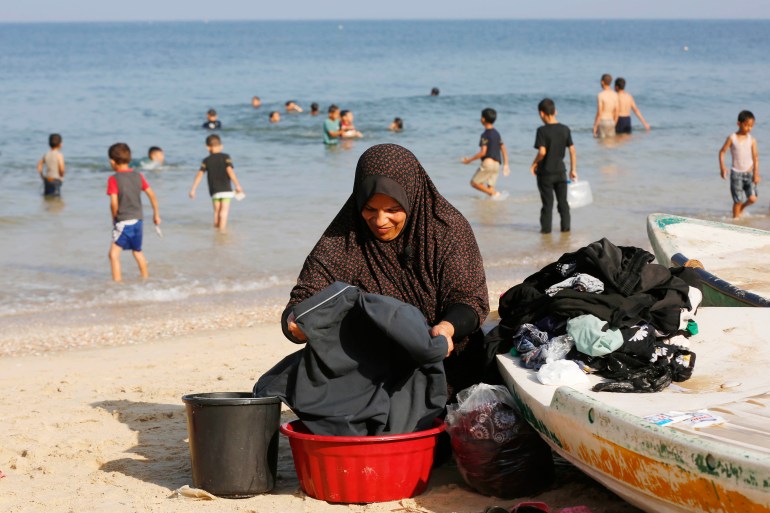
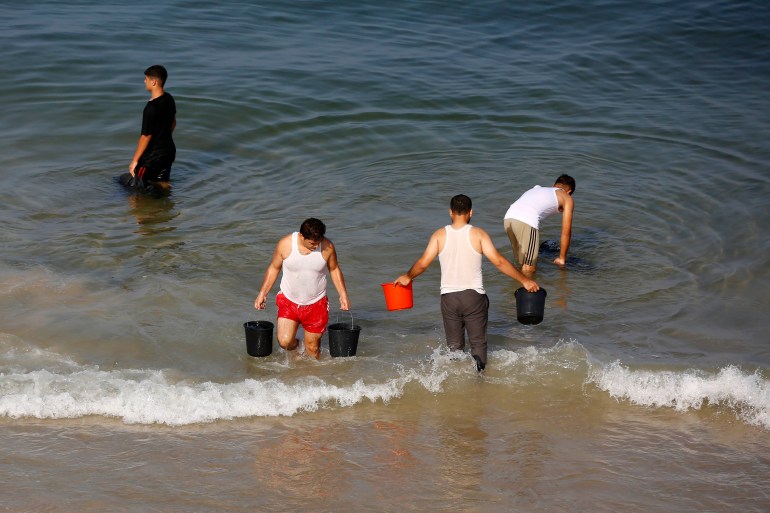
The school is close to the Mediterranean Sea, and because of the complete lack of clean running water, it has become a standard practice for some of the families and their children to head there to swim, bathe and wash their clothes.
Israel imposed a total siege on the Gaza Strip more than a month ago, after the October 7 Hamas attacks on Israeli towns and army outposts that killed at least 1,400 Israelis. Some aid has been allowed into the enclave through the Rafah crossing with Egypt in recent days, but Israel continues to bar the entry of fuel. Gaza’s sole desalination plant is out of service due to the lack of fuel.
The coastal strip, which has already been under a 17-year blockade by Egypt and Israel, has been transformed into scenes of staggering destruction. More than 10,300 Palestinians have been killed, the majority of them being women and children. Basic infrastructure has also been targeted. At least 58 percent of all residential units in the strip have been damaged, or 212,000 homes. Without fuel and electricity, hospitals have been working on solar-powered generators.
The United Nations Office for the Coordination of Humanitarian Affairs (OCHA) has recorded that between October 21 and November 1, just 26 trucks carrying vital water and sanitation supplies entered the Gaza Strip, noting that this is nowhere near enough to meet the essential needs for the survival of the 2.3 million-strong population.
“We have no water, no sanitation, no running sewage system,” said Imm Mahmoud, who is staying at the same school. “With this lack of basic hygiene, neither the adults nor the children are comfortable.”
The 52-year-old mother has been displaced for a month and said she has no choice but to wash her family’s clothes in the sea.
But she knows that even the seawater is polluted.
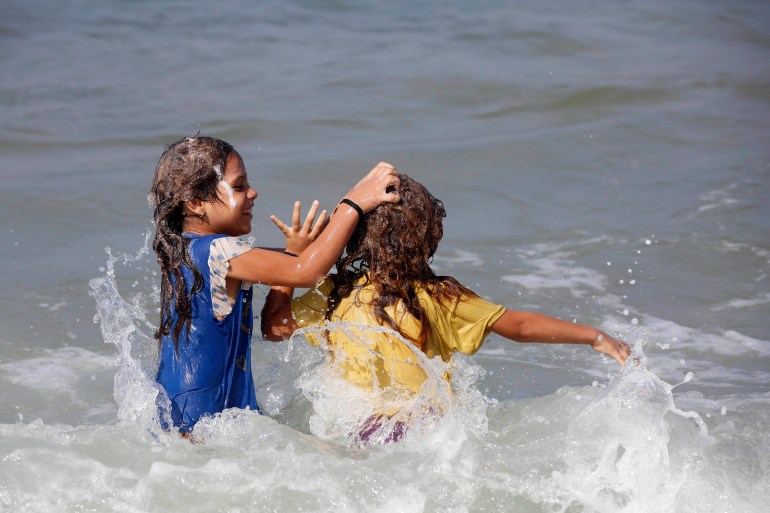
“Children have been suffering from diarrhoea, coughs and colds from the pollution and swimming in the sea,” she said. “But what do you expect them to do? They have to find a way to release their energy. Being cooped up in a school can lead to a lot of yelling and fights with their families.”
‘Environmental and health crisis’
Even before the current war, inadequate sanitation infrastructure and electricity shortages meant that untreated sewage water was dumped into the sea – between 100 to 108 million litres – and was responsible for more than one-quarter of illnesses. It was the primary cause of child morbidity in the Gaza Strip.
According to the Norwegian Refugee Council, the total shutdown of wastewater treatment plants in October has led to the release of more than 130,000 cubic metres of untreated sewage into the Mediterranean Sea daily, posing a grave environmental hazard.
The three major water pipelines in the Gaza Strip are all controlled by Israel. Since October 8, the pipeline from Israel to northern Gaza has remained closed. In the south, Israel reconnected the water supply to Khan Younis on October 15 but turned off the supply two weeks later.
And in the central area of the Gaza Strip, Israeli authorities confirmed their intention to restart water supplies on October 29, but residents say that has not happened, and the water coming in taps is either highly chlorinated or salty.
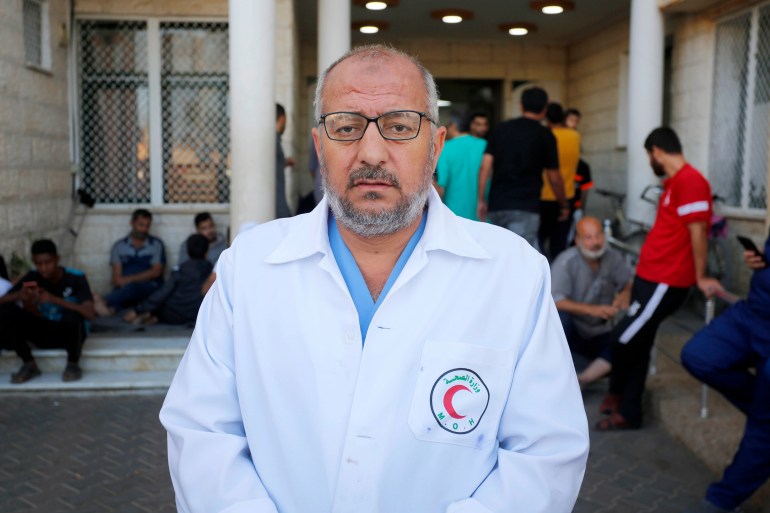
Khalil al-Degran, a doctor and emergency supervisor at Deir al-Balah’s al-Aqsa Martyrs Hospital, said there is “an environmental disaster and massive health crisis” brought upon by the swelling of the population in the central Gaza Strip due to displaced families who are staying in UNRWA schools.
“You have on average 70 people staying in one classroom in unsanitary conditions,” he said. “As a result, there’s a lot of diseases and infections going around, such as lung infections and intestinal flu due to the overcrowding. The lack of electricity and clean water has only exacerbated this.
“Due to the lack of clean running water, some of the displaced people have resorted to using the sea as a place to wash their clothes or to bathe, risking their lives under the Israeli bombing,” he said.
On Sunday, an Israeli air raid targeted a group of children who were on the beach west of Deir Al-Balah.
“Three of them were killed and seven were wounded as a result of the Israeli air attack,” al-Degran said.
“This aggression needs to stop immediately, and the border crossings must be open,” he added. “We don’t have medical supplies to treat the sick people, let alone those who are wounded from Israeli attacks.”
Foul-smelling and dirty conditions
Displaced families said they will continue to bathe in the sea, saying there is no other choice.
“The schools are disgusting and there is no running water,” said Nasser Zayed, 60.
“I come down to the sea to bathe every other day, otherwise I’d be like an eternal student, spending all my time within the confines of a classroom,” he added.
“The toilets in the school are foul-smelling,” said 17-year-old Rima Zaqqout. “The school in general smells horrible because there are piles of trash everywhere.”
Rima’s family were displaced three times after their home in northern Gaza was destroyed. They stayed with an aunt, then their uncle, but both homes were also damaged in the Israeli bombardment.
Despite the dangers, the sea is a respite for Rima and her siblings, who go to the sea every day at noon.
“We take shampoo with us to bathe the children,” she said. “Sometimes we also swim. We’re living through extremely trying times.”






For today’s students and Gen Zs, a smartphone is more than just a communication device—it’s a study partner, entertainment hub, camera and productivity tool. From attending virtual classes and researching assignments to creating content and staying connected with friends, students need a phone that can keep up with their fast-paced lifestyle.
The itel A300+ is designed to do exactly that. Combining a 2.01-inch Smart Secondary Screen, a 7000mAh Ultra-Large Battery, and IP65 dust and water resistance, it delivers practical features that make everyday student life easier.
Power through every lecture and moment
Whether you’re moving between lecture halls, spending hours in the library or commuting across town, battery life matters. The 7000mAh battery keeps you connected throughout the day!
Smart convenience at a glance
The itel A300+’s standout feature is its 2.01-inch Smart Secondary Screen. It lets you quickly view notifications, control your music, personalise watch faces and even preview selfies using the rear camera—all without constantly unlocking your phone.
It’s a smarter, faster way to stay connected while keeping distractions to a minimum.

Built for everyday Life
Life can be unpredictable. From rushing between classes to unexpected rain showers, students need a phone that can handle everyday challenges. With IP65 dust and water resistance, the itel A300+ is built to offer added confidence wherever the day takes you.
When it’s time to relax, the hole-punch display and dual speakers provide an immersive experience for streaming, gaming and enjoying your favourite content.
Get the itel A300+ Now
Whether you’re preparing for a new semester or simply looking for a smartphone that can keep up with your daily routine, the itel A300+ offers the right balance of innovation, performance and convenience.
Visit your nearest itel Home Store today, Click HERE or check out a retail store near you and experience the itel A300+. Plus, enjoy FREE 1GB on your MTN line and 50% bonus data on every recharge for the next six months when you purchase the device.



Fitness meets cultural expression as GOOD SWEAT prepares to bring its CULTURE RUN experience to Lagos on Saturday, October 31, 2026.
Designed around the connection between physical wellness and cultural identity, CULTURE RUN offers participants an opportunity to embrace an active lifestyle while celebrating the richness of African culture. The event brings together fitness enthusiasts, culture lovers, and individuals looking for a refreshing way to connect through movement and shared experiences.
The run is scheduled to begin at 4:30 PM, setting the stage for an evening that extends beyond fitness. At 6:00 PM, participants can look forward to the CULTURE PARTY, the event’s post-run celebration.
Adding to the experience is a distinctive dress code that encourages attendees to wear their regular running kits with a touch of cultural wear. This creative blend of athletic apparel and traditional-inspired fashion gives participants an opportunity to express their individuality while celebrating their cultural roots.
The event will take place at Bistrot Samantha’s, located at 7/12 Rumen’s Road, Ikoyi, Lagos.
With its combination of fitness, fashion, culture, and social interaction, CULTURE RUN aims to create an experience that extends beyond the running track, bringing people together through a shared appreciation for wellness and cultural expression.
As Lagos continues to embrace lifestyle experiences that combine fitness with social engagement, CULTURE RUN offers an opportunity for participants to stay active, celebrate their heritage, and connect with like-minded individuals in a vibrant setting.
EVENT DETAILS
Event: CULTURE RUN
Presented by: GOOD SWEAT
Date: Saturday, October 31, 2026
Run Time: 4:30 PM
Post-Run Party: 6:00 PM
Dress Code: Running kit with a touch of cultural wear
Venue: Bistrot Samantha’s
Address: 7/12 Rumen’s Road, Ikoyi, Lagos, Nigeria

-
 Audio10 years ago
Page – Day Break Everywhere Burst
-
 Audio5 years ago
Shadykarz – Forever
-
 Audio10 years ago
Juniorboy ft. 9ice – IRAPADA
-
 Entertainment Gists6 years ago
Ex-Beauty Queen, Sandra Benede Shares Sexy Photo
-
 Audio5 years ago
Simi – Happy Birthday ft. Adekunle Gold, DeJa
-
 Audio5 years ago
Ruger – Bounce
-
 Mixtapes4 years ago
Mixtape: DJ DimpleNipple – The Best Of Amapiano Thrills
-
 Editorials4 years ago
Sa’eedah Imam On Creating Her Imprint In The Nigerian Music Industry As An Emerging Creative Writer