

The president of the United States is not just the leader of his country, he is probably the most powerful person on Earth. What he does changes life for all of us. Donald Trump is no exception. So how exactly has Mr Trump changed the world?

How the world sees America
President Trump has repeatedly declared the US “the greatest country in the world”. But according to a recent 13-nation poll by the Pew Research Center, he hasn’t done much for its image overseas.
In many European countries, the percentage of the public with a positive view of America is at its lowest for almost 20 years. In the UK, 41% had a favourable opinion, while in France it was 31%, the lowest since 2003, and in Germany just 26%.


America’s response to the coronavirus pandemic was a major factor – only 15% of respondents felt the US had handled the virus well, according to figures from July and August.
Stepping back on climate change
It’s hard to pin down what President Trump believes about climate change, as he’s called it everything from “an expensive hoax”, to a “serious subject” that is “very important to me”. What is clear is that six months into the job, he dismayed scientists by announcing America’s withdrawal from the Paris climate accord, which committed nearly 200 countries to keeping global temperature rises well under 2C.
Rejecting the Paris agreement, the president claimed it “would have been shutting down American producers with excessive regulatory restrictions”. This has been a theme for Mr Trump, who has removed a raft of pollution regulations to cut the cost of producing coal, oil and gas.

Several US coal mines have still closed, however, driven by competition from cheaper natural gas and state efforts to support renewable energy. Government figures show renewable sources generated more energy than coal in the US in 2019, for the first time in more than 130 years.
America’s exit from the Paris climate deal formally takes effect on 4 November, the day after the presidential election. Joe Biden has pledged to rejoin the pact if he wins.
Fears that the US pull-out would prompt a domino effect have not been realised, although some observers believe it smoothed the path for Brazil and Saudi Arabia to block progress on cutting carbon emissions.
Closed borders, for some
The number of foreign-born people living in the US was about 3% higher in 2019 than in 2016, President Obama’s last year in office. But who those immigrants are has changed.

The percentage of US residents born in Mexico has fallen steadily during Mr Trump’s term, while the number who moved from elsewhere in Latin America and the Caribbean has increased. There has also been a general tightening of the number of visas enabling people to settle permanently in the US – particularly for relatives of those already living there.
If there’s an emblem of President Trump’s immigration policy, it’s surely the “big, beautiful wall” he swore to build on the border with Mexico. As of 19 October, US Customs and Border Protection says 371 miles of wall have been constructed – almost all of it replacement fencing where barriers already existed.
The work did not deter those desperate to reach America.
The number of migrants detained at the US-Mexico border hit its highest level for 12 years in 2019, spurred by a peak in arrivals during the spring. More than half were families, mostly from Guatemala, Honduras, and El Salvador, where violence and poverty are driving people to seek asylum and a new life elsewhere.
Turning to refugees, Donald Trump has made swingeing cuts to the number who can resettle in America. The US took in almost 85,000 refugees in the fiscal year 2016, which fell to under 54,000 people the following year.
In 2021, the maximum will be 15,000 people – the fewest since the refugee programme launched in 1980.
The rise of ‘fake news’
“I think one of the greatest of all terms I’ve come up with is ‘fake’,” Donald Trump said in an October 2017 interview. Although the president definitely didn’t invent the term “fake news”, it’s fair to say he popularised it. According to social media posts and audio transcripts monitored by Factba.se, he has used the phrase about 2,000 times since first tweeting it in December 2016.
Reports by @CNN that I will be working on The Apprentice during my Presidency, even part time, are ridiculous & untrue – FAKE NEWS!
— Donald J. Trump (@realDonaldTrump) December 10, 2016
Search Google for “fake news” today and you’ll get more than 1.1 billion results from all over the world. Charted over time, you can see how US interest rose in the winter of 2016-17, and spiked the week the president unveiled what he called the “Fake News Awards”, a list of news stories he viewed as false.

The president has frequently used “fake news” to attack news stories he disagrees with. In February 2017, he took it further, branding several news outlets “the enemy of the American people”.
The FAKE NEWS media (failing @nytimes, @NBCNews, @ABC, @CBS, @CNN) is not my enemy, it is the enemy of the American People!
— Donald J. Trump (@realDonaldTrump) February 17, 2017
It’s a term that’s been picked up by leaders in Thailand, the Philippines, Saudi Arabia and Bahrain, among others, and some have used allegations of spreading “fake news” to justify repression and prosecutions against opposition activists and journalists.
Civil society groups say that by using the term against credible reporting, politicians fundamentally undermine democracy, which relies on people agreeing what the basic facts are.
America’s ‘endless wars’, and a Middle East deal
The numbers paint a more nuanced story. Not least because months down the line, Mr Trump decided to keep about 500 troops in Syria after all to protect oil wells. The president has scaled back the presence he inherited in Afghanistan, and to an extent in Iraq and Syria. But American forces are still everywhere they were the day he took office.

There are ways to impact on the Middle East without troops, of course. President Trump overturned the objections of previous presidents by moving the US embassy from Tel Aviv to Jerusalem in 2018, and recognising the city, including its occupied East, as Israel’s capital. Last month he hailed the “dawn of a new Middle East” when the United Arab Emirates and Bahrain signed agreements normalising relations with Israel – a move the US helped broker.
Rhetoric aside, this was perhaps the most significant diplomatic achievement of the Trump administration. The two Gulf states are just the third and fourth Arab nations in the Middle East to recognise Israel since it declared independence in 1948.
The art of the (trade) deal
President Trump seems to scorn deals he didn’t broker. On his first day in office, he dumped the Trans-Pacific Partnership, a 12-nation trade deal approved by President Obama, after branding it “horrible”. The withdrawal mostly benefited China, which viewed the deal as an attempt to curb its influence in the Asia-Pacific region. But in the US, critics who felt the agreement would compromise American jobs cheered its demise.
The president’s real fixation has been how America benefits from trade with the world. The outcome was a bitter trade war with China, in which the world’s two largest economies imposed hundreds of billions of dollars of taxes on each other’s goods. It’s been a headache for US soybean farmers and the tech and auto industries. China was affected too, as businesses moved their manufacturing to countries like Vietnam and Cambodia to lower their costs.

However, despite the coronavirus pandemic heavily influencing trends for 2020. America still imports more goods than it exports.
Tussles with China
This Trump tweet refers to a policy rollback so stunning that the phone call in question has its own Wikipedia page.
The President of Taiwan CALLED ME today to wish me congratulations on winning the Presidency. Thank you!
— Donald J. Trump (@realDonaldTrump) December 3, 2016
On 2 December 2016, Mr Trump (then president-elect) took the highly unusual step of speaking directly to the president of Taiwan – breaking with a precedent set in 1979, when formal relations were cut. Carrie Gracie, then the BBC’s China editor, predicted the move would prompt “alarm and anger” in Beijing, which sees Taiwan as a province of China not an independent state.
The bold opener from Mr Trump was the first in a multi-pronged poking contest between the great geopolitical rivals, which has sunk relations to their lowest point in years.
President Trump has renamed Covid-19 “the China virus”, and while he may be keen to deflect scrutiny from his own handling of the pandemic, a change of US leadership wouldn’t necessarily mean a more conciliatory tone. Democratic nominee Joe Biden has called President Xi a thug, and claimed the Chinese leader “doesn’t have a [democratic] bone in his body”.
An almost-war with Iran
Days later, to global shock, the US assassinated Qasem Suleimani, Iran’s most powerful general, and the man who spearheaded its military operations in the Middle East. Iran retaliated, firing more than a dozen ballistic missiles at two American bases in Iraq. More than 100 US troops were injured, and analysts deemed the nations on the brink of war.
There was no war, but innocent civilians still died: just hours after Iran’s missile strikes, its military mistakenly shot down a Ukrainian passenger jet, killing all 176 people on board.
How did it come to this? A series of mutual miscalculations made against a backdrop of mistrust.
The US and Iran have been at loggerheads since 1979, when Iran’s US-backed shah (its monarch) was overthrown, and 52 Americans were taken hostage inside the US embassy. In May 2018, Mr Trump ratcheted up tensions by abandoning a 2015 nuclear deal, under which Iran agreed to limit its nuclear programme in return for the lifting of economic sanctions. He then put in place what the White House called “the toughest sanctions regime ever imposed” – designed to compel Iran’s leaders into a deal more to his liking.
Tehran refused to bend. The sanctions drove Iran’s economy into severe recession, and by October 2019 the cost of food was up by 61% year-on-year and the price of tobacco by 80%. Suffering Iranians held widespread protests a month later.
While the coronavirus crisis has absorbed political attention in both hard-hit countries, their diplomatic channels remain few and their flashpoints numerous.



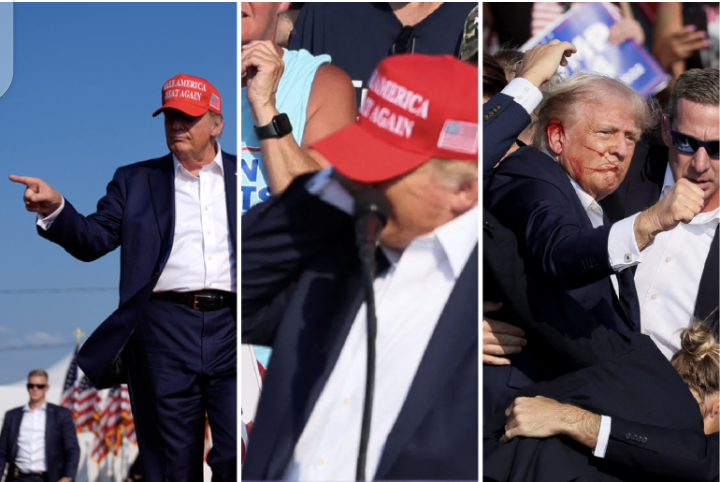

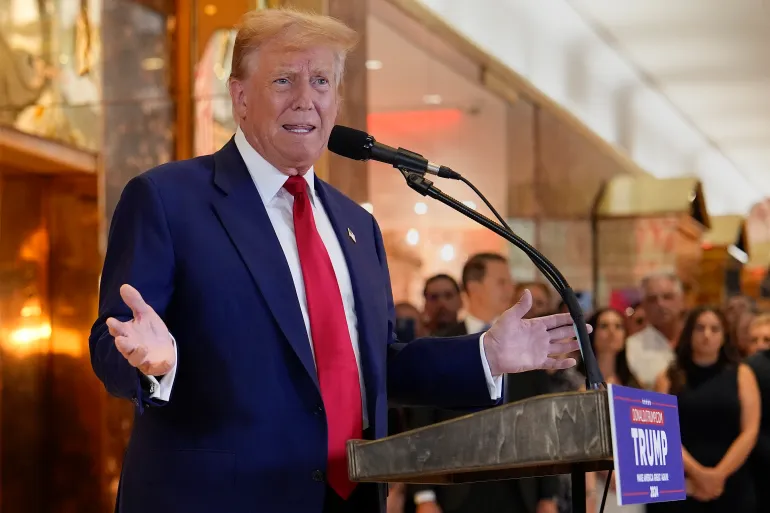


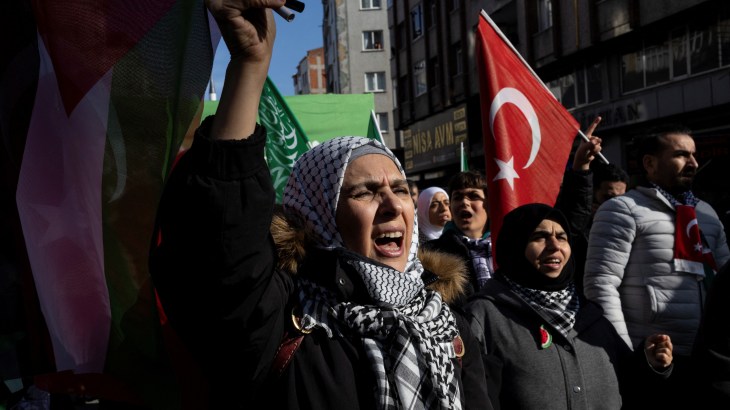
Dozens of Palestinians killed in overnight Israeli strikes in central and south Gaza as Red Sea tensions rise.
Here’s how things stand on Monday, January 15, 2024:
Latest updates and human impact
- Israeli attacks continue unabated overnight killing and wounding dozens of civilians in central and southern Gaza. At least 22 people were killed and a large number injured as a result of Israeli forces targeting al-Thalatheni Street in the central Gaza Strip.
- Yemen’s Houthi rebels fired an antiship cruise missile toward an American destroyer in the Red Sea, which was shot down by a US fighter jet, announced US Central Command (CENTCOM) on X.
- This was the first US-acknowledged Houthi attack since the US strikes on Yemen on Friday.
- Hamas released a 37-second video showing three Israeli captives held in Gaza on Sunday, saying they would reveal the fate of the captives on Monday and urging the Israeli government to stop the offensive.
- The Israeli military says it has shifted to a new phase of the war focused on the southern end of Gaza, where almost 2 million internally displaced Palestinians are running out of safe spaces to shelter.
- The Gaza Ministry of Health has said almost 24,000 people have been killed in the Israeli offensive. More than 60,000 people have been wounded in 100 days of war.
Diplomacy
- Israeli Prime Minister Benjamin Netanyahu said on Sunday that his country will pursue its war against Hamas until victory and will not be stopped by anyone, including the International Court of Justice (ICJ).
- The White House said on Sunday that “it’s the right time” for Israel to scale back its military offensive in the Gaza Strip.
- Egypt’s State Information Service (SIS) said in a statement on Sunday that one of the biggest obstacles to the timely delivery of sufficient aid to Gaza was Israeli inspection of the aid. The statement came after Israel blamed Cairo for the delay in aid delivery to Gaza during its defence at the ICJ.
- US Secretary of State Antony Blinken posted on X on Monday, calling for the release of the remaining captives held in Gaza on the 100th day since they were taken by Hamas. He did not mention the Palestinian casualties.
- Australia’s Foreign Minister Penny Wong, who described herself as a “friend of Israel” to the press, will travel to Jordan, Israel, the occupied Palestinian Territories and the United Arab Emirates this week, her office said on Monday.
West Bank raids and violence
- Israeli forces arrested 25 students staging a sit-in in protest against high tuition fees at An-Najah University in Nablus. Al Jazeera’s Hamdah Salhut reported that the protesting students received a text message from Israeli forces telling them to “surrender now”.
- Israeli forces have reportedly raided the family home of Nael al-Barghouti, the longest-serving Palestinian prisoner, in the village of Kobar, in Ramallah, in the occupied West Bank.
- The Israeli army said on Friday that it killed three Palestinian men who infiltrated a West Bank settlement and fired upon soldiers.
- The Israeli military killed two Palestinians after accusing them of ramming their car through a checkpoint near Hebron.
- Local sources reported that Israeli forces bulldozed two Palestinian-owned houses during a Sunday midnight raid in the city of Qalqilya, Palestinian news agency Wafa reported.
- Armed Israeli settlers broke into the village of Burin, south of Nablus, and attacked Palestinian residents’ houses and properties after midnight on Sunday, Wafa reported.
- “Violent raids and arrests have become part of the fabric of daily life in the occupied West Bank,” Al Jazeera’s Mohammed Jamjoom, reporting from Ramallah in the occupied West Bank, said. At least 347 Palestinians have been killed and thousands have been arrested since October 7.

Flames and smoke billow during Israeli attacks against Gaza on October 9, 2023
Human Rights Watch terms Israeli Defence Minister Yoav Gallant’s call for a ‘complete siege’ on Gaza a ‘war crime’.
The Hamas movement has threatened to kill an Israeli hostage every time Israel bombs a Palestinian home without warning as Israel mobilised some 300,000 reservists and imposed a total blockade of the Gaza Strip, denying the enclave’s millions of residents access to food, water and fuel.
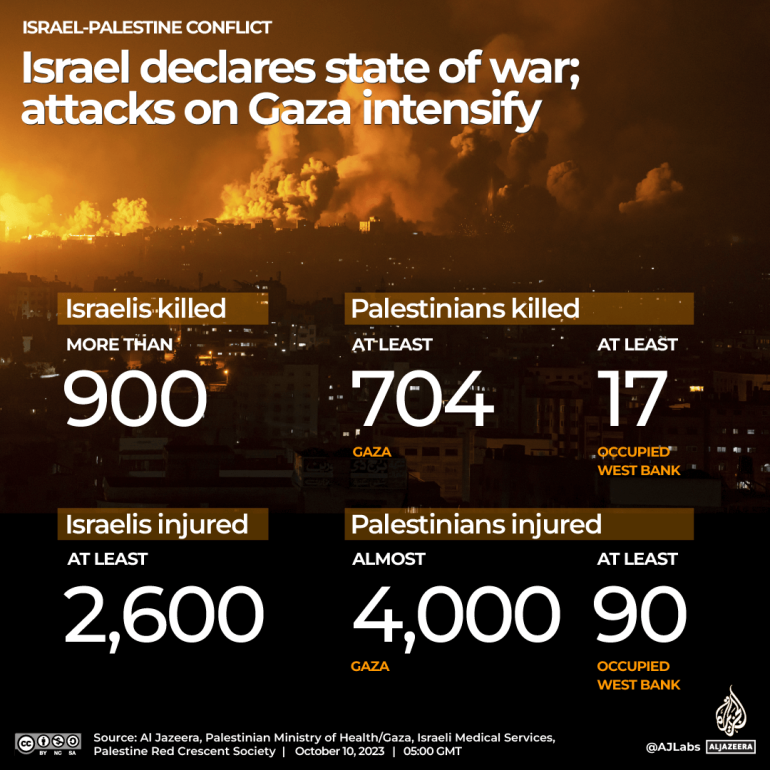
The warning from Hamas came on Monday as the death toll from the armed group’s surprise weekend attack climbed to 900 in Israel and revenge attacks by Israeli forces on the besieged Gaza Strip killed more than 700 people and left some 3,700 others wounded.
Residential apartment blocks, hospitals, schools and a mosque have been among the sites attacked by Israeli fighter jets, artillery and drones, according to media reports and witnesses.
Hamas spokesperson Abu Ubaida issued the threat to kill Israelis from the dozens held captive by the armed group. He said an Israeli hostage would be killed for every Israeli bombing of a civilian house without warning.
Israeli Foreign Minister Eli Cohen said more than 100 people were taken captive by Hamas during the deadly cross-border incursion over the weekend.
As Israeli forces conducted intense retaliatory attacks on Gaza on Monday, Israel’s Defence Minister Yoav Gallant drew international condemnation by announcing a total blockade of the densely populated and besieged enclave, which is home to 2.3 million people.
Gallant said Israel would impose a “complete siege” on Gaza. “No electricity, no food, no water, no gas – it’s all closed.”
United Nations Secretary-General Antonio Guterres said he was “deeply distressed” by the siege announcement and warned that Gaza’s already dire humanitarian situation will now “only deteriorate exponentially”.
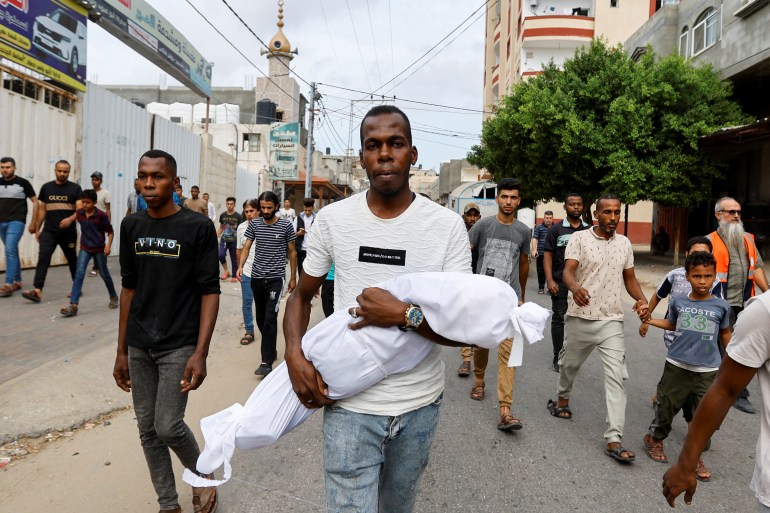
Guterres also said some 137,000 people were taking shelter with the UN Relief and Works Agency for Palestinian Refugees (UNRWA) at schools across Gaza.
UNRWA said on Tuesday that almost 190,000 people have been displaced in Gaza amid the Israeli attacks and the figure is expected to grow further as the violence intensifies.
Nearly half a million people have also not received food rations this week in Gaza as UN food distribution centres have been forced to remain closed amid the Israeli onslaught, UNRWA said.
Human Rights Watch said Israel’s total blockade on the necessities of life for everyday people in Gaza was a war crime.
“Defense Minister Gallant’s statements are abhorrent,” Omar Shakir, Israel and Palestine director at Human Rights Watch, said in a statement.
“Depriving the population in an occupied territory of food and electricity is collective punishment, which is a war crime, as is using starvation as a weapon of war. The International Criminal Court should take note of this call to commit a war crime,” he said.
Abhorrent. This is a call to commit a war crime by @yoavgallant. The @IntlCrimCourt should take note.
Quote by @OmarSShakir ⤵️ https://t.co/kKVo6YtpI1 pic.twitter.com/neHQMwnXVn
— Human Rights Watch (@hrw) October 9, 2023
Shakir also condemned the threat by Hamas to kill hostages, warning that such action was also a war crime.
“All hostages should be safely released to their families,” he said.
Grotesque. These threatened acts would amount to flagrant war crimes by Hamas’ armed wing. The @IntlCrimCourt will be watching.
Quote from @OmarSShakir ⤵️ https://t.co/FuNtvHe0YG pic.twitter.com/6cnHODLWyZ
— Human Rights Watch (@hrw) October 9, 2023
On the diplomatic front, Egyptian President Abdel Fattah el-Sisi and his Turkish counterpart Recep Tayyip Erdogan called on Hamas and Israel to immediately end violence and protect civilians, the Egyptian presidency said.
Erdogan urged Israel against “indiscriminately” attacking civilians and delivered measured criticism of Hamas, urging both sides to respect the “ethics” of war.
The United Kingdom, French, German, Italian and US governments issued a joint statement on Monday recognising the “legitimate aspirations” of the Palestinian people and supporting equal measures of justice and freedom for Israelis and Palestinians alike.
But the prospect that fighting could spread also alarmed the region and the world.
Lebanese armed group Hezbollah fired rockets into northern Israel in response to at least three of its members being killed in Israeli shelling of Lebanon.
Israel said one of its deputy commanders was also killed in an earlier cross-border raid from Lebanon.

US President Joe Biden holds a bilateral meeting with Israeli Prime Minister Benjamin Netanyahu on the sidelines of the 78th United Nations General Assembly in New York City, the US, September 20, 2023
Social media users, including journalists and observers, are calling out what they call a ‘double standard’.
After Saturday’s surprise attack by the Palestinian group Hamas on Israel, Ukrainian President Volodymyr Zelenskyy took to the social media platform X to offer “condolences go out to everyone who lost relatives or close ones in the terrorist attack”.
He also stated, “Israel’s right to self-defence is unquestionable.”
Many world leaders, including US President Joe Biden and UK Prime Minister Rishi Sunak, shared similar sentiments.
The world is seeing appalling images.
Thousands of rockets raining down on Israeli cities. Hamas terrorists killing not only Israeli soldiers, but civilians on the streets and in their homes.
It’s unconscionable. Israel has a right to defend itself – full stop.
— President Biden (@POTUS) October 7, 2023
European Commission President Ursula von der Leyen stated, “Israel has the right to defend itself – today and in the days to come. The European Union stands with Israel.”
Accusations of Western ‘double standards’
Some social media users have criticised these statements, saying they highlight a double standard.
The world is seeing appalling images.
Thousands of rockets raining down on Israeli cities. Hamas terrorists killing not only Israeli soldiers, but civilians on the streets and in their homes.
It’s unconscionable. Israel has a right to defend itself – full stop.
— President Biden (@POTUS) October 7, 2023
Ukraine’s right to defend itself is praised by most international leaders while Russia’s invasion is condemned, but commentators said the same cannot be said about Israel’s occupation of the West Bank and Gaza.
Aaron Bastani, a leftist British journalist, said on X that there’s a “clear double standard in endorsing terrorism against civilian targets in Ukraine … and condemning it by Palestinians”.
Many users said Western diplomats and media support the Ukrainians who defend their land, but label the Palestinians fighting against Israel as “terrorists”.
https://twitter.com/KhaledBeydoun/status/1710787817415082349?ref_src=twsrc%5Etfw%7Ctwcamp%5Etweetembed%7Ctwterm%5E1710787817415082349%7Ctwgr%5E6acf829869e993177f32aa38aa48c02f38cb7f61%7Ctwcon%5Es1_&ref_url=https%3A%2F%2Fwww.aljazeera.com%2Fnews%2F2023%2F10%2F9%2Fwestern-leaders-accused-of-hypocrisy-over-response-to-palestine-ukraine
An illustration of a woman’s face, in which one eye is closed beside a Palestinian flag, and one eye open beside a Ukrainian flag, has been regularly shared as a symbol of the West’s alleged double standards in how the two conflicts are viewed.
https://twitter.com/OnlinePalEng/status/1710994682883273172?ref_src=twsrc%5Etfw%7Ctwcamp%5Etweetembed%7Ctwterm%5E1710994682883273172%7Ctwgr%5E6acf829869e993177f32aa38aa48c02f38cb7f61%7Ctwcon%5Es1_&ref_url=https%3A%2F%2Fwww.aljazeera.com%2Fnews%2F2023%2F10%2F9%2Fwestern-leaders-accused-of-hypocrisy-over-response-to-palestine-ukraine
Clips also emerged on social media from a CNN interview with Mustafa Barghouti, the general secretary of the Palestinian National Initiative, in which he posed the rhetorical question, “Why does the United States support Ukraine in fighting occupation – while here they support the occupier, who continues to occupy us?”
The hypocrisy and double standards of western governments and media platforms dealing with situations in Ukraine-Russia and Palestine-Israel blow the mind. Absolute disgrace.
— Said Yacoubi (@AlyacoubiSaid) October 8, 2023
It is not the first time Western nations have been accused of double standards in their stance on the Ukraine war.
Earlier in the year, Amnesty International published a report highlighting the West’s “double standards” on global human rights.
Agnes Callamard, Amnesty’s secretary-general, told Al Jazeera at the time that the occupation of Palestinian territory was a “particularly important one”.
“Without making any comparison between Russia’s aggression and Israel … it is clear the Palestinian people are under a regime of oppression – a regime of occupation and a regime of apartheid,” Callamard told Al Jazeera.
Over the last three days, X users recirculated earlier statements calling out what they called Western hypocrisy, sharing video by the Irish lawmaker Richard Boyd Barrett from March 2022 in which he berated the Irish government’s double standards regarding Ukraine and Palestine:
“You’re happy to use the most strong and robust language to describe the crimes against humanity of [Russian President] Vladimir Putin, but you will not use the same strength of language when it comes to describing Israel’s treatment of the Palestinians.”
Barrett on Sunday again called out what he described as “shocking double standards of Western leaders supporting Ukraine resistance but condemning Palestinian[s].”
Meanwhile, others warned against comparing conflicts.
https://twitter.com/denfordauthor/status/1710993737738768607?ref_src=twsrc%5Etfw%7Ctwcamp%5Etweetembed%7Ctwterm%5E1710993737738768607%7Ctwgr%5E6acf829869e993177f32aa38aa48c02f38cb7f61%7Ctwcon%5Es1_&ref_url=https%3A%2F%2Fwww.aljazeera.com%2Fnews%2F2023%2F10%2F9%2Fwestern-leaders-accused-of-hypocrisy-over-response-to-palestine-ukraine
And some cautioned that Hamas and the Palestinians should not be seen as one and the same.
Just to clarify:
Palestine did not mount an attack on Israel. An Iranian proxy militia did. Palestinians are by and large huddled in their homes praying that an Israeli airstrike won't kill them or theirs. Hamas is the culprit here. This isn't a decentralized grassroots thing.
— Romeo Kokriatski (@VagrantJourno) October 9, 2023
Ukrainian footballer Oleksandr Zinchenko, who plays for Arsenal, posted on Instagram, stating he “stands with Israel”.
Zinchenko has been a vocal supporter of his home country in its ongoing defence against Russia, and he participated in a Game4Ukraine charity match in London earlier this year to raise money for Ukraine.
After online backlash, with some questioning an alleged double standard in his support of Israel, the footballer removed the post and switched his social media account to private.
Several people claimed that Zinchenko’s football club, in not responding to his comments, was guilty of hypocrisy after they had distanced themselves from former player Mesut Ozil’s comments in 2019 over alleged human rights abuses against Uighur Muslims in China.
-
 Audio10 years ago
Page – Day Break Everywhere Burst
-
 Audio5 years ago
Shadykarz – Forever
-
 Audio10 years ago
Juniorboy ft. 9ice – IRAPADA
-
 Entertainment Gists5 years ago
Ex-Beauty Queen, Sandra Benede Shares Sexy Photo
-
 Audio5 years ago
Simi – Happy Birthday ft. Adekunle Gold, DeJa
-
 Audio5 years ago
Ruger – Bounce
-
 Mixtapes4 years ago
Mixtape: DJ DimpleNipple – The Best Of Amapiano Thrills
-
 Editorials3 years ago
Sa’eedah Imam On Creating Her Imprint In The Nigerian Music Industry As An Emerging Creative Writer