

Four years after the world watched Donald Trump’s momentum build and build until he became the Republican nominee, America is again deciding who will run for the White House.
The nominees will be chosen through a series of primaries and caucuses in every US state and territory, that began in Iowa on 3 February and ends in Puerto Rico in early June.
Short of a big shock, the Republican nominee will be Donald Trump. Even though technically he has two challengers, he is so popular among Republicans, he has a clear run ahead of him. With that in mind, the Democratic primaries are the only ones worth watching.
It’s an unusual process, not all of which makes sense, although we’ve tried.
Step one: The start line
A whole year before the primaries, the first candidates emerged from hibernation. Over the year, others woke up and eventually 28 people announced they were running to become the Democratic nominee for president.
But dwindling funds, luke-warm or (ice-cold) public reaction and campaign infighting have, to varying degrees, led to 16 candidates pulling out of the race.
At the start of primary season, 11 people remained in the running. In theory, any one of them could become the nominee. In reality, only a few have a chance.
Step two: The Iowa caucuses
The first event of the primary season isn’t a primary at all – it’s a series of caucuses, in Iowa. These took place on Monday 3 February, in somewhat chaotic fashion.
What are caucuses?

A caucus involves people attending a meeting – maybe for a few hours – before they vote on their preferred candidate, perhaps via a head count or a show of hands. Those meetings might be in just a few select locations – you can’t just turn up at a polling station.
As a result, caucuses tend to really suit candidates who are good at rousing their supporters to get out of bed. People like Bernie Sanders, for example, who performed well in Iowa this time, as did Pete Buttigieg.
Caucuses used to be far more popular back in the day, but this year, Democrats are holding only four in US states – in Nevada, North Dakota, Wyoming and Iowa.
If any candidate gets under 15% of the vote in any caucus, their supporters then get to pick a second choice from among the candidates who did get more than 15%, or they can just choose to sit out the second vote.
Why does Iowa matter?
A win there for any candidate can help give them momentum and propel them to victory in the primaries.
Why is Iowa first in the primary calendar? You can blame Jimmy Carter, sort of. Iowa became first in 1972, for various technical electoral reasons too boring to go into here. But when Carter ran for president in 1976, his team realised they could grab the momentum by campaigning early in Iowa. He won there, then surprisingly won the presidency, and Iowa’s fate was sealed.
Why does Iowa not matter?
Iowa doesn’t represent the entire US – it’s largely white, so the way people vote there is very, very different than in other states.
Its record on picking the eventual nominees is a bit rubbish too, at least when it comes to Republicans – when there’s an open Republican race, Iowa hasn’t opted for the eventual nominee since 2000. Such names as Mike Huckabee, Rick Santorum and Ted Cruz have won there in recent years.
This year, Iowa suffered a bloody nose when the Democratic result was delayed by days due to technical glitches. Its curtain-raiser status may now be in doubt.
Step three: The New Hampshire primary
 New Hampshire: Intensely bucolic
Eight days after Iowa on Tuesday, 11 February, was the first primary, in New Hampshire. The tiny north-eastern state of only 1.3m people once again became an unlikely hotbed of political activity.
What is a primary?
Unlike a caucus, where voters are expected to turn up at a few limited locations at certain times and stick around for a while, primary voters can just turn up at a polling booth and vote in secret. Then leave.
How does a primary work?
The more votes a candidate gets in a caucus or primary, the more “delegates” they are awarded, and all candidates will be hoping to win an unbeatable majority of delegates.
The number of delegates differs in each state, and is decided by a convoluted series of criteria. In California’s primary, for example, there are 415 Democratic delegates up for grabs this year. In New Hampshire, it was only 24.
This year is a bit different. Any candidate would need to get at least 15% of the vote in any primary or caucus to be awarded delegates. There are still eight candidates in the running – an unusually large number – so there’s a risk the vote share will be spread out and some of the candidates may struggle to reach 15%.
After New Hampshire, we started to get a clear picture of who was struggling (Joe Biden, Elizabeth Warren), but even though Bernie Sanders and Pete Buttigieg had claimed the most delegates at this stage, neither is guaranteed to become the nominee.
The picture should become much clearer on…
Step four: Super Tuesday
A few other states vote in between New Hampshire and the end of February, but this is when things really start to warm up: Super Tuesday, on 3 March.
What is Super Tuesday?
It is the big date in the primary calendar, when 16 states, territories or groups vote for their preferred candidate in primaries or caucuses. A third of all the delegates available in the entire primary season are up for grabs on Super Tuesday. By the end of the day it could be much clearer who the Democratic candidate will be.
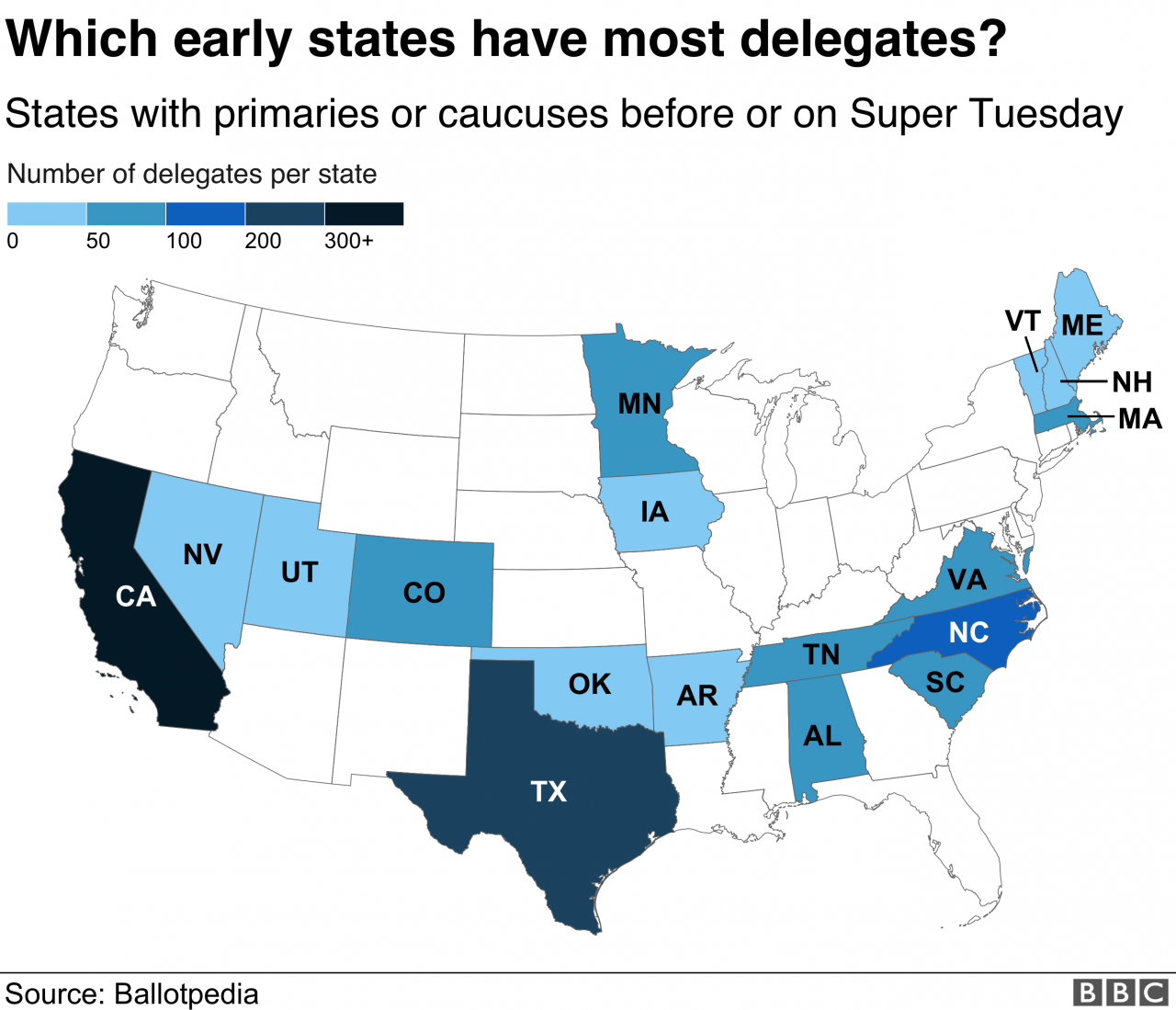
The two states with the most delegates are voting on Super Tuesday – California (with 415 Democratic delegates) and Texas (228). California is voting three months earlier than in 2016, making Super Tuesday even more super than normal.
California and Texas are two states with very diverse populations, so we may see them going for very different candidates than those chosen in Iowa and New Hampshire.
Step five: The rest of the race
After hectic Super Tuesday, everyone gets to cool down for a week, before another busy day on Tuesday, 10 March, when six states vote, with 352 delegates available.
After that, the primary season still has three months left to run ,and at the end, the role of those delegates will become clear…
Step six: The conventions
 Hillary Clinton celebrates becoming the Democratic nominee at the 2016 convention. This is as good as things got for her campaign.
Donald Trump will almost certainly be sworn in as the Republican nominee at the party convention in Charlotte, North Carolina, between 24 and 27 August. The Democrats will confirm their candidate at their own convention between 13 and 16 July in Milwaukee, Wisconsin.
What happens in a convention?
Here’s where those delegates come in.
Let’s say that during primary season, candidate A wins 10 delegates. During the convention, those 10 delegates would vote for candidate A to become the Democratic nominee. (Any party member can apply to be a delegate – they tend to be party activists or local political leaders.)
All through the Democratic primaries, there are 3,979 delegates available. If any one candidate wins more than 50% of those delegates during primary season (that’s 1,990 delegates), then they become the nominee in a vote at the convention.
But if we get to the Democratic convention and no-one has more than 50% of the delegates, it becomes what’s known as a “contested” or “brokered” convention. This could well happen this year. There are so many candidates that no one frontrunner emerges in the primaries, and they split the delegates between them. In that circumstance, a second vote would follow.
In that second vote, all the 3,979 delegates would vote again, except this time they would be joined by an estimated 771 “superdelegates”. These are senior party officials past and present (former president Bill Clinton is one, as is current Vermont senator and presidential contender Bernie Sanders), and they’re free to vote for whomever they wish.
If a candidate wins 50% or more in that vote – 2,376 delegates – then they become the nominee.
This is all thanks to a rule change in 2020: last time around, the superdelegates voted at the start of the convention, with the delegates. But many had pledged their support to Hillary Clinton even before the convention, leading her rival Mr Sanders to suggest the deck was stacked against him.
He’s the one who campaigned for the change – and it may benefit him in 2020.
Step seven: The presidency?
After inching past Iowa, negotiated New Hampshire, survived Super Tuesday and come through the convention, there is only one step left for the nominee: the presidential election, on 3 November.
We’ll explain how that one works a little closer to the time.

Full primary season calendar
(Primaries unless stated otherwise)
FEBRUARY
Monday 3
- Iowa caucuses (Democratic, Republican)
Tuesday 11
- New Hampshire (D,R)
Saturday 22
- Nevada (D)
Saturday 29:
- South Carolina (D)
MARCH
Tuesday 3 (Super Tuesday)
- Alabama (D, R)
- American Samoa caucuses (D)
- Arkansas (D, R)
- California (D, R)
- Colorado (D, R)
- Maine (D, R)
- Massachusetts (D, R)
- Minnesota (D, R)
- North Carolina (D, R)
- Oklahoma (D, R)
- Tennessee (D, R)
- Texas (D, R)
- Utah (D, R)
- Vermont (D, R)
- Virginia (D)
- Democrats Abroad (D)
Tuesday 10
- Idaho (D, R)
- Michigan (D, R)
- Mississippi (D, R)
- Missouri (D, R)
- North Dakota caucuses (D)
- Washington state (D, R)
Thursday, 12
- Virgin Islands caucuses (R)
Saturday 14
- Guam caucuses (R)
- Northern Marianas (D)
Tuesday 17
- Arizona (D)
- Florida (D, R)
- Illinois (D, R)
- Northern Marianas caucuses (R)
- Ohio (D, R)
Tuesday 24
- American Samoa caucuses (R)
- Georgia (D, R)
Sunday 29
- Puerto Rico (D)
APRIL
Saturday 4
- Alaska (D)
- Hawaii (D)
- Louisiana (D, R)
- Wyoming caucuses (D)
Tuesday 7
- Wisconsin (D)
Tuesday 28
- Connecticut (D, R)
- Delaware (D, R)
- Maryland (D, R)
- New York (D, R)
- Pennsylvania (D, R)
- Rhode Island (D, R)
MAY
Saturday 2
- Guam caucuses (D)
- Kansas (D)
Tuesday 5
- Indiana (D, R)
Tuesday 12
- Nebraska (D, R)
- West Virginia (D, R)
Tuesday 19
- Kentucky (D, R)
- Oregon (D, R)
JUNE
Tuesday 2
- District of Columbia (D, R)
- Montana (D, R)
- New Jersey (D, R)
- New Mexico (D, R)
- South Dakota (D, R)
Saturday 6
- Virgin Islands caucuses (D)
Sunday 7
- Puerto Rico (R)







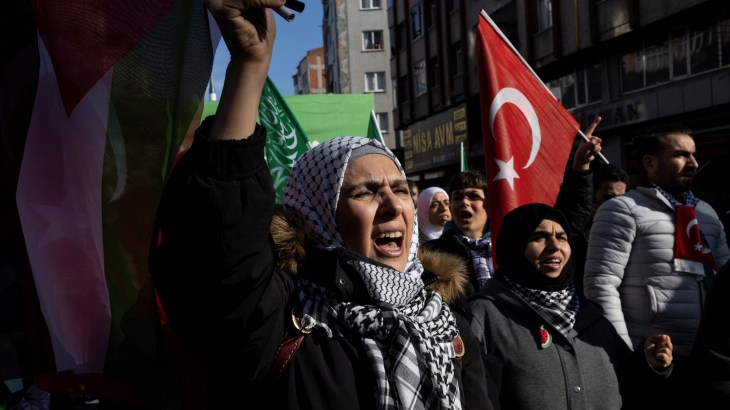
Dozens of Palestinians killed in overnight Israeli strikes in central and south Gaza as Red Sea tensions rise.
Here’s how things stand on Monday, January 15, 2024:
Latest updates and human impact
- Israeli attacks continue unabated overnight killing and wounding dozens of civilians in central and southern Gaza. At least 22 people were killed and a large number injured as a result of Israeli forces targeting al-Thalatheni Street in the central Gaza Strip.
- Yemen’s Houthi rebels fired an antiship cruise missile toward an American destroyer in the Red Sea, which was shot down by a US fighter jet, announced US Central Command (CENTCOM) on X.
- This was the first US-acknowledged Houthi attack since the US strikes on Yemen on Friday.
- Hamas released a 37-second video showing three Israeli captives held in Gaza on Sunday, saying they would reveal the fate of the captives on Monday and urging the Israeli government to stop the offensive.
- The Israeli military says it has shifted to a new phase of the war focused on the southern end of Gaza, where almost 2 million internally displaced Palestinians are running out of safe spaces to shelter.
- The Gaza Ministry of Health has said almost 24,000 people have been killed in the Israeli offensive. More than 60,000 people have been wounded in 100 days of war.
Diplomacy
- Israeli Prime Minister Benjamin Netanyahu said on Sunday that his country will pursue its war against Hamas until victory and will not be stopped by anyone, including the International Court of Justice (ICJ).
- The White House said on Sunday that “it’s the right time” for Israel to scale back its military offensive in the Gaza Strip.
- Egypt’s State Information Service (SIS) said in a statement on Sunday that one of the biggest obstacles to the timely delivery of sufficient aid to Gaza was Israeli inspection of the aid. The statement came after Israel blamed Cairo for the delay in aid delivery to Gaza during its defence at the ICJ.
- US Secretary of State Antony Blinken posted on X on Monday, calling for the release of the remaining captives held in Gaza on the 100th day since they were taken by Hamas. He did not mention the Palestinian casualties.
- Australia’s Foreign Minister Penny Wong, who described herself as a “friend of Israel” to the press, will travel to Jordan, Israel, the occupied Palestinian Territories and the United Arab Emirates this week, her office said on Monday.
West Bank raids and violence
- Israeli forces arrested 25 students staging a sit-in in protest against high tuition fees at An-Najah University in Nablus. Al Jazeera’s Hamdah Salhut reported that the protesting students received a text message from Israeli forces telling them to “surrender now”.
- Israeli forces have reportedly raided the family home of Nael al-Barghouti, the longest-serving Palestinian prisoner, in the village of Kobar, in Ramallah, in the occupied West Bank.
- The Israeli army said on Friday that it killed three Palestinian men who infiltrated a West Bank settlement and fired upon soldiers.
- The Israeli military killed two Palestinians after accusing them of ramming their car through a checkpoint near Hebron.
- Local sources reported that Israeli forces bulldozed two Palestinian-owned houses during a Sunday midnight raid in the city of Qalqilya, Palestinian news agency Wafa reported.
- Armed Israeli settlers broke into the village of Burin, south of Nablus, and attacked Palestinian residents’ houses and properties after midnight on Sunday, Wafa reported.
- “Violent raids and arrests have become part of the fabric of daily life in the occupied West Bank,” Al Jazeera’s Mohammed Jamjoom, reporting from Ramallah in the occupied West Bank, said. At least 347 Palestinians have been killed and thousands have been arrested since October 7.

Flames and smoke billow during Israeli attacks against Gaza on October 9, 2023
Human Rights Watch terms Israeli Defence Minister Yoav Gallant’s call for a ‘complete siege’ on Gaza a ‘war crime’.
The Hamas movement has threatened to kill an Israeli hostage every time Israel bombs a Palestinian home without warning as Israel mobilised some 300,000 reservists and imposed a total blockade of the Gaza Strip, denying the enclave’s millions of residents access to food, water and fuel.
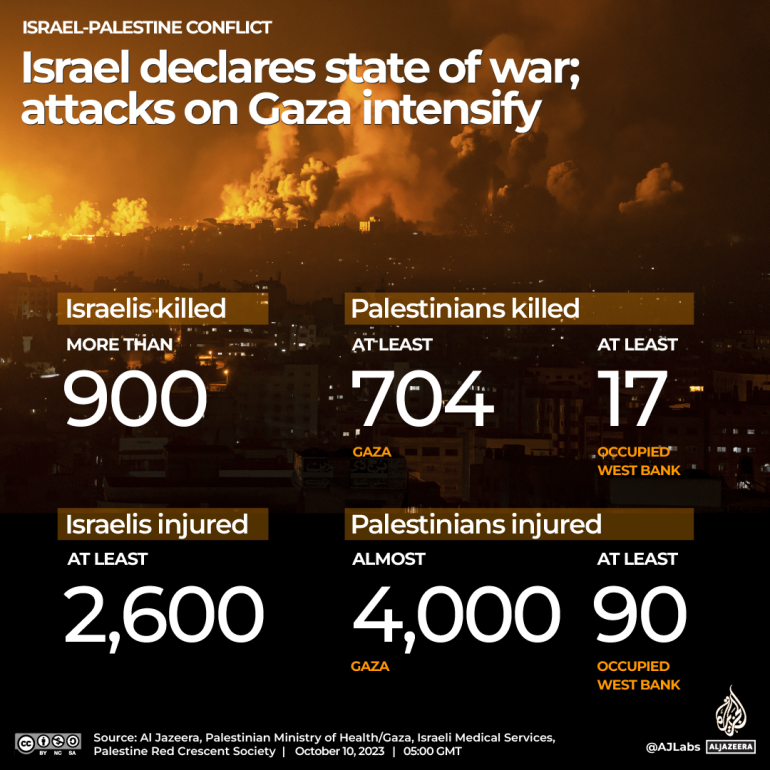
The warning from Hamas came on Monday as the death toll from the armed group’s surprise weekend attack climbed to 900 in Israel and revenge attacks by Israeli forces on the besieged Gaza Strip killed more than 700 people and left some 3,700 others wounded.
Residential apartment blocks, hospitals, schools and a mosque have been among the sites attacked by Israeli fighter jets, artillery and drones, according to media reports and witnesses.
Hamas spokesperson Abu Ubaida issued the threat to kill Israelis from the dozens held captive by the armed group. He said an Israeli hostage would be killed for every Israeli bombing of a civilian house without warning.
Israeli Foreign Minister Eli Cohen said more than 100 people were taken captive by Hamas during the deadly cross-border incursion over the weekend.
As Israeli forces conducted intense retaliatory attacks on Gaza on Monday, Israel’s Defence Minister Yoav Gallant drew international condemnation by announcing a total blockade of the densely populated and besieged enclave, which is home to 2.3 million people.
Gallant said Israel would impose a “complete siege” on Gaza. “No electricity, no food, no water, no gas – it’s all closed.”
United Nations Secretary-General Antonio Guterres said he was “deeply distressed” by the siege announcement and warned that Gaza’s already dire humanitarian situation will now “only deteriorate exponentially”.
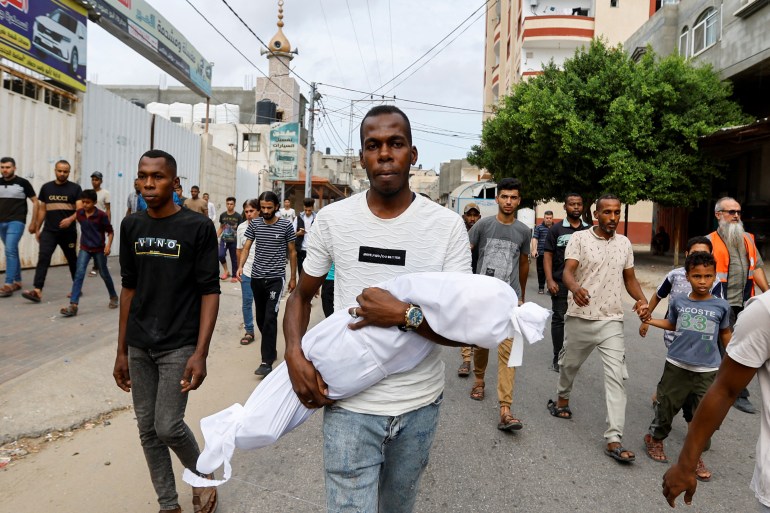
Guterres also said some 137,000 people were taking shelter with the UN Relief and Works Agency for Palestinian Refugees (UNRWA) at schools across Gaza.
UNRWA said on Tuesday that almost 190,000 people have been displaced in Gaza amid the Israeli attacks and the figure is expected to grow further as the violence intensifies.
Nearly half a million people have also not received food rations this week in Gaza as UN food distribution centres have been forced to remain closed amid the Israeli onslaught, UNRWA said.
Human Rights Watch said Israel’s total blockade on the necessities of life for everyday people in Gaza was a war crime.
“Defense Minister Gallant’s statements are abhorrent,” Omar Shakir, Israel and Palestine director at Human Rights Watch, said in a statement.
“Depriving the population in an occupied territory of food and electricity is collective punishment, which is a war crime, as is using starvation as a weapon of war. The International Criminal Court should take note of this call to commit a war crime,” he said.
Abhorrent. This is a call to commit a war crime by @yoavgallant. The @IntlCrimCourt should take note.
Quote by @OmarSShakir ⤵️ https://t.co/kKVo6YtpI1 pic.twitter.com/neHQMwnXVn
— Human Rights Watch (@hrw) October 9, 2023
Shakir also condemned the threat by Hamas to kill hostages, warning that such action was also a war crime.
“All hostages should be safely released to their families,” he said.
Grotesque. These threatened acts would amount to flagrant war crimes by Hamas’ armed wing. The @IntlCrimCourt will be watching.
Quote from @OmarSShakir ⤵️ https://t.co/FuNtvHe0YG pic.twitter.com/6cnHODLWyZ
— Human Rights Watch (@hrw) October 9, 2023
On the diplomatic front, Egyptian President Abdel Fattah el-Sisi and his Turkish counterpart Recep Tayyip Erdogan called on Hamas and Israel to immediately end violence and protect civilians, the Egyptian presidency said.
Erdogan urged Israel against “indiscriminately” attacking civilians and delivered measured criticism of Hamas, urging both sides to respect the “ethics” of war.
The United Kingdom, French, German, Italian and US governments issued a joint statement on Monday recognising the “legitimate aspirations” of the Palestinian people and supporting equal measures of justice and freedom for Israelis and Palestinians alike.
But the prospect that fighting could spread also alarmed the region and the world.
Lebanese armed group Hezbollah fired rockets into northern Israel in response to at least three of its members being killed in Israeli shelling of Lebanon.
Israel said one of its deputy commanders was also killed in an earlier cross-border raid from Lebanon.

US President Joe Biden holds a bilateral meeting with Israeli Prime Minister Benjamin Netanyahu on the sidelines of the 78th United Nations General Assembly in New York City, the US, September 20, 2023
Social media users, including journalists and observers, are calling out what they call a ‘double standard’.
After Saturday’s surprise attack by the Palestinian group Hamas on Israel, Ukrainian President Volodymyr Zelenskyy took to the social media platform X to offer “condolences go out to everyone who lost relatives or close ones in the terrorist attack”.
He also stated, “Israel’s right to self-defence is unquestionable.”
Many world leaders, including US President Joe Biden and UK Prime Minister Rishi Sunak, shared similar sentiments.
The world is seeing appalling images.
Thousands of rockets raining down on Israeli cities. Hamas terrorists killing not only Israeli soldiers, but civilians on the streets and in their homes.
It’s unconscionable. Israel has a right to defend itself – full stop.
— President Biden (@POTUS) October 7, 2023
European Commission President Ursula von der Leyen stated, “Israel has the right to defend itself – today and in the days to come. The European Union stands with Israel.”
Accusations of Western ‘double standards’
Some social media users have criticised these statements, saying they highlight a double standard.
The world is seeing appalling images.
Thousands of rockets raining down on Israeli cities. Hamas terrorists killing not only Israeli soldiers, but civilians on the streets and in their homes.
It’s unconscionable. Israel has a right to defend itself – full stop.
— President Biden (@POTUS) October 7, 2023
Ukraine’s right to defend itself is praised by most international leaders while Russia’s invasion is condemned, but commentators said the same cannot be said about Israel’s occupation of the West Bank and Gaza.
Aaron Bastani, a leftist British journalist, said on X that there’s a “clear double standard in endorsing terrorism against civilian targets in Ukraine … and condemning it by Palestinians”.
Many users said Western diplomats and media support the Ukrainians who defend their land, but label the Palestinians fighting against Israel as “terrorists”.
https://twitter.com/KhaledBeydoun/status/1710787817415082349?ref_src=twsrc%5Etfw%7Ctwcamp%5Etweetembed%7Ctwterm%5E1710787817415082349%7Ctwgr%5E6acf829869e993177f32aa38aa48c02f38cb7f61%7Ctwcon%5Es1_&ref_url=https%3A%2F%2Fwww.aljazeera.com%2Fnews%2F2023%2F10%2F9%2Fwestern-leaders-accused-of-hypocrisy-over-response-to-palestine-ukraine
An illustration of a woman’s face, in which one eye is closed beside a Palestinian flag, and one eye open beside a Ukrainian flag, has been regularly shared as a symbol of the West’s alleged double standards in how the two conflicts are viewed.
https://twitter.com/OnlinePalEng/status/1710994682883273172?ref_src=twsrc%5Etfw%7Ctwcamp%5Etweetembed%7Ctwterm%5E1710994682883273172%7Ctwgr%5E6acf829869e993177f32aa38aa48c02f38cb7f61%7Ctwcon%5Es1_&ref_url=https%3A%2F%2Fwww.aljazeera.com%2Fnews%2F2023%2F10%2F9%2Fwestern-leaders-accused-of-hypocrisy-over-response-to-palestine-ukraine
Clips also emerged on social media from a CNN interview with Mustafa Barghouti, the general secretary of the Palestinian National Initiative, in which he posed the rhetorical question, “Why does the United States support Ukraine in fighting occupation – while here they support the occupier, who continues to occupy us?”
The hypocrisy and double standards of western governments and media platforms dealing with situations in Ukraine-Russia and Palestine-Israel blow the mind. Absolute disgrace.
— Said Yacoubi (@AlyacoubiSaid) October 8, 2023
It is not the first time Western nations have been accused of double standards in their stance on the Ukraine war.
Earlier in the year, Amnesty International published a report highlighting the West’s “double standards” on global human rights.
Agnes Callamard, Amnesty’s secretary-general, told Al Jazeera at the time that the occupation of Palestinian territory was a “particularly important one”.
“Without making any comparison between Russia’s aggression and Israel … it is clear the Palestinian people are under a regime of oppression – a regime of occupation and a regime of apartheid,” Callamard told Al Jazeera.
Over the last three days, X users recirculated earlier statements calling out what they called Western hypocrisy, sharing video by the Irish lawmaker Richard Boyd Barrett from March 2022 in which he berated the Irish government’s double standards regarding Ukraine and Palestine:
“You’re happy to use the most strong and robust language to describe the crimes against humanity of [Russian President] Vladimir Putin, but you will not use the same strength of language when it comes to describing Israel’s treatment of the Palestinians.”
Barrett on Sunday again called out what he described as “shocking double standards of Western leaders supporting Ukraine resistance but condemning Palestinian[s].”
Meanwhile, others warned against comparing conflicts.
https://twitter.com/denfordauthor/status/1710993737738768607?ref_src=twsrc%5Etfw%7Ctwcamp%5Etweetembed%7Ctwterm%5E1710993737738768607%7Ctwgr%5E6acf829869e993177f32aa38aa48c02f38cb7f61%7Ctwcon%5Es1_&ref_url=https%3A%2F%2Fwww.aljazeera.com%2Fnews%2F2023%2F10%2F9%2Fwestern-leaders-accused-of-hypocrisy-over-response-to-palestine-ukraine
And some cautioned that Hamas and the Palestinians should not be seen as one and the same.
Just to clarify:
Palestine did not mount an attack on Israel. An Iranian proxy militia did. Palestinians are by and large huddled in their homes praying that an Israeli airstrike won't kill them or theirs. Hamas is the culprit here. This isn't a decentralized grassroots thing.
— Romeo Kokriatski (@VagrantJourno) October 9, 2023
Ukrainian footballer Oleksandr Zinchenko, who plays for Arsenal, posted on Instagram, stating he “stands with Israel”.
Zinchenko has been a vocal supporter of his home country in its ongoing defence against Russia, and he participated in a Game4Ukraine charity match in London earlier this year to raise money for Ukraine.
After online backlash, with some questioning an alleged double standard in his support of Israel, the footballer removed the post and switched his social media account to private.
Several people claimed that Zinchenko’s football club, in not responding to his comments, was guilty of hypocrisy after they had distanced themselves from former player Mesut Ozil’s comments in 2019 over alleged human rights abuses against Uighur Muslims in China.
-
 Audio10 years ago
Page – Day Break Everywhere Burst
-
 Audio5 years ago
Shadykarz – Forever
-
 Audio10 years ago
Juniorboy ft. 9ice – IRAPADA
-
 Entertainment Gists6 years ago
Ex-Beauty Queen, Sandra Benede Shares Sexy Photo
-
 Audio5 years ago
Simi – Happy Birthday ft. Adekunle Gold, DeJa
-
 Audio6 years ago
Ruger – Bounce
-
 Mixtapes4 years ago
Mixtape: DJ DimpleNipple – The Best Of Amapiano Thrills
-
 Editorials4 years ago
Sa’eedah Imam On Creating Her Imprint In The Nigerian Music Industry As An Emerging Creative Writer