
Features
Donald Trump Travel Ban Comes Into Effect For Six Countries


People from six mainly Muslim countries and all refugees now face tougher US entry due to President Donald Trump’s controversial travel ban.
It means people without “close” family or business relationships in the US could be denied visas and barred entry.
Lawyers took up positions at US airports, offering free advice.
But there was no sign of the chaos that affected travellers when the first version of the ban was brought in at a few hours’ notice in January.
That is because the executive order does not affect people who already have valid visas or green cards.
The Department of Homeland Security said it expected “business as usual at our ports of entry”.
Monday’s Supreme Court ruling upheld the temporary ban, a key Trump policy.
But the judges provided a major exception, for those who have “a credible claim of a bona fide relationship” with someone in the US.
The effect is that citizens of the affected countries with a close relative in the US, such as a spouse, parent, child or sibling, will potentially be allowed in.
In a last minute change, the Trump administration extended the definition of close family to include fiancés.
However grandparents, aunts, uncles, nephews and nieces are not considered to be “bona fide” relations.
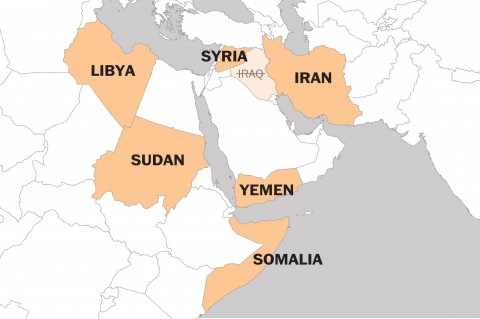
The rules apply to people from Iran, Libya, Syria, Somalia, Sudan and Yemen, as well as to all refugees.
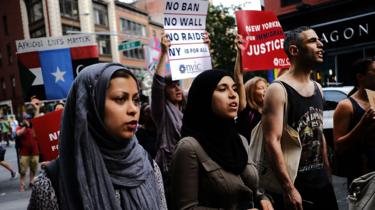
Moments before the ban began at 20:00 Washington time on Thursday (00:00 GMT), it emerged that the state of Hawaii had asked a federal judge for clarification.
Hawaii’s attorney general has argued that the definition of “close family” is too narrow and may improperly prevent people from travelling to the US.
The American Civil Liberties Union (ACLU) said it would be closely monitoring the guidance and implementation of the order.
The Supreme Court is expected to make a final decision on the ban when its next session begins in October.
Who can come in?
According to the new rules, for the next 90 days those from the six countries without a close relationship will not be able to enter the US.
IN – a parent, spouse, fiancé, child, son- or daughter-in-law, or sibling, including step- or half-siblings.
OUT – grandparents, aunts, uncles, nieces, nephews, in-laws, extended family and grandchildren.
Also exempt from the new rules are those with business or educational ties to the US.
However, the guidelines specifically state that the relationship must be formal, documented and not formed for the purpose of evading the order.
As well as making clear that those with valid visas and legal permanent residents are not affected, the Department of Homeland Security says dual nationals who travel on their passport from the unaffected country will also be allowed entry.
The Supreme Court also approved a 120-day ban on refugees entering the US, allowing the government to bar entry to refugee claimants who cannot prove the same ties to an American individual or entity.
How did we get here?
The US president insisted his ban was necessary for national security and pointed to terrorist attacks in Paris, London, Brussels and Berlin as evidence.
However, critics called the policy un-American and Islamophobic, and said that this ban would not have stopped atrocities in the US perpetrated by American-born attackers.
The original ban, released on 27 January, provoked mass protests at American airports.
It included Iraq among nations whose travellers would be barred from the US, and imposed a full ban on refugees from Syria.
The president issued a revised version with a narrower scope on 6 March to overcome some of the legal problems.
The policy was left in limbo after it was struck down by federal judges in Hawaii and Maryland.




Kosi’s emergence on the Afrobeat scene feels both familiar and fresh. Rooted in a childhood shaped by gospel music and choir rehearsals, his sound carries the discipline and soul of his church background. But, there’s also a raw edge, drawn from the streets of Festac, Lagos, that gives his music a grittier, lived-in texture. The blend is strikingly obvious as you’d hear a voice trained in harmony and a message born of hustle.
The artist’s approach to songwriting is intentional, pulling from personal experiences and everyday realities rather than chasing empty trends. It’s this mix of vulnerability and confidence that has quickly earned him attention within Lagos‘s music circles, even though he has just a few releases. Kosi is already making a case for himself as a voice that can stand out in the crowd, honest, grounded, and undeniably Afrobeat.

A man places a Russian national flag on a balcony of a residential building in Lysychansk, eastern Ukraine, which is now territory under the control of the self-described Luhansk People’s Republic
As the Russia-Ukraine war enters its 132nd day, we take a look at the main developments.
Here are the key events so far on Tuesday, July 5.
Fighting
- Ukraine’s President Volodymyr Zelenskyy said his troops have “no alternative” but to “push back and destroy the offensive potential” of Russian forces, as the battle moves from Luhansk to nearby Donetsk.
- Ukrainian forces that retreated from Lysychansk are now holding the line between Bakhmut and Sloviansk, preparing to fend off a further Russian advance, Luhansk governor Serhiy Haidai said.
- President Vladimir Putin congratulated Russian troops on “liberating” the eastern Ukrainian region of Luhansk.
- At least 345 children have died in Ukraine as a result of Russia’s invasion and 644 have been wounded, the prosecutor general’s office reported.

Diplomacy
- Swedish Prime Minister Magdalena Andersson met Ukraine’s president in Kyiv, with the two parties signing a joint statement on defence and energy cooperation.
- Russian foreign minister Sergey Lavrov will fly to Hanoi on Tuesday for a two-day visit to Vietnam before heading to a G20 meeting later this week in Indonesia, the Vietnamese government said.
- Zelenskyy thanked the International Olympic Committee (IOC) for supporting a ban on Russian teams and athletes competing in most Olympic sports.
- Putin did not congratulate President Joe Biden on the United States’ Independence Day on July 4 due to “unfriendly” relations, the Kremlin said.
Economy
- Ukraine needs $750bn for a recovery plan, Prime Minister Denys Shmyhal told a Ukraine Recovery Conference hosted by Switzerland.
- Ukraine is holding talks with Turkey and the United Nations to secure guarantees for grain exports from Ukrainian ports, Zelenskyy said.
- Britain said it would on Tuesday introduce new economic, trade and transport sanctions on Belarus over its support for Russia’s invasion of Ukraine, and also sanctioned six Russians it said were spreading disinformation.
- Belarus said it was freezing foreign shareholdings in 190 Belarusian companies, including the software engineering company EPAM Systems and Lukoil Belarus, in response to Western sanctions.

Race plays key factor in a society where 10 percent of population owns more than 80 percent of wealth, World Bank says.
South Africa is the most unequal country in the world, with race playing a determining factor in a society where 10 percent of the population owns more than 80 percent of the wealth, a World Bank report has said.
“South Africa… is the most unequal country in the world, ranking first among 164 countries,” the Washington-based institution said Wednesday in a report, Inequality in Southern Africa.
Almost three decades after the end of apartheid, “race remains a key driver of high inequality in South Africa, due to its impact on education and the labor market,” it said.
When race is considered as a factor in income disparities, the report added, “its contribution to income inequality amounts to 41 percent, while contribution of education is reduced to 30 percent.
“The legacy of colonialism and apartheid, rooted in racial and spatial segregation, continues to reinforce inequality.”
The country’s neighbours that make up the rest of the Southern African Customs Union – Botswana, Eswatini, Lesotho and Namibia – established in 1910, all finish higher on the list of the most unequal countries in the world.
In the region, women earn on average 30 percent less than men with the same level of education with the pay gap as wide as 38 percent in Namibia and South Africa.
The uneven distribution of agricultural land is also a factor driving inequality, especially in rural areas.
In Namibia, 70 percent of the 39.7 million hectares (98.1 million acres) of commercial agricultural land “still belong to Namibians of European descent”, the World Bank said.
The report was produced before the COVID-19 pandemic and its authors used the Gini coefficient – an indicator of income inequality – to rank countries.
-
 Audio10 years ago
Page – Day Break Everywhere Burst
-
 Audio5 years ago
Shadykarz – Forever
-
 Audio10 years ago
Juniorboy ft. 9ice – IRAPADA
-
 Entertainment Gists6 years ago
Ex-Beauty Queen, Sandra Benede Shares Sexy Photo
-
 Audio5 years ago
Simi – Happy Birthday ft. Adekunle Gold, DeJa
-
 Audio6 years ago
Ruger – Bounce
-
 Mixtapes4 years ago
Mixtape: DJ DimpleNipple – The Best Of Amapiano Thrills
-
 Editorials4 years ago
Sa’eedah Imam On Creating Her Imprint In The Nigerian Music Industry As An Emerging Creative Writer