

General Frank McKenzie put the nearly 20 years of war in Afghanistan into numbers at a Pentagon news briefing.
In the early morning hours of August 31, the last US military plane took off from Hamid Karzai International Airport, officially ending the US’s nearly 20-year-long war in Afghanistan.
In a Pentagon news briefing, General Frank McKenzie, head of US Central Command, said the US had evacuated 79,000 people from Kabul, including 6,000 American citizens, since August 14, a day before the Taliban took control of the capital city.
Celebratory gunfire was heard across Kabul following the US withdrawal. In a tweet, Anas Haqqani, a senior Taliban official said that “we made history again. The 20-year occupation of Afghanistan by the United States and NATO ended tonight.”
Below is an infographic summarising the main figures mentioned by General McKenzie during his briefing.
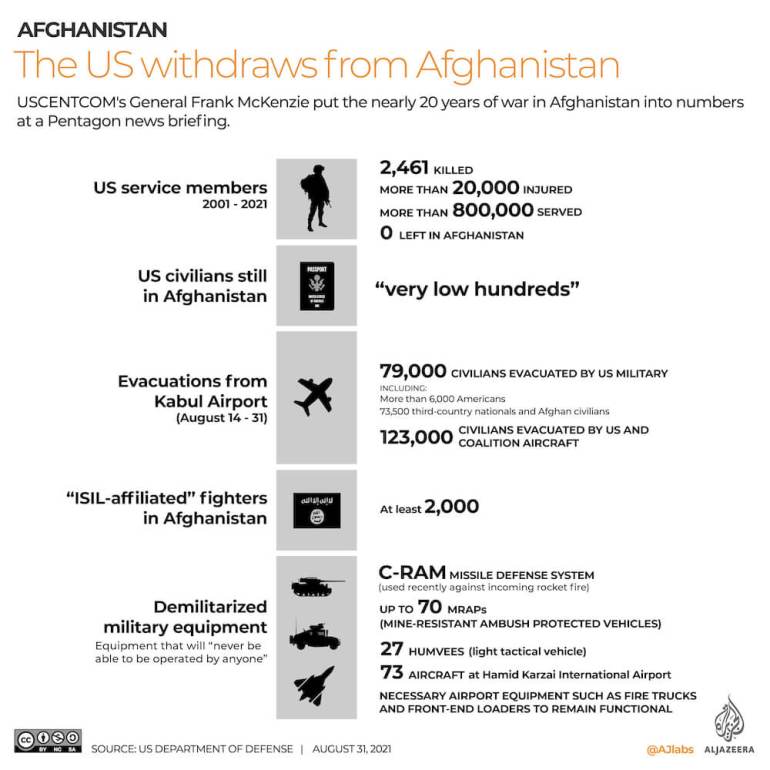
A complete transcript of his address is provided below:
Press Secretary John F Kirby: Good afternoon, everybody.
I’m going to turn the – we got the – the general? – I’m going to turn the podium over to General Frank McKenzie, commander of US Central Command. He’ll have some opening comments, and then he’ll take some questions. We do have a hard stop at 5 o’clock, so I will not waste up any more time.
General, can you hear and see me okay?
General Kenneth F McKenzie, Jr: Hey, John. I can hear and see you just fine. How me? Over.
Kirby: Thank you, sir. Thanks for being here today, and I turn it over to you, sir.
McKenzie: Thanks, John.
Good afternoon, everyone.
I’m here to announce the completion of our withdrawal from Afghanistan and the end of the military mission to evacuate American citizens, third-country nationals and vulnerable Afghans.
The last C-17 lifted off from Hamid Karzai International Airport this afternoon at 3:29pm East Coast time and the last manned aircraft is now clearing the airspace above Afghanistan. We will soon release a photo of the last C-17 departing Afghanistan with Major General Chris Donahue and the US ambassador to Afghanistan, Ross Wilson, aboard.
While the military evacuation is complete, the diplomatic mission to ensure additional US citizens and eligible Afghans who want to leave continues. And I know that you have heard – and I know that you’re going to hear more about that from the State Department shortly.
Tonight’s withdrawal signifies both the end of the military component of the evacuation but also the end of the nearly 20-year mission that began in Afghanistan shortly after September 11th, 2001.
It’s a mission that brought Osama bin Laden to a just end along with many of his al-Qaeda co-conspirators, and it was not – it was not a cheap mission. The cost was 2,461 US service members and civilians killed and more than 20,000 who were injured. Sadly that includes 13 US service members who were killed last week by an ISIS-K suicide bomber. We honour their sacrifice today as we remember their heroic accomplishments.
No words from me could possibly capture the full measure of sacrifices and accomplishments of those who served, nor the emotions they’re feeling at this moment. But I will say that I’m proud that both my son and I have been a part of it.
Before I open it up for questions, I do want to provide some important context to the evacuation mission that we just completed in what was the largest non-combatant evacuation in the US military’s history.
Since August the 14th, over an 18-day period, US military aircraft have evacuated more than 79,000 civilians from Hamid Karzai International Airport. That includes 6,000 Americans and more than 73,500 third-country nationals and Afghan civilians. This last category includes special immigrant visas, consular staff, at-risk Afghans and their families.
In total, US and coalition aircraft combine to evacuate more than 123,000 civilians, which were all enabled by US military service members who were securing and operating the airfield.
On average, we have evacuated more than 7,500 civilians per day over the 18 days of the mission, which includes 16 full days of evacuations, and more than 19,000 on a single day. These numbers do not include the roughly 5,000 service members and their equipment that were sent to Afghanistan to secure the airfield and who will withdraw on the conclusion of our mission.
The numbers I provided represent a monumental accomplishment, but they do not do justice to the determination, the grit, the flexibility and the professionalism of the men and women of the US military and our coalition partners who were able to rapidly combine efforts and evacuate so many under such difficult conditions. As such, I think it’s important that I provide you with what I hope will be some valuable context.
When the president directed the complete withdraw of US forces from Afghanistan in April, the team at US Central Command began to update and refine our existing plan for a potential non-combatant evacuation operation, or a NEO, in Afghanistan.
We had a framework of plans that included numerous branches and sequels depending on the nature of the security environment. Over time, we continued to refine our plans, which included the interagency, the international community and other combatant commands.
Plans such as this are built upon a number of facts and assumptions, and facts and assumptions change over time. While observing the security environment deteriorate, we continued to update our facts and assumptions.
As the security situation rapidly devolved in Afghanistan, we took a number of actions to position ourselves for a potential NEO based upon direction from the secretary of defence. We positioned forces in the region and put them on increased alert. We began to pre-position supplies, and we began some preparatory work on intermediate facilities in Qatar with the support of our gracious host nation.
When the evacuation was formerly directed on August the 14th, we began to carry out our plan, based upon the initial assumption that the Afghan security forces would be a willing and able security partner in Kabul, defending the capital for a matter of weeks, or at least for a few days. Within 24 hours, of course, the Afghan military collapsed completely, opening Kabul up to the Taliban’s advance.
On August the 15th, in a meeting with Taliban senior leadership in Doha, I delivered a message on behalf of the president that our mission in Kabul was now the evacuation of Americans and our partners, that we would not tolerate interference and that we would forcefully defend our forces and the evacuees if necessary. The Taliban’s response in that meeting was in line with what they’ve said publicly: While they stated their intent to enter and occupy Kabul, they also offered to work with us on a deconfliction mechanism to prevent miscalculation while our forces operated in close quarters. Finally, they promised not to interfere with our withdrawal.
It’s important to understand that within 48 hours of the NEO execution order, the facts on the ground had changed significantly. We had gone from cooperating on security with a longtime partner and ally to initiating a pragmatic relationship of necessity with a longtime enemy.
And to that environment, Rear Admiral Pete Vasely and Brigadier General Farrell Sullivan of the Marines, and subsequently Major General Chris Donahue of the Army’s 82nd Airborne Division, deployed and employed their forces and did extraordinary work with the leading elements or reinforcement package to safely close the embassy in one period of darkness or one… one evening, to establish a deconfliction mechanism with the Taliban, to establish security at the airport, and to bring in the rest of our reinforcements into the airport. They accomplished this difficult list of tasks within 48 hours of supporting the transfer of the embassy to the airport.
I visited Kabul on Tuesday, August the 17th, to see the work being done to establish security first-hand and to observe the transition to the evacuation. I left on a C-17 that brought more than 130 Afghans and American citizens out from Karzai International Airport to Al Udeid Air Base in Qatar. Our men and women on the ground at the airport quickly embraced the dangerous and methodical work of defending the airport while conducting the hand… the hand screening of more than 120,000 evacuees from six different entry points under the airfield. We also conducted three separate helicopter extractions of three distinct groups of civilians, including at least 185 American citizens, and with our German partners, 21 German citizens.
Additionally, US Special Operations Forces reached out to help break in… bring in more than 1,064 American citizens and 2017 SIVs, or Afghans at risk, and 127 third-country nationals, all via phone calls, vectors and escorting. We have evacuated more than 6,000 US civilians, which we believe represents the vast majority of those who wanted to leave at this time.
It would be difficult to overestimate the number of unusual challenges and competing demands that our forces on the ground have successfully overcome. The threat to our forces, particularly from ISIS-K, was very real and tragically resulted in the loss of 13 service members and dozens of Afghan civilians.
I said this before, but I’d like to say it again, we greatly appreciate the contributions of the many coalition partners that stood with us on the ground at the Karzai International Airport. I’m just going to single out one nation as an example of the many, the Norwegians, who maintained their hospital at the airport. And they were absolutely critical for the immediate care of our wounded after the Abbey Gate attack. Even after the attack, they agreed to extend the presence of their hospital to provide more coverage for us.
Our diplomats have also been with us in Kabul from the beginning, and their work in processing over 120,000 people stands right beside that of their military partners. We were a team on the ground.
As I close my remarks, I would like to offer my personal appreciation to the more than 800,000 service members and 25,000 civilians who have served in Afghanistan, and particularly to the families of those whose loved ones have been lost or wounded. Your service, as well as that of your comrades and family members, will never be forgotten.
My heart is broken over the losses we sustained three days ago. As the poem by Laurence Binyon goes, we will remember them.
The last 18 days have been challenging. Americans can be proud of the men and women of the armed forces who met these challenges head-on.
I’m now ready to take your questions.
Kirby: Thank you, General.
We’ll start with Lita at AP. We’re asking you to – because we’re limited on time – please limit your follow-up so that more people can get questions asked. Go ahead.
Q: General, thanks for doing this.
Can you give us a sense of whether or not there were any American citizens or other civilians who were taken out on any of those last couple of C-17s that flew out this afternoon? And can you give us a picture of what you saw with equipment and other things getting either destroyed or removed at the airport before they left?
McKenzie: So, we, no American citizens came out on the last, what we call, the joint tactical exfiltration; the last five jets to leave. We maintained the ability to bring them in up until immediately before departure, but we were not able to bring any Americans out. That activity ended probably about 12 hours before our exit, although we continued the outreach and would have been prepared to bring them on until the very last minute. But none of them made it to the airport and were able to be… and were able to be accommodated.
Q: (Off-mic.)
McKenzie: We brought some of it out, and we demilitarized some of it. Let me give an example of something that we demilitarized.
You’re very much aware, of course, of the rocket attack that occurred yesterday, where five rockets were fired at… at the airfield. Our C-RAMs were very effective in… in engaging the two rockets that did fall on the airfield, and we believe they probably kept them from doing more significant damage. We elected to keep those systems in operation up until the very last minute.
It’s a complex procedure – it’s a complex and time-intensive procedure to break down those systems. So we demilitarized those systems so that they’ll never be used again. And they were just a – we felt it was more important to protect our forces than to bring those systems back.
We have also demilitarized equipment that we did not bring out of the airport that included a number of MRAPs – up to 70 MRAPs that we demilitarized that will never be used again by anyone; 27 Humvees, that little tactical vehicle, that will never be driven again.
And additionally, on the ramp at – at HKIA are a total of 73 aircraft. Those aircraft will never fly again when we left. They’ll never be able to be operated by anyone. Most of them were non-mission capable, to begin with, but certainly, they’ll never be able to be flown again.
Thank you.
Kirby: David.
Q: General, David Martin with CBS.
Was there any attempt to interfere with the final flights out, either by the Taliban or by ISIS or any other group? And did – at the end, did Americans just vacate the premises, or did they turn it over to the Taliban?
McKenzie: Oh, we know that ISIS-K has worked very, very hard to strike us and to continue to strike us.
We feel that the strike we took yesterday in Kabul actually was very disruptive to their attack plans and threw them off stride. And I think that was one of the significant reasons why they were not able to organise themselves and get after us as we conducted the final withdrawal.
I will tell you, the Taliban had been very… very pragmatic and very businesslike as we have approached this withdrawal. We did not turn it over to the Taliban. General Donahue, one of the last things he did before leaving was talk to the Taliban commander that he had been coordinating with, as soon as – at about the time we were going to leave – just to let him know that we were leaving.
But there was no discussion of turning anything over, of that at all.
Kirby: Jen?
Q: General McKenzie, Jennifer Griffin from Fox News.
If I could just have you reflect personally, after 20 years of war you’ve served there, you’ve now watched the last troops leave, you’ve lost troops in recent days, how did it feel leaving Afghanistan to the very group that you overthrew 20 years ago, the Taliban?
McKenzie: Well, as I sort of said in my remarks, as you know, I’ve been there a couple times. My son’s been there a couple times. So – and it was very – I was very conflicted actually. But I would tell you, I was pretty much focused on the task at hand.
I’ll have days ahead to actually think about that, but there was just so much going on in this headquarters and we were so completely focused on getting our troops out and in the days before, getting – you know, getting our citizens out, and vulnerable Afghans to the best of our ability, that I did not have a lot of time for reflection.
I’m sure I will do that in the future, but right now, I’m pretty much consumed with the… with the operational task at hand.
That’s a huge question, and I… and I am going to be thinking about that in the days ahead.
Q: Your message to Americans and Afghan allies who were left behind?
McKenzie: So, the military phase of this operation has ended. The diplomatic sequel to that will now begin. And I believe our Department of State is going to work very hard to allow any American citizens that are left – and we think the citizens that were not brought out number in the low, very low, hundreds. I believe that we’re going to… we’re going to be able to get those people out, and I think we’re also going to negotiate very hard and very aggressively to get our other Afghan partners out.
The military phase is over, but our desire to bring these people out remains as intense as it was before. The weapons have just shifted, if you will, from the military realm to the diplomatic realm, and the Department of State will now take the lead on it.
Kirby: Nancy?
Q: (inaudible) Can you clarify just a couple points, can you tell us how many people were on that final C-17 flight? Can you tell us where that flight is headed?
And you mentioned that General Donahue talked to his Taliban essential… essentially his Taliban counterpart. Can you give us any sense of what role the Taliban played from a security perspective to allow the US to safely depart Kabul?
McKenzie: Yes, so I’m not going to be able to answer the first two questions because those operations are still concluding, as to where those aircraft are going and the… and the exact disposition of our forces on the aircraft.
I can tell you this, though, about what the Taliban has done. They established a firm perimeter outside of the airfield to prevent people from coming on the airfield during our departure. And we, we’ve worked that with them for a number of days. They did not have direct knowledge of our time of departure. We choose to keep that… we chose to keep that very… information very restricted. But they were actually very helpful and useful to us as we closed down operations.
Kirby: I want to go to the phones. I haven’t done that yet. Dan Lamothe?
Q: Hey, thanks for… thanks for calling on me.
General, can you… can you give us a… I guess, a deeper level of detail on what this last day looked like in terms of number of flights, number of people you had on the ground to start with, who might have been on the last plane, particularly senior leaders, and kind of just how this all played out?
Thanks.
McKenzie: Sure.
So let me actually begin with the back end of your question.
On the last aeroplane out was General Chris Donahue, the commander of the 82nd Airborne Division and my ground force commander there. And he was accompanied by our charge, Ambassador Ross Wilson. So they came out together. So the State and Defense team came out on the last aircraft and were, in fact, the last people to stand on the ground and step on the aeroplane.
So what has happened over the last 12 or 18 hours is we – first of all, we were intent on maintaining the ability to bring out Americans and other… and other Afghans as long as we could. So we kept that capability until just a few hours ago. And we were able to bring out some people earlier in the day, although, as I’ve noted earlier, we had to cut it off sometime before this operation began. But we were intent on maintaining that capability.
We were also intent on maintaining our force protection because the threats from ISIS were very real, very concerning. And so, we did a number of things.
We had overwhelming US airpower overhead should there have been any challenge to our departure. And again, there was absolutely no question: We were not going to be challenged by the Taliban. We were — if we were going to be challenged, it was going to be by ISIS. And I think some of the things we’d done yesterday, particularly the strike, and other things we’d done had disrupted their ability to conduct that — to conduct that attack planning.
But they remain a very lethal force and I think we would assess that probably there are at least 2,000 hardcore ISIS fighters in Afghanistan now. And, of course, many of those come from prisons that were — that were opened a few — a few days ago. So that number is up and is probably as high as it’s ever been in quite a while, and that’s going to be a challenge for the Taliban, I believe, in the days ahead.
Kirby: Idrees.
Q: Thank you, General.
A few quick questions. There are about 500 Afghan soldiers who are protecting the perimeter. Did you evacuate them and their families?
And secondly, just on the airport, now that you’ve departed, do you believe it can take on civilian aircraft pretty soon or will it require some type of repair or expertise?
McKenzie: Sure thing.
To the best of my knowledge, which is actually pretty good, I believe we brought out all the Afghan military force who were partnered with us to defend the airfield and their family members. And I believe that — that has been accomplished.
We need the airport to be operational and we need the airport to be operational quickly for civilian — you know, for civilian traffic. So we’re going to do everything we can to — to help with that.
Let me give you an example. One of the things we did not demilitarize as we left were those pieces of equipment that are necessary for airport operations, such as the fire trucks and front-end loaders, things like that. We left that — we left that equipment. So that is available to allow that airport to get back and get operating as soon as possible. And it needs to get operating as soon as possible.
Kirby: Luis?
Q: General, today is August 30th and the deadline has repeatedly been said that it was going to be August 31st. Do you think that there may be some people who had some false hope that they had at least one more day before this happened? And can you explain the tactical decision as to why you are completing this mission on the 30th as opposed to the 31st?
McKenzie: Sure.
So it’s actually the 31st in Afghanistan as we take a look what day of the week — at what day of the month it is. It’s the 30th here, 31st in Afghanistan. So we actually went out on the 31st, not the 30th if you look at Afghan time.
Look, there’s a lot of heartbreak associated with this departure. We did not get everybody out that we wanted to get out. But I think if we’d stayed another 10 days, Luis, we wouldn’t have gotten everybody out that we wanted to get out, and there still would have been people who would have been disappointed with that. It’s a — it’s a tough situation.
But I want to emphasis again that simply because we have left, that doesn’t mean the opportunities for both Americans that are in Afghanistan that want to leave and Afghans who want to leave — they will not be denied that opportunity. I think our Department of State’s gonna work that very hard in the days and weeks ahead.
Kirby: Courtney?
Q: Just one clarification, General McKenzie. It’s Courtney Kube from NBC news. So were there any evacuees left at the airport when the last US military flight left?
McKenzie: There were no evacuees left at the airport when the US last flight left.
Q: Thank you.
And then just on the Taliban, you know, you’ve talked about their pragmatic ways of operating with the US military here. Do you see a role for the US military to have open conversations with the Taliban, even potential coordination, going forward; in particular, with this growing and now accentuated threat from ISIS?
McKenzie: Well, I’ll tell you, my — my dealing with the Taliban and my — the dealings of my commanders on the ground with the Taliban revolved around our determination to execute this operation, and the very flat statement we made to them that if we — you know, “If you challenge us, we’re going to hurt you.” And I think they recognize that. And for their own purposes, this is something they wanted to have happen, too.
I can’t foresee the way future coordination between us would go. I would leave that for — for some future date. I will simply say that they wanted us out; we wanted to get out with our people and with our — and with our friends and partners. And so for that short period of time, our issues — our — our — our view of the world was congruent, it was the same.
Finally, I do believe the Taliban is going to have their hands full with ISIS-K. And they let a lot of those people out of prisons, and now they’re going to be able to reap what they sowed.
Kirby: Tara.
Q: Thank you.
General McKenzie, Tara Copp with Defense One. can you assure the American public that every single US servicemember is now out of Afghanistan?
McKenzie: Every single US servicemember is now out of Afghanistan. I can say that with 100 percent certainty.
Kirby: Carla.
Q: Sir, really quickly, just to clarify. you mentioned 123,000 out of Afghanistan. Earlier this morning, we heard 122,000. So can we assume that that was 1,000 Afghans that came out in these — some of these final flights?
And then I have a quick follow-up.
McKenzie: We brought about 1,000 Afghans — I think over 1,500 out in the last 24 hours or so. Now, the exact number, I’m sure, was probably — that — that computation is probably going to change a little bit in the days ahead. I don’t think it’s going to change much.
But yes, we brought a number of Afghans out here at the very end.
Q: And then, sir, how would you characterize this evacuation mission? Because on the one hand, 123,000 people got out. On the other hand, of course, you have — you lost 13 Marines, more than 100 Afghans died, and there’re still potentially tens of thousands of SIVs, P-1s, P-2s, and others that wanted to get out that did not get out, as you said.
So, how would you characterize this mission?
McKenzie: Well, first of all, the 11 Marines, the soldier and the sailor that we lost, I will never forget that. That — that will — that will be with me, and I know every other commander involved, for the rest of our lives. We’ve all lost — we’ve all lost people before, and it’s never an easy thing.
You would like to bring out everybody that wanted to come out; we’re not able to do that. The situation wouldn’t allow it.
I think we did a very good job of getting everybody that we could get — that we could get out, given the unique challenges of the tactical situation on the ground. The fact that really not — not all Americans wanted to leave. There were Americans that for a variety of reasons, want to stay for a while. I think we’ll go back, and they’ll have the opportunity to — they’ll have the opportunity to revisit that and come out if they want.
I think it’s just important to — to note that we shouldn’t look on this as the end of that engagement about people in Afghanistan. I am confident that that engagement is going to continue through a variety of venues. And it won’t just be the United States that’s going to be engaged in this. I think our international partners are also going to be very engaged on this as well going forward.
Kirby: Yeah, we’ve got two more. I’m afraid that we’ll go to the phones again. Jack Detsch?
Q: Thanks. Thanks, General McKenzie.
I’m kind of curious just how American citizens are going to be expected to get to the airport and what the continuing terror threat will be just in the coming days and — and what the evacuation picture is going to look like for them.
McKenzie: Well, I think that the — the terror threat is going to be very high. And I don’t want to minimize that. But I think what we’ll do is we will work with the Taliban and work with the next governor of Afghanistan, whatever his characterization is going to be in order to ensure that our citizens are protected and that they have an opportunity to — to leave.
As you know, we still held a variety of significant leverage over whatever future government exists in Kabul, and I — and I have no doubt that the Department of State will fully exercise that leverage.
Q: Do you have any confidence in their ability to secure the city right now, the Taliban?
McKenzie: I think they’re going to be challenged to secure the city.
I do know this, just speaking purely practically, as a professional. They helped us secure the airfield. Not perfectly, but they — they gave it a very good effort, and it was actually significantly — significantly helpful to us, particularly here at the end.
Kirby: Last question for today. Meghann?
Q: Are there any US – sorry. This is Meghann Meyers at Military Times. Are there any US aircraft still doing overflights of Afghanistan, either Kabul or otherwise, looking out for potential threats?
McKenzie: So, as we have said for quite a while, we always reserve the opportunity to go after in the CT realm, the counterterrorism realm, al-Qaeda and ISIS when those targets prevent — present themselves. So we will always retain the ability to do that.
Kirby: OK, that’s about all the time we have. General, any concluding thoughts you might want to add?
McKenzie: John, it’s been a — it’s been a long day, and much longer, actually, for our forces that are coming out. The operations have gone smoothly so far. And I just look forward to — look forward to recovering the force completely, getting everybody home.
Kirby: Thank you, General. Thanks for your time.
Thank you all. Have a nice afternoon.






Dozens of Palestinians killed in overnight Israeli strikes in central and south Gaza as Red Sea tensions rise.
Here’s how things stand on Monday, January 15, 2024:
Latest updates and human impact
- Israeli attacks continue unabated overnight killing and wounding dozens of civilians in central and southern Gaza. At least 22 people were killed and a large number injured as a result of Israeli forces targeting al-Thalatheni Street in the central Gaza Strip.
- Yemen’s Houthi rebels fired an antiship cruise missile toward an American destroyer in the Red Sea, which was shot down by a US fighter jet, announced US Central Command (CENTCOM) on X.
- This was the first US-acknowledged Houthi attack since the US strikes on Yemen on Friday.
- Hamas released a 37-second video showing three Israeli captives held in Gaza on Sunday, saying they would reveal the fate of the captives on Monday and urging the Israeli government to stop the offensive.
- The Israeli military says it has shifted to a new phase of the war focused on the southern end of Gaza, where almost 2 million internally displaced Palestinians are running out of safe spaces to shelter.
- The Gaza Ministry of Health has said almost 24,000 people have been killed in the Israeli offensive. More than 60,000 people have been wounded in 100 days of war.
Diplomacy
- Israeli Prime Minister Benjamin Netanyahu said on Sunday that his country will pursue its war against Hamas until victory and will not be stopped by anyone, including the International Court of Justice (ICJ).
- The White House said on Sunday that “it’s the right time” for Israel to scale back its military offensive in the Gaza Strip.
- Egypt’s State Information Service (SIS) said in a statement on Sunday that one of the biggest obstacles to the timely delivery of sufficient aid to Gaza was Israeli inspection of the aid. The statement came after Israel blamed Cairo for the delay in aid delivery to Gaza during its defence at the ICJ.
- US Secretary of State Antony Blinken posted on X on Monday, calling for the release of the remaining captives held in Gaza on the 100th day since they were taken by Hamas. He did not mention the Palestinian casualties.
- Australia’s Foreign Minister Penny Wong, who described herself as a “friend of Israel” to the press, will travel to Jordan, Israel, the occupied Palestinian Territories and the United Arab Emirates this week, her office said on Monday.
West Bank raids and violence
- Israeli forces arrested 25 students staging a sit-in in protest against high tuition fees at An-Najah University in Nablus. Al Jazeera’s Hamdah Salhut reported that the protesting students received a text message from Israeli forces telling them to “surrender now”.
- Israeli forces have reportedly raided the family home of Nael al-Barghouti, the longest-serving Palestinian prisoner, in the village of Kobar, in Ramallah, in the occupied West Bank.
- The Israeli army said on Friday that it killed three Palestinian men who infiltrated a West Bank settlement and fired upon soldiers.
- The Israeli military killed two Palestinians after accusing them of ramming their car through a checkpoint near Hebron.
- Local sources reported that Israeli forces bulldozed two Palestinian-owned houses during a Sunday midnight raid in the city of Qalqilya, Palestinian news agency Wafa reported.
- Armed Israeli settlers broke into the village of Burin, south of Nablus, and attacked Palestinian residents’ houses and properties after midnight on Sunday, Wafa reported.
- “Violent raids and arrests have become part of the fabric of daily life in the occupied West Bank,” Al Jazeera’s Mohammed Jamjoom, reporting from Ramallah in the occupied West Bank, said. At least 347 Palestinians have been killed and thousands have been arrested since October 7.

Flames and smoke billow during Israeli attacks against Gaza on October 9, 2023
Human Rights Watch terms Israeli Defence Minister Yoav Gallant’s call for a ‘complete siege’ on Gaza a ‘war crime’.
The Hamas movement has threatened to kill an Israeli hostage every time Israel bombs a Palestinian home without warning as Israel mobilised some 300,000 reservists and imposed a total blockade of the Gaza Strip, denying the enclave’s millions of residents access to food, water and fuel.
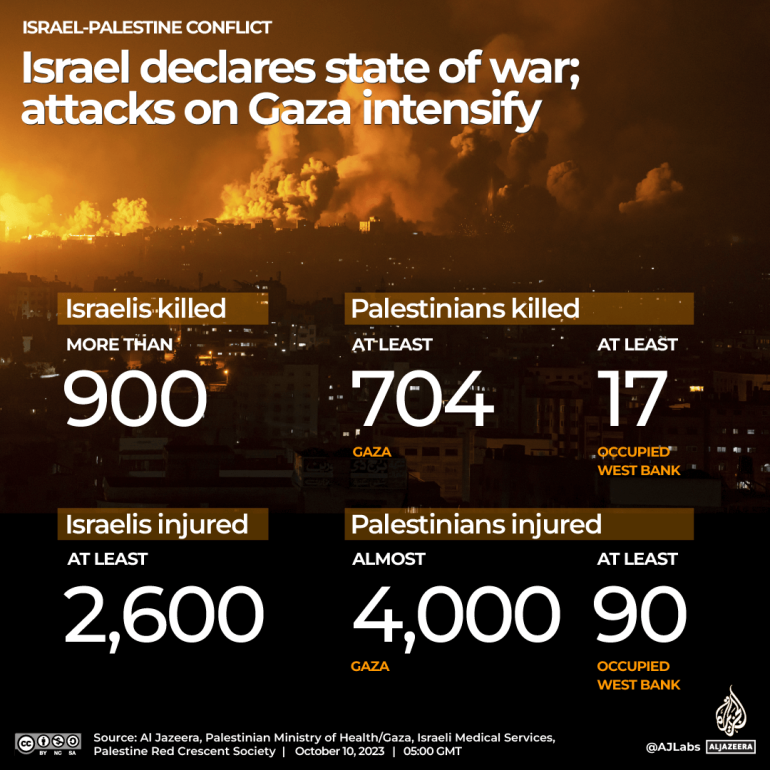
The warning from Hamas came on Monday as the death toll from the armed group’s surprise weekend attack climbed to 900 in Israel and revenge attacks by Israeli forces on the besieged Gaza Strip killed more than 700 people and left some 3,700 others wounded.
Residential apartment blocks, hospitals, schools and a mosque have been among the sites attacked by Israeli fighter jets, artillery and drones, according to media reports and witnesses.
Hamas spokesperson Abu Ubaida issued the threat to kill Israelis from the dozens held captive by the armed group. He said an Israeli hostage would be killed for every Israeli bombing of a civilian house without warning.
Israeli Foreign Minister Eli Cohen said more than 100 people were taken captive by Hamas during the deadly cross-border incursion over the weekend.
As Israeli forces conducted intense retaliatory attacks on Gaza on Monday, Israel’s Defence Minister Yoav Gallant drew international condemnation by announcing a total blockade of the densely populated and besieged enclave, which is home to 2.3 million people.
Gallant said Israel would impose a “complete siege” on Gaza. “No electricity, no food, no water, no gas – it’s all closed.”
United Nations Secretary-General Antonio Guterres said he was “deeply distressed” by the siege announcement and warned that Gaza’s already dire humanitarian situation will now “only deteriorate exponentially”.
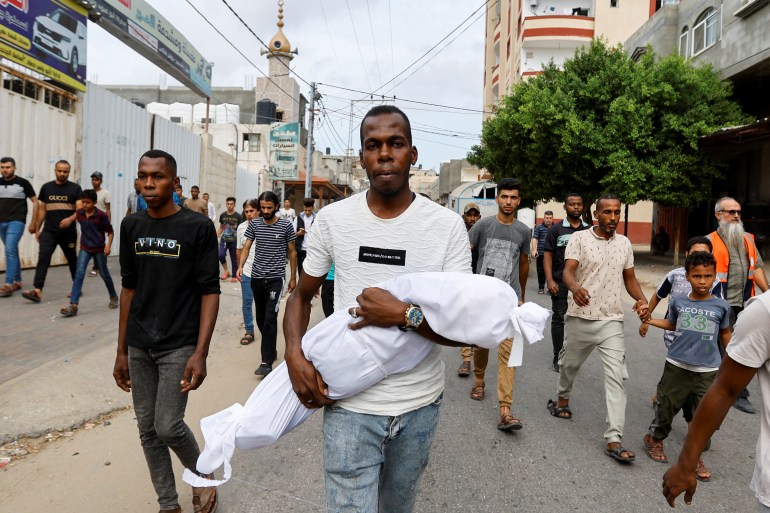
Guterres also said some 137,000 people were taking shelter with the UN Relief and Works Agency for Palestinian Refugees (UNRWA) at schools across Gaza.
UNRWA said on Tuesday that almost 190,000 people have been displaced in Gaza amid the Israeli attacks and the figure is expected to grow further as the violence intensifies.
Nearly half a million people have also not received food rations this week in Gaza as UN food distribution centres have been forced to remain closed amid the Israeli onslaught, UNRWA said.
Human Rights Watch said Israel’s total blockade on the necessities of life for everyday people in Gaza was a war crime.
“Defense Minister Gallant’s statements are abhorrent,” Omar Shakir, Israel and Palestine director at Human Rights Watch, said in a statement.
“Depriving the population in an occupied territory of food and electricity is collective punishment, which is a war crime, as is using starvation as a weapon of war. The International Criminal Court should take note of this call to commit a war crime,” he said.
Abhorrent. This is a call to commit a war crime by @yoavgallant. The @IntlCrimCourt should take note.
Quote by @OmarSShakir ⤵️ https://t.co/kKVo6YtpI1 pic.twitter.com/neHQMwnXVn
— Human Rights Watch (@hrw) October 9, 2023
Shakir also condemned the threat by Hamas to kill hostages, warning that such action was also a war crime.
“All hostages should be safely released to their families,” he said.
Grotesque. These threatened acts would amount to flagrant war crimes by Hamas’ armed wing. The @IntlCrimCourt will be watching.
Quote from @OmarSShakir ⤵️ https://t.co/FuNtvHe0YG pic.twitter.com/6cnHODLWyZ
— Human Rights Watch (@hrw) October 9, 2023
On the diplomatic front, Egyptian President Abdel Fattah el-Sisi and his Turkish counterpart Recep Tayyip Erdogan called on Hamas and Israel to immediately end violence and protect civilians, the Egyptian presidency said.
Erdogan urged Israel against “indiscriminately” attacking civilians and delivered measured criticism of Hamas, urging both sides to respect the “ethics” of war.
The United Kingdom, French, German, Italian and US governments issued a joint statement on Monday recognising the “legitimate aspirations” of the Palestinian people and supporting equal measures of justice and freedom for Israelis and Palestinians alike.
But the prospect that fighting could spread also alarmed the region and the world.
Lebanese armed group Hezbollah fired rockets into northern Israel in response to at least three of its members being killed in Israeli shelling of Lebanon.
Israel said one of its deputy commanders was also killed in an earlier cross-border raid from Lebanon.

US President Joe Biden holds a bilateral meeting with Israeli Prime Minister Benjamin Netanyahu on the sidelines of the 78th United Nations General Assembly in New York City, the US, September 20, 2023
Social media users, including journalists and observers, are calling out what they call a ‘double standard’.
After Saturday’s surprise attack by the Palestinian group Hamas on Israel, Ukrainian President Volodymyr Zelenskyy took to the social media platform X to offer “condolences go out to everyone who lost relatives or close ones in the terrorist attack”.
He also stated, “Israel’s right to self-defence is unquestionable.”
Many world leaders, including US President Joe Biden and UK Prime Minister Rishi Sunak, shared similar sentiments.
The world is seeing appalling images.
Thousands of rockets raining down on Israeli cities. Hamas terrorists killing not only Israeli soldiers, but civilians on the streets and in their homes.
It’s unconscionable. Israel has a right to defend itself – full stop.
— President Biden (@POTUS) October 7, 2023
European Commission President Ursula von der Leyen stated, “Israel has the right to defend itself – today and in the days to come. The European Union stands with Israel.”
Accusations of Western ‘double standards’
Some social media users have criticised these statements, saying they highlight a double standard.
The world is seeing appalling images.
Thousands of rockets raining down on Israeli cities. Hamas terrorists killing not only Israeli soldiers, but civilians on the streets and in their homes.
It’s unconscionable. Israel has a right to defend itself – full stop.
— President Biden (@POTUS) October 7, 2023
Ukraine’s right to defend itself is praised by most international leaders while Russia’s invasion is condemned, but commentators said the same cannot be said about Israel’s occupation of the West Bank and Gaza.
Aaron Bastani, a leftist British journalist, said on X that there’s a “clear double standard in endorsing terrorism against civilian targets in Ukraine … and condemning it by Palestinians”.
Many users said Western diplomats and media support the Ukrainians who defend their land, but label the Palestinians fighting against Israel as “terrorists”.
https://twitter.com/KhaledBeydoun/status/1710787817415082349?ref_src=twsrc%5Etfw%7Ctwcamp%5Etweetembed%7Ctwterm%5E1710787817415082349%7Ctwgr%5E6acf829869e993177f32aa38aa48c02f38cb7f61%7Ctwcon%5Es1_&ref_url=https%3A%2F%2Fwww.aljazeera.com%2Fnews%2F2023%2F10%2F9%2Fwestern-leaders-accused-of-hypocrisy-over-response-to-palestine-ukraine
An illustration of a woman’s face, in which one eye is closed beside a Palestinian flag, and one eye open beside a Ukrainian flag, has been regularly shared as a symbol of the West’s alleged double standards in how the two conflicts are viewed.
https://twitter.com/OnlinePalEng/status/1710994682883273172?ref_src=twsrc%5Etfw%7Ctwcamp%5Etweetembed%7Ctwterm%5E1710994682883273172%7Ctwgr%5E6acf829869e993177f32aa38aa48c02f38cb7f61%7Ctwcon%5Es1_&ref_url=https%3A%2F%2Fwww.aljazeera.com%2Fnews%2F2023%2F10%2F9%2Fwestern-leaders-accused-of-hypocrisy-over-response-to-palestine-ukraine
Clips also emerged on social media from a CNN interview with Mustafa Barghouti, the general secretary of the Palestinian National Initiative, in which he posed the rhetorical question, “Why does the United States support Ukraine in fighting occupation – while here they support the occupier, who continues to occupy us?”
The hypocrisy and double standards of western governments and media platforms dealing with situations in Ukraine-Russia and Palestine-Israel blow the mind. Absolute disgrace.
— Said Yacoubi (@AlyacoubiSaid) October 8, 2023
It is not the first time Western nations have been accused of double standards in their stance on the Ukraine war.
Earlier in the year, Amnesty International published a report highlighting the West’s “double standards” on global human rights.
Agnes Callamard, Amnesty’s secretary-general, told Al Jazeera at the time that the occupation of Palestinian territory was a “particularly important one”.
“Without making any comparison between Russia’s aggression and Israel … it is clear the Palestinian people are under a regime of oppression – a regime of occupation and a regime of apartheid,” Callamard told Al Jazeera.
Over the last three days, X users recirculated earlier statements calling out what they called Western hypocrisy, sharing video by the Irish lawmaker Richard Boyd Barrett from March 2022 in which he berated the Irish government’s double standards regarding Ukraine and Palestine:
“You’re happy to use the most strong and robust language to describe the crimes against humanity of [Russian President] Vladimir Putin, but you will not use the same strength of language when it comes to describing Israel’s treatment of the Palestinians.”
Barrett on Sunday again called out what he described as “shocking double standards of Western leaders supporting Ukraine resistance but condemning Palestinian[s].”
Meanwhile, others warned against comparing conflicts.
https://twitter.com/denfordauthor/status/1710993737738768607?ref_src=twsrc%5Etfw%7Ctwcamp%5Etweetembed%7Ctwterm%5E1710993737738768607%7Ctwgr%5E6acf829869e993177f32aa38aa48c02f38cb7f61%7Ctwcon%5Es1_&ref_url=https%3A%2F%2Fwww.aljazeera.com%2Fnews%2F2023%2F10%2F9%2Fwestern-leaders-accused-of-hypocrisy-over-response-to-palestine-ukraine
And some cautioned that Hamas and the Palestinians should not be seen as one and the same.
Just to clarify:
Palestine did not mount an attack on Israel. An Iranian proxy militia did. Palestinians are by and large huddled in their homes praying that an Israeli airstrike won't kill them or theirs. Hamas is the culprit here. This isn't a decentralized grassroots thing.
— Romeo Kokriatski (@VagrantJourno) October 9, 2023
Ukrainian footballer Oleksandr Zinchenko, who plays for Arsenal, posted on Instagram, stating he “stands with Israel”.
Zinchenko has been a vocal supporter of his home country in its ongoing defence against Russia, and he participated in a Game4Ukraine charity match in London earlier this year to raise money for Ukraine.
After online backlash, with some questioning an alleged double standard in his support of Israel, the footballer removed the post and switched his social media account to private.
Several people claimed that Zinchenko’s football club, in not responding to his comments, was guilty of hypocrisy after they had distanced themselves from former player Mesut Ozil’s comments in 2019 over alleged human rights abuses against Uighur Muslims in China.
-
 Audio10 years ago
Page – Day Break Everywhere Burst
-
 Audio5 years ago
Shadykarz – Forever
-
 Audio10 years ago
Juniorboy ft. 9ice – IRAPADA
-
 Entertainment Gists6 years ago
Ex-Beauty Queen, Sandra Benede Shares Sexy Photo
-
 Audio5 years ago
Simi – Happy Birthday ft. Adekunle Gold, DeJa
-
 Audio5 years ago
Ruger – Bounce
-
 Mixtapes4 years ago
Mixtape: DJ DimpleNipple – The Best Of Amapiano Thrills
-
 Editorials3 years ago
Sa’eedah Imam On Creating Her Imprint In The Nigerian Music Industry As An Emerging Creative Writer