

My mum called it. Long before planes had been grounded. Long before hospitals became places to fear. Long before 2020 had become a byword for all that was wrong – the worst year ever.
Back then, China and cruise-ships remained the epicentres of the outbreak. We spoke with naïve optimism of track and tracing rather than blanket lockdowns. But when I booked tickets for my family to spend Easter in Britain, my mum thought the chances of us making the trans-Atlantic journey were slim.
Her prophecy, of course, turned out to be prescient; and my response would soon come to sound ridiculous: “Mum, they can’t shut down the entire world.”
My sense early on was that 2020 would go down in history, but as the year when we finally awoke to the enormity of the climate emergency. The Australian bushfires that dominated the New Year headlines were the kind of catastrophic event that would separate the past and the future into the before and the after.
The images coming out of Sydney were jolting and alarming: of the shells of the Opera House shrouded in smoke; of the residents of one of the planet’s most liveable cities going about their daily lives wearing masks.
Soon, however, those pieces of fabric would appear in every city on every continent, as a guard against a different kind of respiratory threat. The mask not only became an emblem of the year, but also of a frightening new age.

We had entered what were billed as the roaring Twenties with muffled mouths, and a sense of inner dread. Dystopian films and literature, of the kind that became strangely popular at the start of the pandemic, ask of us the question, could it happen here? 2020 provided the answer. Yes.
It was a year when time seemed to collapse in on itself; when days were sometimes hard to tell apart; when weeks seemed to merge; when timelines seemed constantly to shift. Life would return to normal in a matter of weeks, we first thought.
Then months. Or maybe it would be years.
In the meantime, we adapted to the new reality, turning living rooms into offices and bedrooms into classrooms. For many, the morning commute came to be measured in metres not miles. And many didn’t even have to travel that far. Our workplaces could often fit neatly in the palms of our disinfected hands.
Covid brought about a new casualness – of dressing from the waist up, or of not getting dressed at all. And in a time of such stringent protocols, many of us relaxed our self-imposed restraints. Monday night drinking was no longer such a taboo. Chocolate flew off the supermarket shelves almost as quickly as toilet paper. Guilty pleasures no longer came with so much guilt. We sought comfort where we could get it, and often we weren’t allowed to travel far to find it.
The handshake was banished, and so, too, were hugs, at the very moment when we needed them most. In this time of enforced estrangement, heavy with so much sadness and bereavement, maybe all of us have suffered a form of affection deficit disorder.

Yet the paradox of social distancing was that it engendered a new intimacy. Many of us have spent more time with our immediate families. And perhaps the privatisation of our lives has made us more outgoing. Maybe you’ve shared the same experience of reconnecting with people you hadn’t heard from for years, sometimes even decades.
Online reunions became a form of virtual refuge. In seeking out long lost friends from the past, we briefly escaped the present. Nostalgia of the nationalistic kind has become such a driver of modern-day politics, but this was about personal reminiscence – evoking the days when we could travel together, watch sport crowded shoulder-to-shoulder in the stands, sit in the same pews at weddings and funerals.
From our mask-covered mouths came a new vocabulary – a patois of the pandemic. New terms such as social distancing. New verbs, such as “to zoom.” New colloquialisms, such as “to Facewine”. Then there were the new pastimes. Men of a certain age felt the need to experiment with artisanal bread, and to digitally document every loaf they baked on social media.

But what I’m describing here is Covid viewed from the lofty vantage point of privilege, the coronavirus lifestyle of the fortunate few.
For millions of families, 2020 wasn’t the year of the sourdough, but rather the time they struggled to put bread on the table. Here in New York, we saw immigrant families queuing for five hours to receive the most meagre of rations – a sandwich and a pot of apple sauce.
In the suburbs, we saw middle-class families waiting all day for a food parcel in their high-end cars – BMWs, Mercedes, upmarket SUVs. On the subway, we watched homeless people turn carriages into dormitories, such was their fear of spending the night in overcrowded shelters. Just as poverty became a propagator of the pandemic, the pandemic became a propagator of poverty.
It was a year when we’ve been forced to act locally, but have been reminded constantly of the global picture – hospitals in northern Italy that looked like something out of a Renaissance hell-scape; the Pope peering out from his balcony on to an empty St Peter’s Square; the medievalism of those mass graves in New York.
But at a time when the world cried out for multilateralism, we’ve witnessed unilateralism on steroids. The search for new drugs and treatments has sometimes resembled the Cold War space race. We’ve been introduced to the concept of “vaccine nationalism,” where governments focus myopically on inoculating their own people at the cost of the global good.
In its 75th year, the United Nations has largely been sidelined, its Security Council paralysed once more by the great power rivalry between Washington and Beijing. But neither of the world’s strongest nations, the United States or China, had the ability or the inclination to assert global leadership individually.
As for the World Health Organization, the UN’s lead agency, it became ensnared in pandemic politics, facing criticism that it wasn’t tough enough on China, and hit by the withdrawal of funding from Washington, its largest donor.
There was a strong body of evidence to suggest that countries run by female leaders handled the crisis more expertly. Angela Merkel’s Germany, Jacinda Ardern’s New Zealand, Tsai Ing-wen’s Taiwan, and Mette Frederiksen’s Denmark.
By contrast, countries governed by presidents and prime ministers who had surfed the populist wave with a macho swagger often did poorly. Donald Trump’s America, Jair Bolsonaro’s Brazil, and Boris Johnson’s Britain. The virus could not be sloganeered away.

The year 2020 also reminded us that national stereotypes often save time. Germany did well. Australia and New Zealand not only benefited from their geographic isolation, but also from smoothly functioning bureaucracies. South Korea underscored what anyone who has stepped off a plane in Seoul over the past decade will have known already – it has become a model of 21st century efficiency, a bureaucratic as well as cultural powerhouse.
In the balance of global power, 2020 has seen a shifting of the plates. To watch America’s response was to witness its national decline play out in real-time. The Trump administration’s management of the outbreak may come to be seen as the most catastrophic domestic policy failure of the past 100 years.
Covid exposed so many of America’s long-term ailments: the debilitation of its government, the downgrading of the science, the decline of reason, the politicisation of everything, the emergence of two duelling realities, one based in fact, the other in science-less fiction.

Conversely, the effects of a virus that originated in China seem only to have emboldened Beijing. Just watch the way it has recently flexed its muscles against Australia, whose crime in the minds of Xi Jinping was to lead calls for an international inquiry into the causes of Covid-19. If this is to be the Chinese century, then the “China virus”, as Donald Trump called it, will have hastened its march towards pre-eminence, if only because of its crippling effect on America.
Covid has shone a spotlight on other trans-national threats. As well as a pandemic, the world has contended with an infodemic. We’ve been confronted by the metastasising effect of misinformation, the scourge of the online world.

And what of globalisation? There’s been a lot of talk of the death of worldwide interconnectedness. But it feels like a re-run of the “end of history” thesis in the 1990s, the premature celebration of the triumph of western liberal democracy. Just as globalisation went into top gear after the defeat of Soviet communism, it would come as no surprise if it returned to maximum velocity after the taming of the coronavirus.
From a personal perspective, I find it impossible to look back on 2020 as the worst year ever. Even though my wife and I were infected with the virus. Even though one night in particular we feared the ambulance sirens we heard ceaselessly outside our windows would soon be at our door.
Because only a matter of months later, in the same bedroom where she had struggled to draw enough breath to finish a sentence, Fleur gave birth to our baby daughter, Honor. Our Covid baby. Our curfew baby, born while anti-racism protests were swirling in the streets down below. Our 2020 baby.
So these have been seasons of intense and conflicted emotions. Of dread and desire; of fear and joy. Forever we will remember 2020, mindful of those who lost their lives, thankful for the magic of new life, and grateful for making it to the end.
CREDIT: BBC






Dozens of Palestinians killed in overnight Israeli strikes in central and south Gaza as Red Sea tensions rise.
Here’s how things stand on Monday, January 15, 2024:
Latest updates and human impact
- Israeli attacks continue unabated overnight killing and wounding dozens of civilians in central and southern Gaza. At least 22 people were killed and a large number injured as a result of Israeli forces targeting al-Thalatheni Street in the central Gaza Strip.
- Yemen’s Houthi rebels fired an antiship cruise missile toward an American destroyer in the Red Sea, which was shot down by a US fighter jet, announced US Central Command (CENTCOM) on X.
- This was the first US-acknowledged Houthi attack since the US strikes on Yemen on Friday.
- Hamas released a 37-second video showing three Israeli captives held in Gaza on Sunday, saying they would reveal the fate of the captives on Monday and urging the Israeli government to stop the offensive.
- The Israeli military says it has shifted to a new phase of the war focused on the southern end of Gaza, where almost 2 million internally displaced Palestinians are running out of safe spaces to shelter.
- The Gaza Ministry of Health has said almost 24,000 people have been killed in the Israeli offensive. More than 60,000 people have been wounded in 100 days of war.
Diplomacy
- Israeli Prime Minister Benjamin Netanyahu said on Sunday that his country will pursue its war against Hamas until victory and will not be stopped by anyone, including the International Court of Justice (ICJ).
- The White House said on Sunday that “it’s the right time” for Israel to scale back its military offensive in the Gaza Strip.
- Egypt’s State Information Service (SIS) said in a statement on Sunday that one of the biggest obstacles to the timely delivery of sufficient aid to Gaza was Israeli inspection of the aid. The statement came after Israel blamed Cairo for the delay in aid delivery to Gaza during its defence at the ICJ.
- US Secretary of State Antony Blinken posted on X on Monday, calling for the release of the remaining captives held in Gaza on the 100th day since they were taken by Hamas. He did not mention the Palestinian casualties.
- Australia’s Foreign Minister Penny Wong, who described herself as a “friend of Israel” to the press, will travel to Jordan, Israel, the occupied Palestinian Territories and the United Arab Emirates this week, her office said on Monday.
West Bank raids and violence
- Israeli forces arrested 25 students staging a sit-in in protest against high tuition fees at An-Najah University in Nablus. Al Jazeera’s Hamdah Salhut reported that the protesting students received a text message from Israeli forces telling them to “surrender now”.
- Israeli forces have reportedly raided the family home of Nael al-Barghouti, the longest-serving Palestinian prisoner, in the village of Kobar, in Ramallah, in the occupied West Bank.
- The Israeli army said on Friday that it killed three Palestinian men who infiltrated a West Bank settlement and fired upon soldiers.
- The Israeli military killed two Palestinians after accusing them of ramming their car through a checkpoint near Hebron.
- Local sources reported that Israeli forces bulldozed two Palestinian-owned houses during a Sunday midnight raid in the city of Qalqilya, Palestinian news agency Wafa reported.
- Armed Israeli settlers broke into the village of Burin, south of Nablus, and attacked Palestinian residents’ houses and properties after midnight on Sunday, Wafa reported.
- “Violent raids and arrests have become part of the fabric of daily life in the occupied West Bank,” Al Jazeera’s Mohammed Jamjoom, reporting from Ramallah in the occupied West Bank, said. At least 347 Palestinians have been killed and thousands have been arrested since October 7.

Flames and smoke billow during Israeli attacks against Gaza on October 9, 2023
Human Rights Watch terms Israeli Defence Minister Yoav Gallant’s call for a ‘complete siege’ on Gaza a ‘war crime’.
The Hamas movement has threatened to kill an Israeli hostage every time Israel bombs a Palestinian home without warning as Israel mobilised some 300,000 reservists and imposed a total blockade of the Gaza Strip, denying the enclave’s millions of residents access to food, water and fuel.
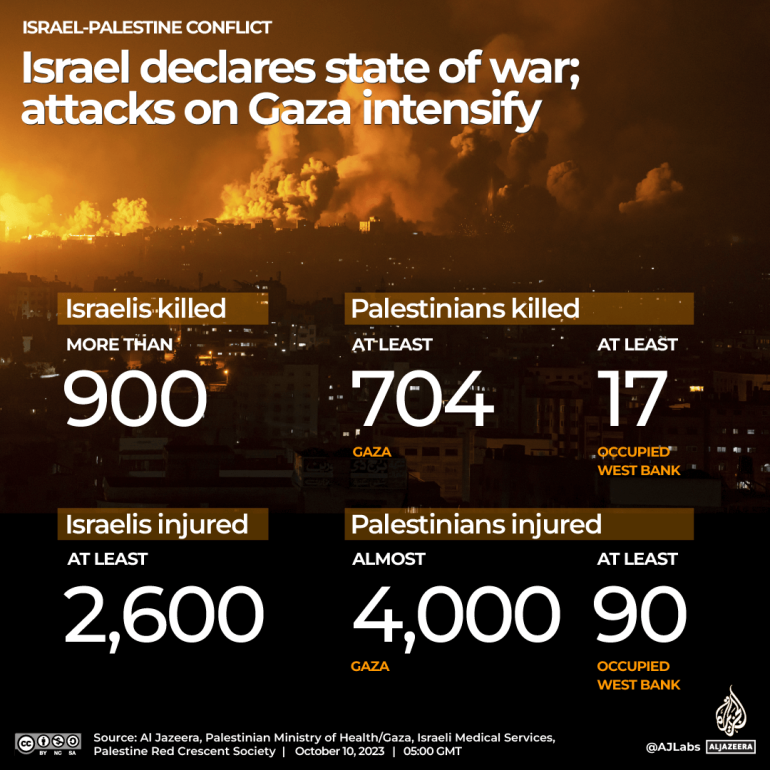
The warning from Hamas came on Monday as the death toll from the armed group’s surprise weekend attack climbed to 900 in Israel and revenge attacks by Israeli forces on the besieged Gaza Strip killed more than 700 people and left some 3,700 others wounded.
Residential apartment blocks, hospitals, schools and a mosque have been among the sites attacked by Israeli fighter jets, artillery and drones, according to media reports and witnesses.
Hamas spokesperson Abu Ubaida issued the threat to kill Israelis from the dozens held captive by the armed group. He said an Israeli hostage would be killed for every Israeli bombing of a civilian house without warning.
Israeli Foreign Minister Eli Cohen said more than 100 people were taken captive by Hamas during the deadly cross-border incursion over the weekend.
As Israeli forces conducted intense retaliatory attacks on Gaza on Monday, Israel’s Defence Minister Yoav Gallant drew international condemnation by announcing a total blockade of the densely populated and besieged enclave, which is home to 2.3 million people.
Gallant said Israel would impose a “complete siege” on Gaza. “No electricity, no food, no water, no gas – it’s all closed.”
United Nations Secretary-General Antonio Guterres said he was “deeply distressed” by the siege announcement and warned that Gaza’s already dire humanitarian situation will now “only deteriorate exponentially”.
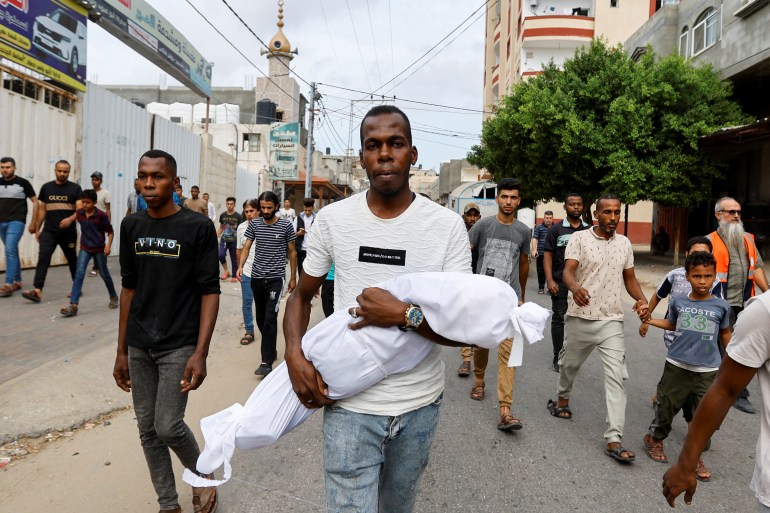
Guterres also said some 137,000 people were taking shelter with the UN Relief and Works Agency for Palestinian Refugees (UNRWA) at schools across Gaza.
UNRWA said on Tuesday that almost 190,000 people have been displaced in Gaza amid the Israeli attacks and the figure is expected to grow further as the violence intensifies.
Nearly half a million people have also not received food rations this week in Gaza as UN food distribution centres have been forced to remain closed amid the Israeli onslaught, UNRWA said.
Human Rights Watch said Israel’s total blockade on the necessities of life for everyday people in Gaza was a war crime.
“Defense Minister Gallant’s statements are abhorrent,” Omar Shakir, Israel and Palestine director at Human Rights Watch, said in a statement.
“Depriving the population in an occupied territory of food and electricity is collective punishment, which is a war crime, as is using starvation as a weapon of war. The International Criminal Court should take note of this call to commit a war crime,” he said.
Abhorrent. This is a call to commit a war crime by @yoavgallant. The @IntlCrimCourt should take note.
Quote by @OmarSShakir ⤵️ https://t.co/kKVo6YtpI1 pic.twitter.com/neHQMwnXVn
— Human Rights Watch (@hrw) October 9, 2023
Shakir also condemned the threat by Hamas to kill hostages, warning that such action was also a war crime.
“All hostages should be safely released to their families,” he said.
Grotesque. These threatened acts would amount to flagrant war crimes by Hamas’ armed wing. The @IntlCrimCourt will be watching.
Quote from @OmarSShakir ⤵️ https://t.co/FuNtvHe0YG pic.twitter.com/6cnHODLWyZ
— Human Rights Watch (@hrw) October 9, 2023
On the diplomatic front, Egyptian President Abdel Fattah el-Sisi and his Turkish counterpart Recep Tayyip Erdogan called on Hamas and Israel to immediately end violence and protect civilians, the Egyptian presidency said.
Erdogan urged Israel against “indiscriminately” attacking civilians and delivered measured criticism of Hamas, urging both sides to respect the “ethics” of war.
The United Kingdom, French, German, Italian and US governments issued a joint statement on Monday recognising the “legitimate aspirations” of the Palestinian people and supporting equal measures of justice and freedom for Israelis and Palestinians alike.
But the prospect that fighting could spread also alarmed the region and the world.
Lebanese armed group Hezbollah fired rockets into northern Israel in response to at least three of its members being killed in Israeli shelling of Lebanon.
Israel said one of its deputy commanders was also killed in an earlier cross-border raid from Lebanon.

US President Joe Biden holds a bilateral meeting with Israeli Prime Minister Benjamin Netanyahu on the sidelines of the 78th United Nations General Assembly in New York City, the US, September 20, 2023
Social media users, including journalists and observers, are calling out what they call a ‘double standard’.
After Saturday’s surprise attack by the Palestinian group Hamas on Israel, Ukrainian President Volodymyr Zelenskyy took to the social media platform X to offer “condolences go out to everyone who lost relatives or close ones in the terrorist attack”.
He also stated, “Israel’s right to self-defence is unquestionable.”
Many world leaders, including US President Joe Biden and UK Prime Minister Rishi Sunak, shared similar sentiments.
The world is seeing appalling images.
Thousands of rockets raining down on Israeli cities. Hamas terrorists killing not only Israeli soldiers, but civilians on the streets and in their homes.
It’s unconscionable. Israel has a right to defend itself – full stop.
— President Biden (@POTUS) October 7, 2023
European Commission President Ursula von der Leyen stated, “Israel has the right to defend itself – today and in the days to come. The European Union stands with Israel.”
Accusations of Western ‘double standards’
Some social media users have criticised these statements, saying they highlight a double standard.
The world is seeing appalling images.
Thousands of rockets raining down on Israeli cities. Hamas terrorists killing not only Israeli soldiers, but civilians on the streets and in their homes.
It’s unconscionable. Israel has a right to defend itself – full stop.
— President Biden (@POTUS) October 7, 2023
Ukraine’s right to defend itself is praised by most international leaders while Russia’s invasion is condemned, but commentators said the same cannot be said about Israel’s occupation of the West Bank and Gaza.
Aaron Bastani, a leftist British journalist, said on X that there’s a “clear double standard in endorsing terrorism against civilian targets in Ukraine … and condemning it by Palestinians”.
Many users said Western diplomats and media support the Ukrainians who defend their land, but label the Palestinians fighting against Israel as “terrorists”.
https://twitter.com/KhaledBeydoun/status/1710787817415082349?ref_src=twsrc%5Etfw%7Ctwcamp%5Etweetembed%7Ctwterm%5E1710787817415082349%7Ctwgr%5E6acf829869e993177f32aa38aa48c02f38cb7f61%7Ctwcon%5Es1_&ref_url=https%3A%2F%2Fwww.aljazeera.com%2Fnews%2F2023%2F10%2F9%2Fwestern-leaders-accused-of-hypocrisy-over-response-to-palestine-ukraine
An illustration of a woman’s face, in which one eye is closed beside a Palestinian flag, and one eye open beside a Ukrainian flag, has been regularly shared as a symbol of the West’s alleged double standards in how the two conflicts are viewed.
https://twitter.com/OnlinePalEng/status/1710994682883273172?ref_src=twsrc%5Etfw%7Ctwcamp%5Etweetembed%7Ctwterm%5E1710994682883273172%7Ctwgr%5E6acf829869e993177f32aa38aa48c02f38cb7f61%7Ctwcon%5Es1_&ref_url=https%3A%2F%2Fwww.aljazeera.com%2Fnews%2F2023%2F10%2F9%2Fwestern-leaders-accused-of-hypocrisy-over-response-to-palestine-ukraine
Clips also emerged on social media from a CNN interview with Mustafa Barghouti, the general secretary of the Palestinian National Initiative, in which he posed the rhetorical question, “Why does the United States support Ukraine in fighting occupation – while here they support the occupier, who continues to occupy us?”
The hypocrisy and double standards of western governments and media platforms dealing with situations in Ukraine-Russia and Palestine-Israel blow the mind. Absolute disgrace.
— Said Yacoubi (@AlyacoubiSaid) October 8, 2023
It is not the first time Western nations have been accused of double standards in their stance on the Ukraine war.
Earlier in the year, Amnesty International published a report highlighting the West’s “double standards” on global human rights.
Agnes Callamard, Amnesty’s secretary-general, told Al Jazeera at the time that the occupation of Palestinian territory was a “particularly important one”.
“Without making any comparison between Russia’s aggression and Israel … it is clear the Palestinian people are under a regime of oppression – a regime of occupation and a regime of apartheid,” Callamard told Al Jazeera.
Over the last three days, X users recirculated earlier statements calling out what they called Western hypocrisy, sharing video by the Irish lawmaker Richard Boyd Barrett from March 2022 in which he berated the Irish government’s double standards regarding Ukraine and Palestine:
“You’re happy to use the most strong and robust language to describe the crimes against humanity of [Russian President] Vladimir Putin, but you will not use the same strength of language when it comes to describing Israel’s treatment of the Palestinians.”
Barrett on Sunday again called out what he described as “shocking double standards of Western leaders supporting Ukraine resistance but condemning Palestinian[s].”
Meanwhile, others warned against comparing conflicts.
https://twitter.com/denfordauthor/status/1710993737738768607?ref_src=twsrc%5Etfw%7Ctwcamp%5Etweetembed%7Ctwterm%5E1710993737738768607%7Ctwgr%5E6acf829869e993177f32aa38aa48c02f38cb7f61%7Ctwcon%5Es1_&ref_url=https%3A%2F%2Fwww.aljazeera.com%2Fnews%2F2023%2F10%2F9%2Fwestern-leaders-accused-of-hypocrisy-over-response-to-palestine-ukraine
And some cautioned that Hamas and the Palestinians should not be seen as one and the same.
Just to clarify:
Palestine did not mount an attack on Israel. An Iranian proxy militia did. Palestinians are by and large huddled in their homes praying that an Israeli airstrike won't kill them or theirs. Hamas is the culprit here. This isn't a decentralized grassroots thing.
— Romeo Kokriatski (@VagrantJourno) October 9, 2023
Ukrainian footballer Oleksandr Zinchenko, who plays for Arsenal, posted on Instagram, stating he “stands with Israel”.
Zinchenko has been a vocal supporter of his home country in its ongoing defence against Russia, and he participated in a Game4Ukraine charity match in London earlier this year to raise money for Ukraine.
After online backlash, with some questioning an alleged double standard in his support of Israel, the footballer removed the post and switched his social media account to private.
Several people claimed that Zinchenko’s football club, in not responding to his comments, was guilty of hypocrisy after they had distanced themselves from former player Mesut Ozil’s comments in 2019 over alleged human rights abuses against Uighur Muslims in China.
-
 Audio10 years ago
Page – Day Break Everywhere Burst
-
 Audio5 years ago
Shadykarz – Forever
-
 Audio10 years ago
Juniorboy ft. 9ice – IRAPADA
-
 Entertainment Gists6 years ago
Ex-Beauty Queen, Sandra Benede Shares Sexy Photo
-
 Audio5 years ago
Simi – Happy Birthday ft. Adekunle Gold, DeJa
-
 Audio5 years ago
Ruger – Bounce
-
 Mixtapes4 years ago
Mixtape: DJ DimpleNipple – The Best Of Amapiano Thrills
-
 Editorials3 years ago
Sa’eedah Imam On Creating Her Imprint In The Nigerian Music Industry As An Emerging Creative Writer