
News
Israel-Palestine Conflict: A Brief History in Maps And Charts


As Gaza reels from Israel’s devastating bombardments, here’s a brief history of the conflict using maps and charts.
Israel’s deadly bombardment of Gaza has killed nearly 15,000 people, including 10,000 women and children, in over 50 days, making it the deadliest war for the besieged Palestinian enclave till date.
Israel has rebuffed calls for a ceasefire as a four-day humanitarian truce comes to an end on November 28. It is unclear whether the truce will be extended.
The devastation of Gaza and the mounting death toll has triggered worldwide protests, bringing the decades-long issue to the centre-stage of global politics.
The Balfour declaration
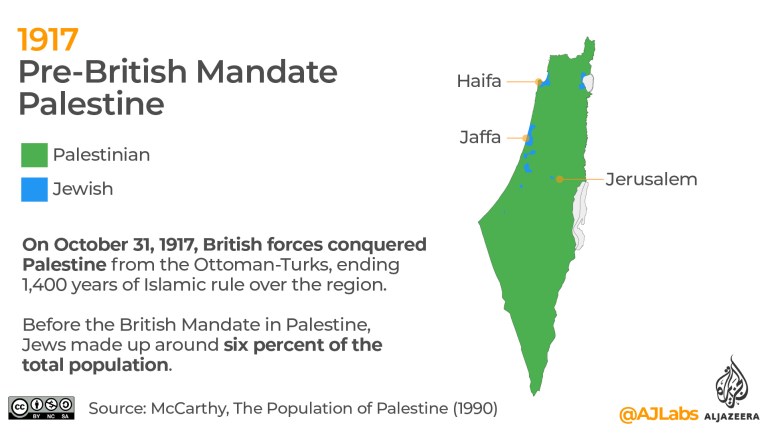
The Israeli-Palestinian issue goes back nearly a century when Britain, during World War I, pledged to establish a national home for the Jewish people in Palestine under the Balfour Declaration. British troops took control of the territory from the Ottoman Empire at the end of October 1917.
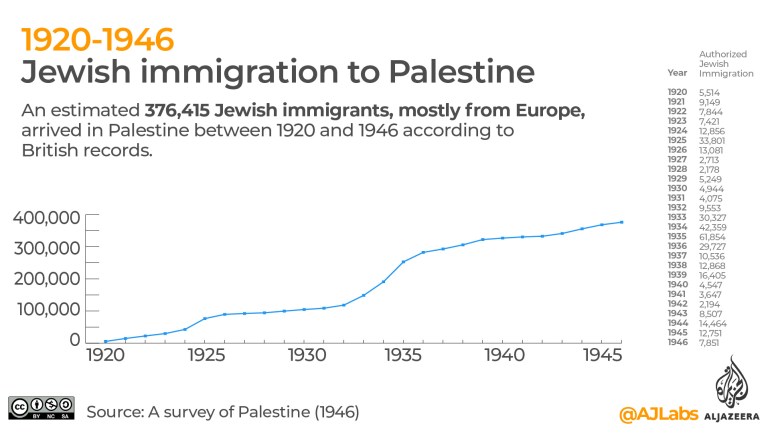
Jewish immigration to Palestine
A large-scale Jewish migration to Palestine began, accelerated by Jewish people fleeing Nazism in Europe. Between 1918 and 1947, the Jewish population in Palestine increased from 6 percent to 33 percent.
Palestinians were alarmed by the demographic change and tensions rose, leading to the Palestinian revolt from 1936 to 1939.
Meanwhile, Zionist organisations continued to campaign for a homeland for Jews in Palestine. Armed Zionist militias started to attack the Palestinian people, forcing them to flee. Zionism, which emerged as a political ideology in the late 19th century, called for the creation of a Jewish homeland.
The UN Partition Plan
As violence ravaged Palestine, the matter was referred to the newly formed United Nations. In 1947, the UN adopted Resolution 181, which called for the partition of Palestine into Arab and Jewish states, handing over about 55 percent of the land to Jews. Arabs were granted 45 percent of the land, while Jerusalem was declared a separate internationalised territory.

The city is currently divided between West Jerusalem, which is predominantly Jewish, and East Jerusalem with a majority Palestinian population. Israel captured East Jerusalem after the Six-Day War in 1967 along with the West Bank – a step not recognised by the international community.
The Old City in occupied East Jerusalem holds religious significance for Christians, Muslims, and Jews. It is home to Al-Aqsa Mosque compound, which is known to Muslims as al-Haram al-Sharif and to Jews as Temple Mount.
In 1981, the UN designated it a World Heritage Site.

The Nakba
Leading up to Israel’s birth in 1948, more than 750,000 Palestinians were ethnically cleansed from their homes by Zionist militias. This mass exodus came to be known as the Nakba or catastrophe.
A further 300,000 Palestinians were displaced by the Six-Day War in 1967.


Israel declared the annexation of East Jerusalem in 1980, but the international community still considers it an occupied territory. Palestinians want East Jerusalem as the capital of their future state.
The Oslo Accords
In 1993, Palestinian leader Yasser Arafat and Israeli Prime Minister Yitzhak Rabin signed the Oslo Accords, which aimed to achieve peace within five years. It was the first time the two sides recognised each other.
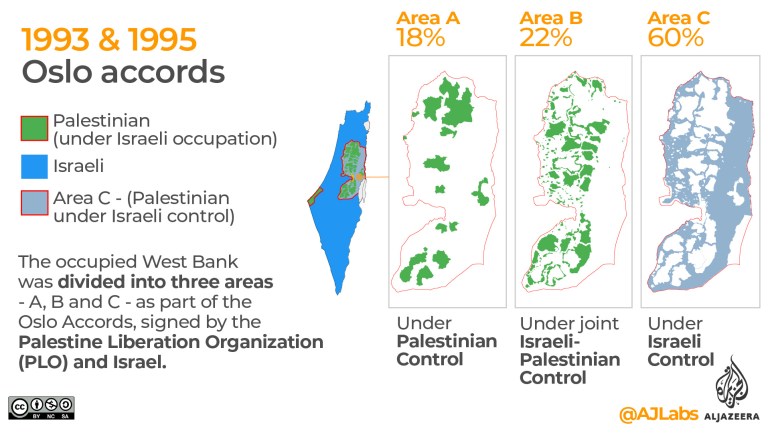
A second agreement in 1995 divided the occupied West Bank into three parts – Area A, B and C. The Palestinian Authority, which was created in the wake of the Oslo Accords, was offered only limited rule on 18 percent of the land as Israel effectively continued to control the West Bank.
Israeli settlements and checkpoints
However, the Oslo Accords slowly broke down as Israeli settlements, Jewish communities built on Palestinian land in the West Bank, grew at a rapid pace.
The settlement population in the West Bank and East Jerusalem grew from approximately 250,000 in 1993 to up to 700,000 in September this year. About three million Palestinians live in the occupied West Bank and East Jerusalem.

The building of Israeli settlements and a separation wall on occupied territories has fragmented the the Palestinian communities and restricted their mobility. About 700 road obstacles, including 140 checkpoints, dot the West Bank. About 70,000 Palestinians with Israeli work permits cross these checkpoints in their daily commute.
Settlements are considered illegal under international law. The UN has condemned settlements, calling it a big hurdle in the realisation of a viable Palestinian state as part of the so-called “two-state solution”.

Blockade of Gaza
Israel imposed a blockade on Gaza in 2007 after the Hamas group came to power. The siege continues till date. Israel also occupies the West Bank and East Jerusalem – the territories Palestinians want to be part of their future state.
Israel imposed a total blockade on the Gaza Strip on October 9, cutting its supplies of electricity, food, water, and fuel in the wake of a surprise Hamas attack inside Israel. At least 1,200 people were killed in that attack.

Israel and Palestine now
This is what Israel and Palestine look like now.

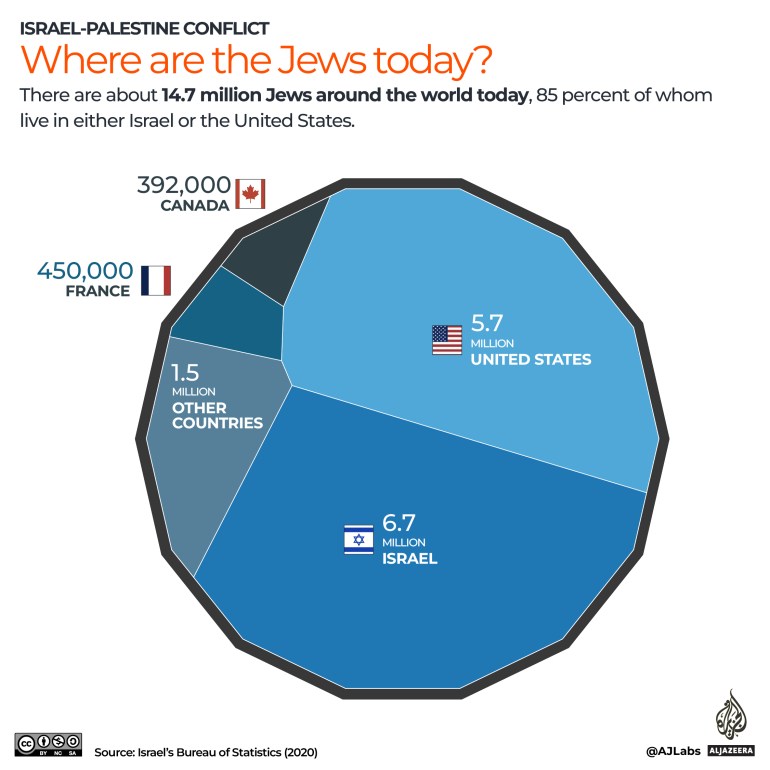
Today, about 5 million Palestinians live in Gaza, the West Bank and East Jerusalem and 1.6 million Palestinians are citizens of Israel. This makes up about half of their total population. The other half lives in other countries, including Arab countries. There are about 14.7 million Jews around the world today, of which 84 percent live in Israel and the United States. The rest live in other countries including France, Canada, Argentina and Russia.

Here is an account of Palestinian and Israeli lives lost to the violence between 2008 and 2023.

Data compiled by Sarah Shamim






itel, the technology empowerment brand for masses, officially unveiled its new product A300+, brand’s first interactive dual-screen smartphone in its price range. itel A300+ comes with a comprehensive set of features — a 7000mAh marathon battery, IP65 military-grade durability, and satellite communication capability, demonstrating that innovation and complete product strength can coexist at an accessible price point.

A First-of-Its-Kind Rear Screen Experience: Interactive Innovation for a New Generation
itel A300+ coming with an interactive rear display is a rare feature in this price category, designed to deliver a smart entertainment experience for young generations. Far from being a cosmetic gimmick, the rear screen provides practical functions built around real everyday scenarios. Users can frame selfies using the higher-quality rear camera with a live preview on the back screen, glance at incoming messages and alerts without waking the main display, and play, pause, or skip tracks directly from the rear screen. The rear display also supports customizable clocks, photos, and designs, giving users a personal window to express their individual style. Complementing the rear screen, the A300+ features a 6.78-inch immersive punch-hole main display, offering a cleaner, more expansive viewing experience for streaming, gaming, browsing, and social media.

Performance and Value in Balance: Delivering Fresh Technology Despite Industry Pressure
Even amid rising industry costs, itel has chosen to bring fresh technology to its products while continuously improving performance and keeping pricing accessible. The A300+ is powered by a 7000mAh marathon battery engineered for long-term reliability, supporting up to 1,200 charging cycles — far exceeding the industry standard, and designed to retain healthy capacity. AI Charging Protection intelligently manages charging patterns to reduce battery degradation, while Smart Power Management optimizes power consumption across apps and hardware to extend usage time between charges.

The device also features 300% ultra-volume DTS stereo speakers, delivering rich, room-filling sound for music, videos, FM radio, and everyday entertainment. Built to withstand daily life and beyond, the A300+ carries IP65 water and dust resistance certification and meets military-grade durability standards, resisting splashes, dust, and accidental drops. Notably, the A300+ includes satellite communication capability, ensuring users can still send basic messages via satellite when cellular networks are unavailable — a safety net in remote areas, during natural disasters, or in other critical situations, setting it apart in its price segment.

The A300+ is built on a clear product philosophy, rather than relying on a single headline feature, it combines its key strengths into one complete product story. The rear screen captures attention first, while battery life, durability, and practical usability make the overall value proposition convincing. With the A300+, itel once again demonstrates its commitment to using innovation to meet the needs and desire for novelty among young users in emerging markets.
The itel A300+ is available in two variants: the 64GB ROM and 128GB ROM and they are both available in all phone retail stores in Nigeria or via online store HERE


DJ ROBOT teams up with TMP OFFISIAL and FATEOFTHEYOUTH for NDSM DELUXE, a new DJ mixtape that expands the world of NDSM — No Dey Stress Me into a bigger, more energetic listening experience.
Built around DJ ROBOT’s approach to sequencing, mixing, and controlling energy, NDSM DELUXE transforms the NDSM mindset into a full sonic journey. The mixtape explores nightlife, pressure, temptation, confidence, freedom, desire, and the decision to simply refuse to let life overwhelm you.
Bringing together DJ ROBOT’s DJ-driven vision with the creative energy of TMP OFFISIAL and FATEOFTHEYOUTH, the deluxe edition adds new dimensions to the original NDSM message while maintaining its central philosophy: No Dey Stress Me.
Rather than simply extending the original project, NDSM DELUXE is designed as an experience — moving through different moods, rhythms, and moments while allowing each transition to contribute to the story.
For DJ ROBOT, the project represents an opportunity to communicate through energy as much as words.
“The original NDSM had more energy and stories to explore. I wanted to take the ‘No Dey Stress Me’ mindset beyond the song and turn it into a full DJ experience — something that captures nightlife, freedom, pressure, temptation, and the moments when you simply choose to enjoy yourself and live in the present.”
Listen below;

Nigerian artist N8TAN is set to unveil his highly anticipated ‘UPRISING EP’, a body of work that chronicles his journey from the streets to the heights of his musical ambition.
Built around themes of struggle, resilience, ambition, survival, and triumph, UPRISING captures the realities of an artist determined to turn adversity into momentum. The project reflects N8TAN’s experiences, the challenges that shaped him, and the relentless drive that continues to push him forward.
More than a collection of songs, UPRISING is presented as a story of transformation—from navigating the streets and confronting uncertainty to finding purpose, embracing growth, and rising toward the top.
With its blend of raw storytelling, infectious energy, and personal perspective, the EP offers listeners an intimate look into N8TAN’s world while reinforcing his determination to carve out his own place in the music industry.
‘UPRISING EP’ is a statement of elevation: a reminder that where you start does not have to determine where you finish.
As N8TAN continues to build his musical identity, UPRISING marks another significant chapter in his journey—and an invitation for listeners to rise with him.
-
 Audio10 years ago
Page – Day Break Everywhere Burst
-
 Audio5 years ago
Shadykarz – Forever
-
 Audio10 years ago
Juniorboy ft. 9ice – IRAPADA
-
 Entertainment Gists6 years ago
Ex-Beauty Queen, Sandra Benede Shares Sexy Photo
-
 Audio5 years ago
Simi – Happy Birthday ft. Adekunle Gold, DeJa
-
 Audio5 years ago
Ruger – Bounce
-
 Mixtapes4 years ago
Mixtape: DJ DimpleNipple – The Best Of Amapiano Thrills
-
 Editorials3 years ago
Sa’eedah Imam On Creating Her Imprint In The Nigerian Music Industry As An Emerging Creative Writer