
News
Israel-Hamas Truce: How Much Aid Has Entered Gaza?


Palestinians walk amid debris of buildings hit in Israeli raids, near al-Zawiya market in Gaza City on November 27, 2023
Aid has come in, some of it reaching north Gaza too. But it’s too little, warn humanitarian agencies.
As the truce between Israel and Hamas extends into its sixth day, aid groups are warning that the war-battered Gaza Strip is on the brink of a full-scale humanitarian crisis.
After nearly two months of Israeli bombardment of Gaza, the “humanitarian pause” was brokered to allow the release of Israeli captives in exchange for Palestinian prisoners. As part of the agreement, more humanitarian aid has been allowed into the Palestinian enclave that has been under near-total siege.
But while United Nations agencies and groups like the Palestine Red Crescent Society have been able to scale up aid entering the enclave through the Rafah border crossing with Egypt, the temporary increase has been insufficient to meet the now critical needs of Gaza’s population of 2.3 million, nearly 80 percent of which is now displaced.
Here’s a breakdown of the aid that Gaza needs, and what it is receiving — even during the truce.
What has the truce changed?
The humanitarian pause began at 7am local time on Friday. Initially brokered for four days, it was extended on Tuesday for two days, which will expire on Thursday morning. As of Tuesday night, Hamas had released 81 of the 240 hostages taken captive while Israel had freed about 180 Palestinian prisoners.
Aid distribution efforts had previously stalled, with agencies warning that perishables were spoiling at the Egyptian border. Now, amid the logistic chaos of the renewed flows, they have been able to deliver limited assistance to the population.
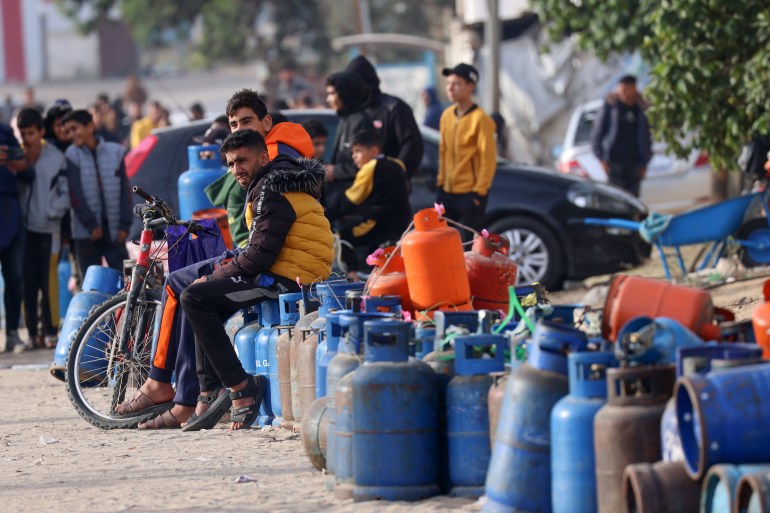
How much aid is entering Gaza
Reporting for Al Jazeera from the southern town of Khan Younis, Hind Khoudary said on Tuesday that at least 750 trucks had crossed the Rafah border into Gaza since Friday.
That works out to roughly 150 trucks per day.
However, on Monday, the UN Relief and Works Agency for Palestine Refugees (UNRWA) told Al Jazeera that 200 trucks of aid would be needed daily over a period of two months to meet the population’s basic needs. Much more fuel is needed to enable the UN agency to power vital services such as sewage treatment plants and water desalination plants.
Even that — 200 trucks a day — falls far short of what Gaza, under a land, sea and air siege by Israel since 2007, was receiving before October 7. Before the current war, 500 aid trucks would enter Gaza daily on average, according to the United Nations Office for the Coordination of Humanitarian Affairs (OCHA).
Last week, Oxfam described the pause as “a band-aid to a bleeding wound”.
What is the humanitarian situation?
The war has devastated Gaza, killing nearly 15,000 people, with at least 6,800 presumed dead under the rubble. Tens of thousands of injured people have suffered due to medical shortages. While the truce has enabled Palestinians in the besieged enclave a little breathing space and some respite from the constant din of drones and warplanes, the humanitarian situation is dire.
Israel’s war has split the territory of 2.3 million people in two. As its attacks on the north intensified, the Israeli military forced people to move south, where supplies of food, fuel and water have been scarce.
International NGO ActionAid said deliveries were largely limited to the south, where 1.8 million people are now displaced. “For many women propping up households and facing more mouths to feed in Gaza’s overstretched shelters, renewed pauses will not come anywhere near close to helping improve the situation they’re facing,” said the NGO.
Al Jazeera’s Khoudary said: “[Palestinian] people are starving, they are striving to find food in the supermarkets and people don’t have the basic needs to continue and to help themselves to survive from starvation…”
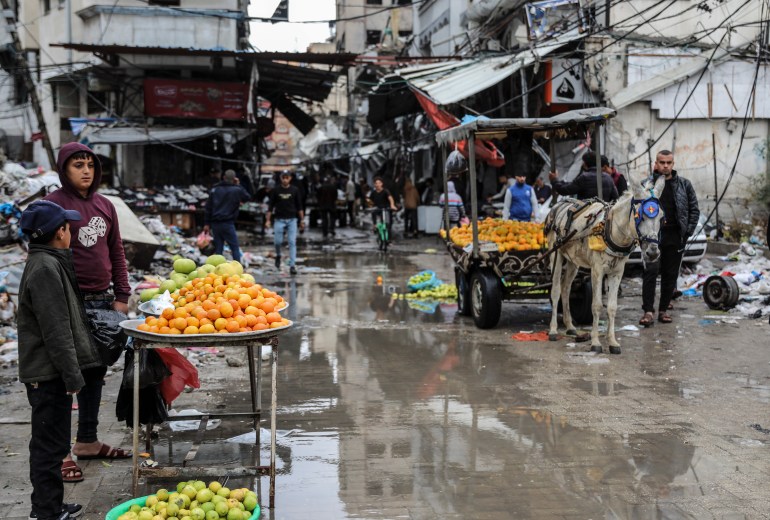
OCHA said aid had reached heavily damaged northern areas, where many have remained – including vulnerable groups such as the elderly, injured and disabled people – amid intense air raids on homes, schools and hospitals. But it acknowledged that most of the assistance had reached only Gaza’s south.
The situation in the north remains dangerous, with concerns about dehydration and outbreaks of disease.
Deliveries of fuel to the north have been severely restricted by Israeli forces. The Kamal Adwan Hospital, the only medical facility still operating in the zone, has been starved of supplies necessary for operations.
“If the hospital is not supplied with fuel within hours, the department is at risk of losing those in it, including premature babies, under our care,” Dr Hossam Abu Safiya, head of the paediatric intensive care department, told Al Jazeera.
On Sunday, Cindy McCain, director of the UN World Food Programme, said the entire enclave was “on the brink of famine”. “This is something that … will spread. And with that comes disease and … everything else that you can imagine,” she told CBS, the US network.
What next?
As the truce inches to a possible end, residents fear the bombing will resume.
Israel, which is intent on obliterating Hamas’s presence in the enclave, has been briefing that the armed group has a command and control centre in southern Gaza.
While the south has been dubbed a “safe zone”, the Israeli military had repeatedly attacked Khan Younis prior to the truce. People in the south had been ordered to move towards a slice of the territory, called Muwasi, along the coast.
Stephane Dujarric, spokesperson for UN chief Guterres, said negotiations must continue so that the truce in Gaza could be upgraded to a full humanitarian ceasefire. “This aid barely registers against the huge needs” of Gaza, he said.







Josh2Funny’s Album Has Fans Talking — But Should He Stick To Music Or Skits? 😂🎶

Nigerian comedian and content creator Josh2Funny has taken his comedy game into music, and Nigerians are definitely having something to say about it.
The comedian released his 15-track album, “On Behalf of Josh,” on July 10, 2026, but instead of fading away after release, the project has continued to generate conversations on X.
And the big question now is:
Should Josh2Funny continue with music or go back to skits? 😂
Fans have been divided. While some listeners openly criticized the album and told him to return to comedy, others found songs they genuinely enjoyed.

One X user joked:
“Josh2Funny stopped doing skits and started music, Everybody wan chop this music money 😂”
Another simply said:
“This Josh2Funny Album no enter make he just go back skit abeg 😂”
But then came “Lembe.” 🔥
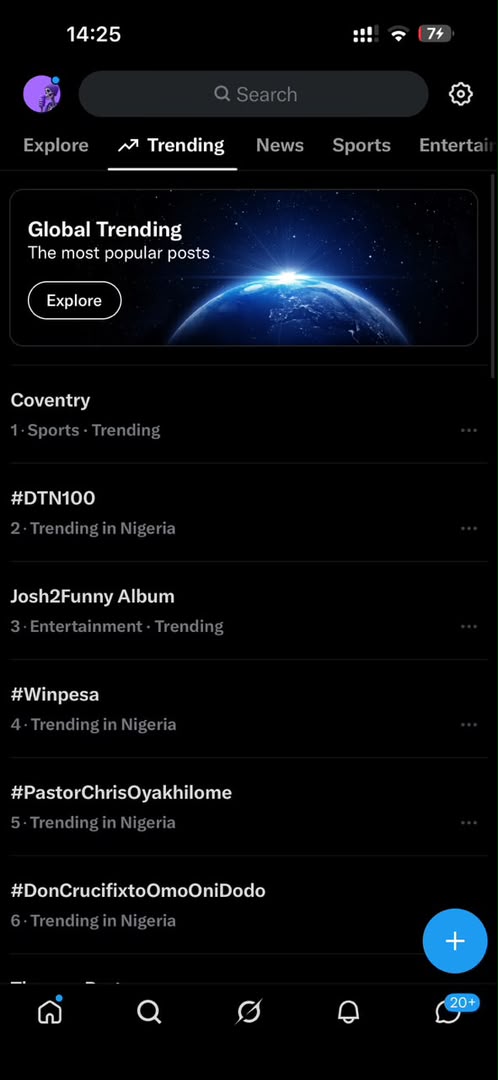
The track caught fire on X and eventually became a trending topic in Nigeria. The #LembeChallenge also gained momentum as creators began jumping on the song.
Josh2Funny later announced ₦1 million for winners of the challenge, giving the song another major push.
And it didn’t stop there.
‘INTERNATIONAL’ FT. ICE PRINCE ALSO TRENDED
On another day, “International” featuring Ice Prince generated its own buzz on X.
One fan even called it their favourite song from the album, while praising the collaboration. The post itself pulled thousands of views, showing that people weren’t only talking about Lembe.
From album criticism to trending songs and challenges, “On Behalf of Josh” has kept Josh2Funny’s name in the conversation.
Whether you love the album or think he should return to skits, one thing is clear:
Josh2Funny has succeeded in getting Nigerians talking. 😂🔥

So, let’s settle this once and for all:
Should Josh2Funny continue with MUSIC 🎶 or return to SKITS 😂?
Music or Skits? Drop your answer! 👇


East Ham, East London — 8 August 2026: The vibrant Igbo community in the UK came together for an unforgettable evening of entertainment, culture and social connection at Igbotic Game Night, one of the biggest social gatherings celebrating the Igbo community in the United Kingdom.
Among the night’s standout moments was an electrifying performance by Afrobeats artist Obeena, who took the stage and immediately captured the attention of the crowd.
Obeena delivered performances of two of his hit songs, “Wara Wara” and “Banging,” bringing his energetic sound and distinctive stage presence to the event. From the opening moments of his set, fans responded with excitement, singing along, dancing and enthusiastically supporting the artist.

His performance of “Wara Wara” created an instant connection with the audience, while “Banging” took the energy to another level. Obeena’s ability to engage the crowd transformed his set into one of the most memorable entertainment moments of the evening.
Held in East Ham, East London, on 8 August 2026, Igbotic Game Night provided a unique platform for members of the Igbo community to celebrate their heritage while enjoying music, games and social interaction. Events such as this continue to play an important role in bringing together Nigerians and the wider African diaspora in the UK.
For Obeena, the performance was another opportunity to showcase his growing artistry and connect directly with fans. His energetic delivery, stage confidence and ability to command the audience demonstrated why his live performances continue to attract attention.
By the end of his set, Obeena had left the crowd amazed and added another memorable chapter to his journey as an Afrobeats artist. His appearance at Igbotic Game Night was not simply a performance—it was a celebration of Nigerian music, culture and community.
With performances like this, Obeena continues to demonstrate his ambition to take his sound beyond the studio and onto major stages, connecting with audiences through music, energy and an unmistakable African identity.
Igbotic Game Night brought the Igbo community together. Obeena gave them a performance to remember.
-
 Audio10 years ago
Page – Day Break Everywhere Burst
-
 Audio5 years ago
Shadykarz – Forever
-
 Audio10 years ago
Juniorboy ft. 9ice – IRAPADA
-
 Entertainment Gists6 years ago
Ex-Beauty Queen, Sandra Benede Shares Sexy Photo
-
 Audio5 years ago
Simi – Happy Birthday ft. Adekunle Gold, DeJa
-
 Audio5 years ago
Ruger – Bounce
-
 Mixtapes4 years ago
Mixtape: DJ DimpleNipple – The Best Of Amapiano Thrills
-
 Editorials3 years ago
Sa’eedah Imam On Creating Her Imprint In The Nigerian Music Industry As An Emerging Creative Writer