

The UK’s mobile providers are being banned from buying new Huawei 5G equipment after 31 December, and they must also remove all the Chinese firm’s 5G kit from their networks by 2027.
Digital Secretary Oliver Dowden told the House of Commons of the decision.
It follows sanctions imposed by Washington, which claims the firm poses a national security threat – something Huawei denies.
Mr Dowden said the move would delay the country’s 5G rollout by a year.
He added that the cumulative cost of this, and earlier restrictions announced against Huawei earlier in the year, would be up to £2bn.
“This has not been an easy decision, but it is the right one for the UK telecoms networks, for our national security and our economy, both now and indeed in the long run,” he said.
Because the US sanctions only affect future equipment, the government has been advised there is no security justification for removing 2G, 3G and 4G equipment supplied by Huawei.
However, when swapping out the company’s masts, networks are likely to switch to a different vendor to provide the earlier-generation services.
Huawei said the move was: “Bad news for anyone in the UK with a mobile phone” and threatened to “move Britain into the digital slow lane, push up bills and deepen the digital divide.”
New restrictions are also being applied to use of the company’s broadband kit.
The government has also been advised operators should “transition away” from purchasing new Huawei equipment for use in the full-fibre network, ideally within the next two years.
Mr Dowden said the government would “embark on a short technical consultation” with operators about this.
He explained that the UK needed to avoid becoming dependent on Nokia as the single supplier of some equipment, and he wanted to avoid “unnecessary delays” to the government’s gigabit-for-all by 2025 pledge.
The action, however, does not affect Huawei’s ability to sell its smartphones to consumers or how they will run.
Chip concerns
The UK last reviewed Huawei’s role in its telecoms infrastructure in January, when it was decided to let the firm remain a supplier but introduced a cap on its market share.
But in May the US introduced new sanctions designed to disrupt Huawei’s ability to get its own chips manufactured.
This led security officials to conclude they could no longer assure the security of its products if the company had to start sourcing chips from third-parties for use in its equipment.
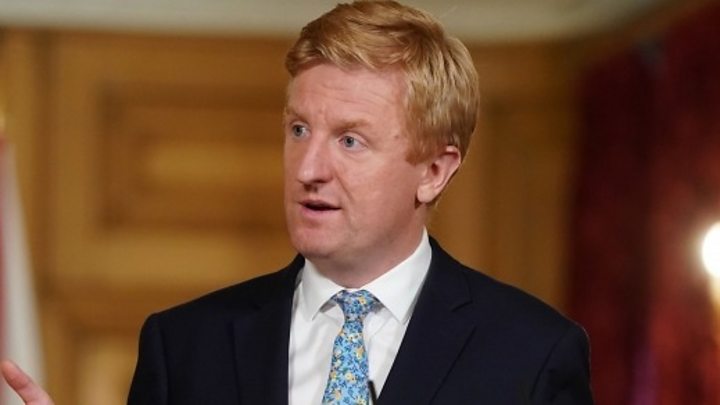
The minister cited a review carried out by GCHQ’s National Cyber Security Centre as being the motivation for the changes.
“Huawei claims to have stockpiles of parts that they can use, but this obviously affects what the NCSC can say about their products going forward,” blogged Dr Ian Levy, the agency’s technical director.
“We think that Huawei products that are adapted to cope with the [sanctions] are likely to suffer more security and reliability problems because of the massive engineering challenge ahead of them, and it will be harder for us to be confident in their use within our mitigation strategy.”
But other political considerations are also likely to have also come into play including the UK’s desire to strike a trade deal with the US, and growing tensions with China over its handling of the coronavirus outbreak and its treatment of Hong Kong.
Some backbench Tory MPs had pressed for a shorter time-span for its removal, in particular there had been calls for the 5G ban to come into effect before the next election in May 2024.
However, Mr Dowden said that “the shorter we make the timetable for removal, the greater the risk of actual disruption to mobile phone networks”.
BT and Vodafone had warned that customers could face mobile blackouts if they were forced to remove all of Huawei’s 5G kit in less time.

Hopes on the part of government that this decision may put the Huawei issue to bed may be optimistic.
The reason that we are here again despite a decision in January is because one of the key players – the US – played a new card in the form of sanctions.
And there is still time between now and legislation coming to parliament in Autumn for others to do the same – whether Conservative backbenchers or Beijing.
In the long run, many countries will be watching carefully how China reacts.
Will it feel it needs to punish the UK in order to discourage others from following its lead on 5G? Or will it want to avoid being seen as a bully and prefer to try and influence the decision more subtly. Whatever the case, the Huawei story in the UK is not over yet.
Chairman resigns
Huawei says it employs about 1,600 people in the UK and claims to be one of Britain’s largest sources of investment from China.
The firm – whose shares are not publicly traded – does not provide a regional breakdown of its earnings. But on Monday, it announced a 13% rise in sales for the first half of 2020 compared to the same period in 2019, totalling 454bn yuan ($64.8bn; £51.3bn).
The UK will have accounted for a fraction of that. The firm’s UK chief recently noted that Huawei had only deployed a total of 20,000 base stations in the UK so far, but by contrast expects to deliver a total of 500,000 globally this year.
Even so, what the firm fears and Washington hopes is that other countries will now follow Westminster’s lead with bans of their own.
Despite there seeming little chance of a U-turn, Huawei said it was still urging UK ministers to reconsider.
“We will conduct a detailed review of what today’s announcement means for our business here and will work with the UK government to explain how we can continue to contribute to a better connected Britain,” spokesman Ed Brewster said.
Shortly before the announcement Sky News revealed that Lord Browne, Huawei’s UK chairman and the ex-chief executive of BP, would be leaving the Chinese company before his term had expired. It said he had given his notice a few days ago and would formally step down in September.

Lord Browne had led efforts to improve the company’s image in the UK and had tried to prevent a ban.
“He has been central to our commitment here dating back 20 years, and we thank him for his valuable contribution,” said Huawei, confirming the report.
Industry reaction
BT is set to be the telecoms operator most affected by the decision given it runs both the EE mobile network and Openreach, which provides fixed-line infrastructure to individual internet providers.
“We need to further analyse the details and implications of this decision before taking a view of potential costs and impacts,” it said.
The move should, however, benefit Nokia and Ericsson, which are the two other main 5G kit vendors.
“We have the capacity and expertise to replace all of the Huawei equipment in the UK’s networks at scale and speed… with minimal impact on the people using our customers’ networks,” said Nokia.
Ericsson added: “Today’s decision removes the uncertainty that was slowing down investment decisions around the deployment of 5G in the UK… and we stand ready to work with the UK operators to meet their timetable.”
However, both firms manufacture some of their 5G equipment in China, which has also caused concern in Washington.
In June, the US Department of Defense published a list of 20 companies it claimed had close ties to the Chinese military.
It included Panda Electronics – the firm with which Ericsson jointly runs a manufacturing facility in the Chinese city of Nanjing.
“A lot of companies assemble equipment or have some type of manufacturing in China,” Ericsson’s head of corporate communications Peter Olofsson told the BBC, when asked about this.
“Our trade compliance people have looked at this [list] and they concluded that it’s not something that has an impact on Ericsson or our operations.”
Huawei’s UK research bases
One consequence of shunning Huawei is that it might lead the company to rethink its research and development investments in the country.
The firm has sponsored work at several universities including Imperial College, London, Southampton and Surrey.
In addition, it operates research centres of its own employing a total of 400 people in:
- Edinburgh
- Bristol
- Cambridge
- Ipswich
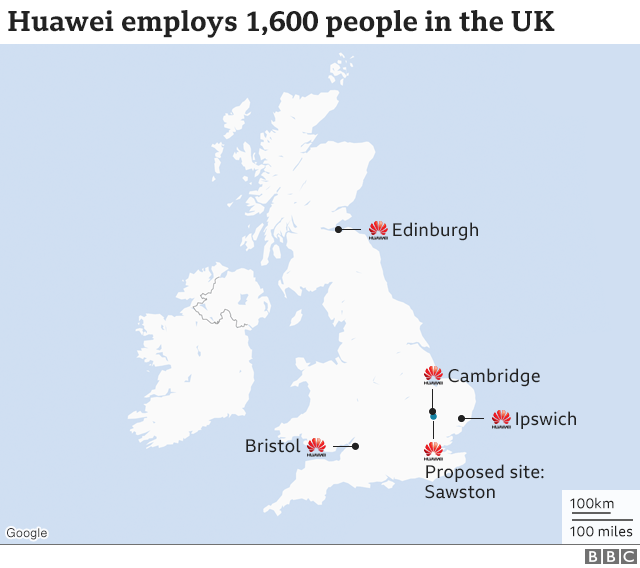

The company also recently gained planning permission to build a new £1bn research centre at Sawston – a large village to the south of Cambridge. It has said the development would create hundreds of further jobs.
But one expert said the new restrictions might not mean the project will be abandoned.
“The research centre in Cambridge has been many years in the planning, and may well be its future sourcing of important technologies within the global supply chain, so Huawei might want to keep it if it is allowed,” said Emily Taylor from the Chatham House think tank.
Where is Huawei’s kit used in UK?
Mobile networks can be divided into two parts: the core and the radio access network (Ran).
The core is likened to the brain and carries out the most sensitive operations, including authenticating users’ identities and making sure calls get sent to the right radio tower to connect to another person’s phone.
The Ran includes the base stations and antennas used to provide a link between individual mobile devices and the core. Insiders sometimes describe this as the “innovative but dumb” part of the network.

BT’s EE mobile network features Huawei in the core of its 4G and 5G networks, but the firm is in the process of replacing it with Ericsson’s products, and has promised to do so by the end of 2023.
Otherwise, the UK’s main mobile providers only use Huawei in the Ran, and then always as part of a mix with at least one other vendor:
- EE to provide 2G, 4G and 5G
- Vodafone to provide 2G, 3G, 4G and 5G
- Three to provide 4G and 5G
- O2 to provide 5G at a relatively small number of sites in London, where it tested the equipment before opting to go with other suppliers elsewhere
Huawei also provides broadband equipment to BT’s Openreach division, which owns the infrastructure used by other internet service providers (ISP), including Plusnet, Sky and TalkTalk.
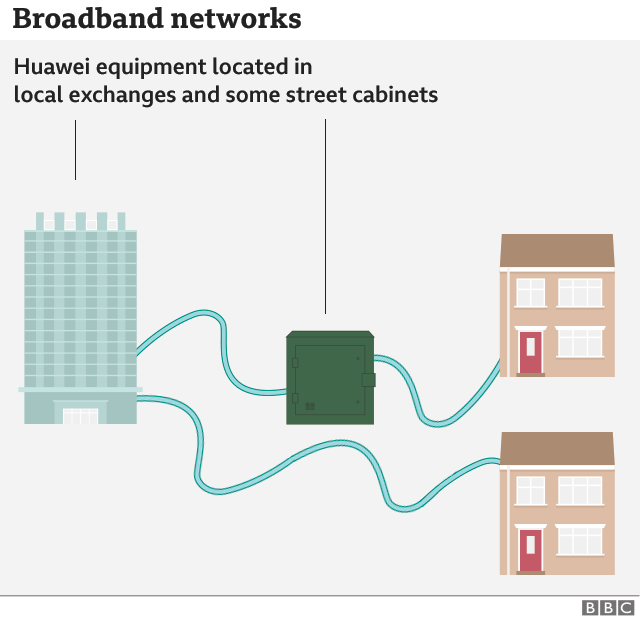
These days, the focus is on rolling out fibre-to-the-premises (FTTP) connections, which offer the fastest speeds and are key to delivering the government’s “gigabit for all” 2025 pledge.
In this case, Openreach uses Huawei’s kit at what it calls the “headend” – a gateway at local telephone exchanges that converts electrical signals to and from light-based ones, and makes sure each customer’s data is sent to the appropriate ISP.
Many people still get their internet via slower connections, which are routed via intermediary street cabinets.
About 70,000 of these cabinets contain Huawei’s kit, and the data also passes through more of the Chinese firm’s products at local exchanges.
Openreach does not, however, use Huawei’s equipment in its core.
Elsewhere, CityFibre – which runs its own smaller full-fibre networks – uses some Huawei gear as a legacy of an acquisition, but intends to strip it out by mid-2021.
Virgin Media does not use Huawei’s equipment within its broadband network.
But it does use it to provide telephone services, both for internet-based landline calls as well as to provide mobile phone subscriptions.
Other mobile virtual network operators (MVNOs) – including Sky Mobile and GiffGaff – also use Huawei’s gear.
It effectively sits between each MVNO and the mobile network whose infrastructure is used, and helps calculate customer bills, among other IT services.






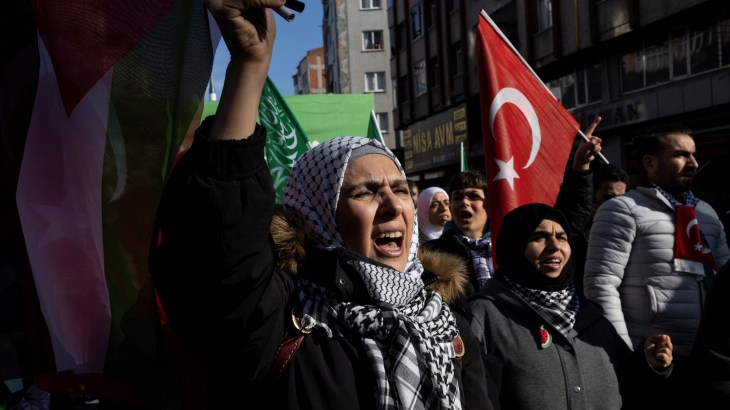
Dozens of Palestinians killed in overnight Israeli strikes in central and south Gaza as Red Sea tensions rise.
Here’s how things stand on Monday, January 15, 2024:
Latest updates and human impact
- Israeli attacks continue unabated overnight killing and wounding dozens of civilians in central and southern Gaza. At least 22 people were killed and a large number injured as a result of Israeli forces targeting al-Thalatheni Street in the central Gaza Strip.
- Yemen’s Houthi rebels fired an antiship cruise missile toward an American destroyer in the Red Sea, which was shot down by a US fighter jet, announced US Central Command (CENTCOM) on X.
- This was the first US-acknowledged Houthi attack since the US strikes on Yemen on Friday.
- Hamas released a 37-second video showing three Israeli captives held in Gaza on Sunday, saying they would reveal the fate of the captives on Monday and urging the Israeli government to stop the offensive.
- The Israeli military says it has shifted to a new phase of the war focused on the southern end of Gaza, where almost 2 million internally displaced Palestinians are running out of safe spaces to shelter.
- The Gaza Ministry of Health has said almost 24,000 people have been killed in the Israeli offensive. More than 60,000 people have been wounded in 100 days of war.
Diplomacy
- Israeli Prime Minister Benjamin Netanyahu said on Sunday that his country will pursue its war against Hamas until victory and will not be stopped by anyone, including the International Court of Justice (ICJ).
- The White House said on Sunday that “it’s the right time” for Israel to scale back its military offensive in the Gaza Strip.
- Egypt’s State Information Service (SIS) said in a statement on Sunday that one of the biggest obstacles to the timely delivery of sufficient aid to Gaza was Israeli inspection of the aid. The statement came after Israel blamed Cairo for the delay in aid delivery to Gaza during its defence at the ICJ.
- US Secretary of State Antony Blinken posted on X on Monday, calling for the release of the remaining captives held in Gaza on the 100th day since they were taken by Hamas. He did not mention the Palestinian casualties.
- Australia’s Foreign Minister Penny Wong, who described herself as a “friend of Israel” to the press, will travel to Jordan, Israel, the occupied Palestinian Territories and the United Arab Emirates this week, her office said on Monday.
West Bank raids and violence
- Israeli forces arrested 25 students staging a sit-in in protest against high tuition fees at An-Najah University in Nablus. Al Jazeera’s Hamdah Salhut reported that the protesting students received a text message from Israeli forces telling them to “surrender now”.
- Israeli forces have reportedly raided the family home of Nael al-Barghouti, the longest-serving Palestinian prisoner, in the village of Kobar, in Ramallah, in the occupied West Bank.
- The Israeli army said on Friday that it killed three Palestinian men who infiltrated a West Bank settlement and fired upon soldiers.
- The Israeli military killed two Palestinians after accusing them of ramming their car through a checkpoint near Hebron.
- Local sources reported that Israeli forces bulldozed two Palestinian-owned houses during a Sunday midnight raid in the city of Qalqilya, Palestinian news agency Wafa reported.
- Armed Israeli settlers broke into the village of Burin, south of Nablus, and attacked Palestinian residents’ houses and properties after midnight on Sunday, Wafa reported.
- “Violent raids and arrests have become part of the fabric of daily life in the occupied West Bank,” Al Jazeera’s Mohammed Jamjoom, reporting from Ramallah in the occupied West Bank, said. At least 347 Palestinians have been killed and thousands have been arrested since October 7.

Flames and smoke billow during Israeli attacks against Gaza on October 9, 2023
Human Rights Watch terms Israeli Defence Minister Yoav Gallant’s call for a ‘complete siege’ on Gaza a ‘war crime’.
The Hamas movement has threatened to kill an Israeli hostage every time Israel bombs a Palestinian home without warning as Israel mobilised some 300,000 reservists and imposed a total blockade of the Gaza Strip, denying the enclave’s millions of residents access to food, water and fuel.
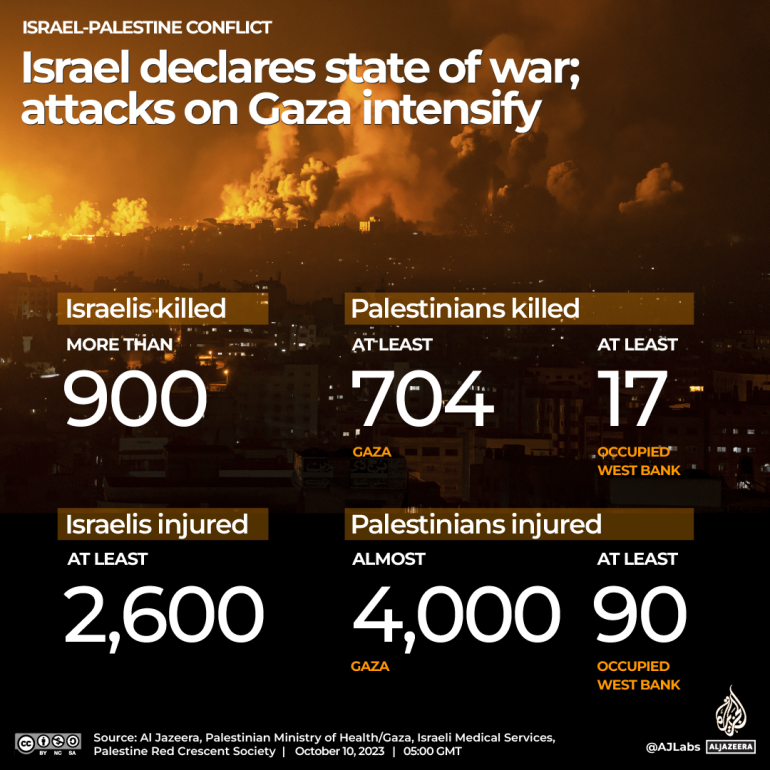
The warning from Hamas came on Monday as the death toll from the armed group’s surprise weekend attack climbed to 900 in Israel and revenge attacks by Israeli forces on the besieged Gaza Strip killed more than 700 people and left some 3,700 others wounded.
Residential apartment blocks, hospitals, schools and a mosque have been among the sites attacked by Israeli fighter jets, artillery and drones, according to media reports and witnesses.
Hamas spokesperson Abu Ubaida issued the threat to kill Israelis from the dozens held captive by the armed group. He said an Israeli hostage would be killed for every Israeli bombing of a civilian house without warning.
Israeli Foreign Minister Eli Cohen said more than 100 people were taken captive by Hamas during the deadly cross-border incursion over the weekend.
As Israeli forces conducted intense retaliatory attacks on Gaza on Monday, Israel’s Defence Minister Yoav Gallant drew international condemnation by announcing a total blockade of the densely populated and besieged enclave, which is home to 2.3 million people.
Gallant said Israel would impose a “complete siege” on Gaza. “No electricity, no food, no water, no gas – it’s all closed.”
United Nations Secretary-General Antonio Guterres said he was “deeply distressed” by the siege announcement and warned that Gaza’s already dire humanitarian situation will now “only deteriorate exponentially”.
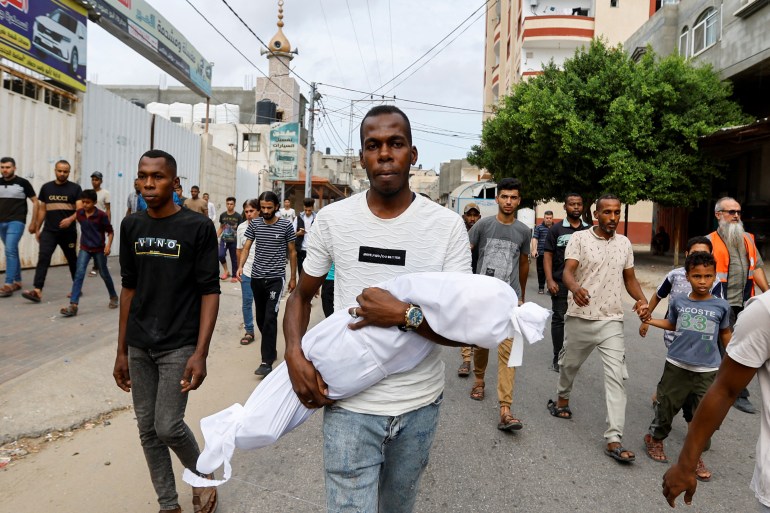
Guterres also said some 137,000 people were taking shelter with the UN Relief and Works Agency for Palestinian Refugees (UNRWA) at schools across Gaza.
UNRWA said on Tuesday that almost 190,000 people have been displaced in Gaza amid the Israeli attacks and the figure is expected to grow further as the violence intensifies.
Nearly half a million people have also not received food rations this week in Gaza as UN food distribution centres have been forced to remain closed amid the Israeli onslaught, UNRWA said.
Human Rights Watch said Israel’s total blockade on the necessities of life for everyday people in Gaza was a war crime.
“Defense Minister Gallant’s statements are abhorrent,” Omar Shakir, Israel and Palestine director at Human Rights Watch, said in a statement.
“Depriving the population in an occupied territory of food and electricity is collective punishment, which is a war crime, as is using starvation as a weapon of war. The International Criminal Court should take note of this call to commit a war crime,” he said.
Abhorrent. This is a call to commit a war crime by @yoavgallant. The @IntlCrimCourt should take note.
Quote by @OmarSShakir ⤵️ https://t.co/kKVo6YtpI1 pic.twitter.com/neHQMwnXVn
— Human Rights Watch (@hrw) October 9, 2023
Shakir also condemned the threat by Hamas to kill hostages, warning that such action was also a war crime.
“All hostages should be safely released to their families,” he said.
Grotesque. These threatened acts would amount to flagrant war crimes by Hamas’ armed wing. The @IntlCrimCourt will be watching.
Quote from @OmarSShakir ⤵️ https://t.co/FuNtvHe0YG pic.twitter.com/6cnHODLWyZ
— Human Rights Watch (@hrw) October 9, 2023
On the diplomatic front, Egyptian President Abdel Fattah el-Sisi and his Turkish counterpart Recep Tayyip Erdogan called on Hamas and Israel to immediately end violence and protect civilians, the Egyptian presidency said.
Erdogan urged Israel against “indiscriminately” attacking civilians and delivered measured criticism of Hamas, urging both sides to respect the “ethics” of war.
The United Kingdom, French, German, Italian and US governments issued a joint statement on Monday recognising the “legitimate aspirations” of the Palestinian people and supporting equal measures of justice and freedom for Israelis and Palestinians alike.
But the prospect that fighting could spread also alarmed the region and the world.
Lebanese armed group Hezbollah fired rockets into northern Israel in response to at least three of its members being killed in Israeli shelling of Lebanon.
Israel said one of its deputy commanders was also killed in an earlier cross-border raid from Lebanon.

US President Joe Biden holds a bilateral meeting with Israeli Prime Minister Benjamin Netanyahu on the sidelines of the 78th United Nations General Assembly in New York City, the US, September 20, 2023
Social media users, including journalists and observers, are calling out what they call a ‘double standard’.
After Saturday’s surprise attack by the Palestinian group Hamas on Israel, Ukrainian President Volodymyr Zelenskyy took to the social media platform X to offer “condolences go out to everyone who lost relatives or close ones in the terrorist attack”.
He also stated, “Israel’s right to self-defence is unquestionable.”
Many world leaders, including US President Joe Biden and UK Prime Minister Rishi Sunak, shared similar sentiments.
The world is seeing appalling images.
Thousands of rockets raining down on Israeli cities. Hamas terrorists killing not only Israeli soldiers, but civilians on the streets and in their homes.
It’s unconscionable. Israel has a right to defend itself – full stop.
— President Biden (@POTUS) October 7, 2023
European Commission President Ursula von der Leyen stated, “Israel has the right to defend itself – today and in the days to come. The European Union stands with Israel.”
Accusations of Western ‘double standards’
Some social media users have criticised these statements, saying they highlight a double standard.
The world is seeing appalling images.
Thousands of rockets raining down on Israeli cities. Hamas terrorists killing not only Israeli soldiers, but civilians on the streets and in their homes.
It’s unconscionable. Israel has a right to defend itself – full stop.
— President Biden (@POTUS) October 7, 2023
Ukraine’s right to defend itself is praised by most international leaders while Russia’s invasion is condemned, but commentators said the same cannot be said about Israel’s occupation of the West Bank and Gaza.
Aaron Bastani, a leftist British journalist, said on X that there’s a “clear double standard in endorsing terrorism against civilian targets in Ukraine … and condemning it by Palestinians”.
Many users said Western diplomats and media support the Ukrainians who defend their land, but label the Palestinians fighting against Israel as “terrorists”.
https://twitter.com/KhaledBeydoun/status/1710787817415082349?ref_src=twsrc%5Etfw%7Ctwcamp%5Etweetembed%7Ctwterm%5E1710787817415082349%7Ctwgr%5E6acf829869e993177f32aa38aa48c02f38cb7f61%7Ctwcon%5Es1_&ref_url=https%3A%2F%2Fwww.aljazeera.com%2Fnews%2F2023%2F10%2F9%2Fwestern-leaders-accused-of-hypocrisy-over-response-to-palestine-ukraine
An illustration of a woman’s face, in which one eye is closed beside a Palestinian flag, and one eye open beside a Ukrainian flag, has been regularly shared as a symbol of the West’s alleged double standards in how the two conflicts are viewed.
https://twitter.com/OnlinePalEng/status/1710994682883273172?ref_src=twsrc%5Etfw%7Ctwcamp%5Etweetembed%7Ctwterm%5E1710994682883273172%7Ctwgr%5E6acf829869e993177f32aa38aa48c02f38cb7f61%7Ctwcon%5Es1_&ref_url=https%3A%2F%2Fwww.aljazeera.com%2Fnews%2F2023%2F10%2F9%2Fwestern-leaders-accused-of-hypocrisy-over-response-to-palestine-ukraine
Clips also emerged on social media from a CNN interview with Mustafa Barghouti, the general secretary of the Palestinian National Initiative, in which he posed the rhetorical question, “Why does the United States support Ukraine in fighting occupation – while here they support the occupier, who continues to occupy us?”
The hypocrisy and double standards of western governments and media platforms dealing with situations in Ukraine-Russia and Palestine-Israel blow the mind. Absolute disgrace.
— Said Yacoubi (@AlyacoubiSaid) October 8, 2023
It is not the first time Western nations have been accused of double standards in their stance on the Ukraine war.
Earlier in the year, Amnesty International published a report highlighting the West’s “double standards” on global human rights.
Agnes Callamard, Amnesty’s secretary-general, told Al Jazeera at the time that the occupation of Palestinian territory was a “particularly important one”.
“Without making any comparison between Russia’s aggression and Israel … it is clear the Palestinian people are under a regime of oppression – a regime of occupation and a regime of apartheid,” Callamard told Al Jazeera.
Over the last three days, X users recirculated earlier statements calling out what they called Western hypocrisy, sharing video by the Irish lawmaker Richard Boyd Barrett from March 2022 in which he berated the Irish government’s double standards regarding Ukraine and Palestine:
“You’re happy to use the most strong and robust language to describe the crimes against humanity of [Russian President] Vladimir Putin, but you will not use the same strength of language when it comes to describing Israel’s treatment of the Palestinians.”
Barrett on Sunday again called out what he described as “shocking double standards of Western leaders supporting Ukraine resistance but condemning Palestinian[s].”
Meanwhile, others warned against comparing conflicts.
https://twitter.com/denfordauthor/status/1710993737738768607?ref_src=twsrc%5Etfw%7Ctwcamp%5Etweetembed%7Ctwterm%5E1710993737738768607%7Ctwgr%5E6acf829869e993177f32aa38aa48c02f38cb7f61%7Ctwcon%5Es1_&ref_url=https%3A%2F%2Fwww.aljazeera.com%2Fnews%2F2023%2F10%2F9%2Fwestern-leaders-accused-of-hypocrisy-over-response-to-palestine-ukraine
And some cautioned that Hamas and the Palestinians should not be seen as one and the same.
Just to clarify:
Palestine did not mount an attack on Israel. An Iranian proxy militia did. Palestinians are by and large huddled in their homes praying that an Israeli airstrike won't kill them or theirs. Hamas is the culprit here. This isn't a decentralized grassroots thing.
— Romeo Kokriatski (@VagrantJourno) October 9, 2023
Ukrainian footballer Oleksandr Zinchenko, who plays for Arsenal, posted on Instagram, stating he “stands with Israel”.
Zinchenko has been a vocal supporter of his home country in its ongoing defence against Russia, and he participated in a Game4Ukraine charity match in London earlier this year to raise money for Ukraine.
After online backlash, with some questioning an alleged double standard in his support of Israel, the footballer removed the post and switched his social media account to private.
Several people claimed that Zinchenko’s football club, in not responding to his comments, was guilty of hypocrisy after they had distanced themselves from former player Mesut Ozil’s comments in 2019 over alleged human rights abuses against Uighur Muslims in China.
-
 Audio10 years ago
Page – Day Break Everywhere Burst
-
 Audio5 years ago
Shadykarz – Forever
-
 Audio10 years ago
Juniorboy ft. 9ice – IRAPADA
-
 Entertainment Gists6 years ago
Ex-Beauty Queen, Sandra Benede Shares Sexy Photo
-
 Audio5 years ago
Simi – Happy Birthday ft. Adekunle Gold, DeJa
-
 Audio5 years ago
Ruger – Bounce
-
 Mixtapes4 years ago
Mixtape: DJ DimpleNipple – The Best Of Amapiano Thrills
-
 Editorials4 years ago
Sa’eedah Imam On Creating Her Imprint In The Nigerian Music Industry As An Emerging Creative Writer