
Foreign
How Was Boris Johnson Forced To Resign And What Happens Next?


It took dozens of Conservative politicians to resign to force the PM’s hand, but what’s next for his party or the country?
Britain’s leader Boris Johnson has been forced by his own team to resign as head of his Conservative Party, but he will remain prime minister until a successor is elected.
Analysts say that Johnson’s modus operandi never changed despite the recent upheavals that saw more than 50 ministers and aides resign before he gave in to the pressure to step aside following a string of scandals.
“Johnson’s time in office is ending as it started, with chaos and breaking conventions. From the illegal prorogation of parliament to the pandemic, it has been a tumultuous three years in UK politics,” Alexandra Meakin, lecturer in politics at the University of Leeds, told Al Jazeera.
“Johnson achieved his primary policy goal: removing the UK from the European Union and ending years of parliamentary stalemate. But families bereaved during the pandemic will struggle to see his tenure as a success overall,” she said.
“Furthermore, his treatment of UK conventions and institutions may have caused long-term damage to our unwritten constitution and lost the trust of the British people in their governing system,” said Meakin.
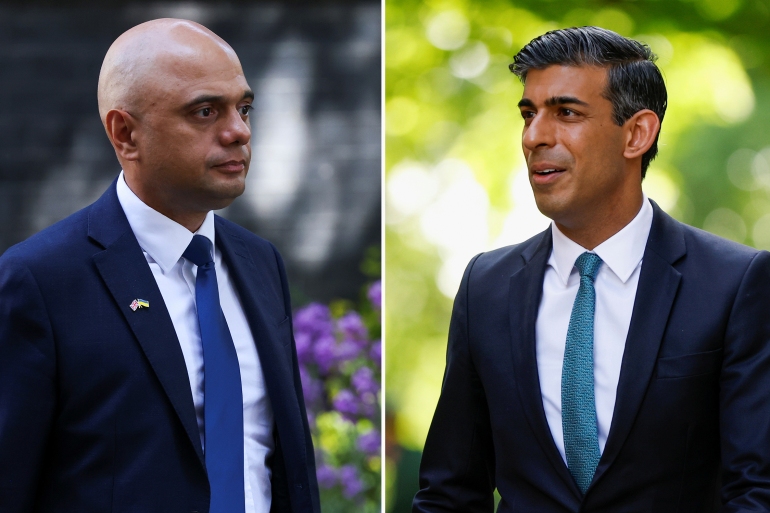
In the past few days, Johnson had come under immense scrutiny, with a string of resignations since Tuesday, including that of Chancellor of the Exchequer Rishi Sunak and health secretary Sajid Javid, two of the most pivotal members of Johnson’s cabinet.
Both called upon the prime minister to step down over his handling of the case of a senior official accused of sexual misconduct.
The events that transpired are unprecedented in the recent history of British politics, Stephen Elstub, reader in British politics at Newcastle University, told Al Jazeera.
“The closest precedent was the MacDonald Labour government in 1931, where the cabinet resigned during an extreme economic crisis. The most recent crisis that merits some comparison was Thatcher in 1990. However, only a few members of her cabinet reigned,” he said.
“What makes it similar to Johnson is that many cabinet members met with her and advised her to resign, saying she had lost control of the party. Advice that she ultimately took.
“In contrast, it has taken swaths of resignations to prompt Johnson to resign in the realisation that he is now unable to govern,” said Elstub.
Indeed Johnson faced difficulties in even filling cabinet roles prior to his resignation. Moreover, Johnson would likely have encountered a new vote of confidence if he had not stepped down and given the latest developments, it would have been inconceivable for him to survive.
“Johnson survived one in June, and the Conservative Party’s rules currently prohibit a second vote within 12 months. But there are elections next week to the 1922 Committee, the body that looks after Conservative MPs’ interests and that sets the rules,” Nicholas Allen, professor of politics at Royal Holloway, University of London, told Al Jazeera.
Given the wave of opposition Johnson faced, a rule change would have been highly likely and, with it, a loss during the vote.
“The threat of changing the rules is usually sufficient to force a leader’s hand, as it did with Theresa May back in 2019,” Allen noted.
Chris Pincher
The most recent government crisis in Westminster was triggered by an affair involving Johnson’s party colleague Chris Pincher, the deputy chief whip.
Johnson had nominated Pincher, who faces multiple counts of sexual harassment allegations, for the role.
Johnson initially denied knowing about the allegations until it became apparent that he had lied.
“The handling of the allegations of sexual assault against Pincher was the final straw for many MPs. In addition to Johnson’s immense failure of judgement in promoting a man who had previously had a complaint of sexual harassment upheld against him, the incident demonstrated Johnson’s loose relationship with the truth and his willingness to send MPs out to lie on his behalf,” Meakin said.
However, the Pincher case was merely the latest in several scandals Johnson either played some role or was the main culprit. Most recently, he was criticised for illegal parties at his Downing Street office during the coronavirus lockdown.
Nevertheless, Johnson had supporters in the government until the very end who lauded him for his COVID-19 vaccine campaign, Brexit and his support of Ukraine.
But other reasons played a role in how long he survived.
No clear replacement
“There isn’t a clear and obvious replacement for Johnson, which makes removing him a big step into the unknown. The fear is that the new leader could be worse, and certainly with the electorate,” Elstub said.
“Moreover, Johnson has appointed people to government loyal to him rather than talented. They are well aware that they would have no chance of being in the cabinet under a different leader.”
Furthermore, while his transgressions were accepted for as long as the party was able to win elections – and Johnson did land the biggest election victory for the Conservatives since Margaret Thatcher only three years ago – the last by-election results showed that Johnson’s lack of decorum had started to affect the party’s success and thus he was no longer untouchable.
“The Tories are now polling the low 30s, their core vote. The longer Johnson had stayed in office, the greater the damage to the party’s electoral prospects. Dishonesty, division and incompetence are a toxic combination,” Allen noted.
With Johnson’s departure imminent, the opposition now demands new elections and is threatening a vote of no confidence in parliament if Johnson does not immediately resign from his position as PM.
‘Fresh start’
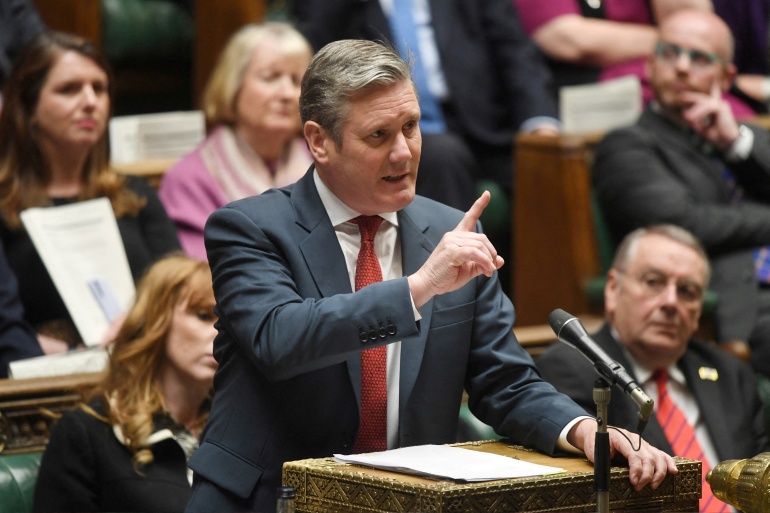
Labour leader Keir Starmer welcomed Johnson’s resignation. However, he demanded that a “fresh start” was now necessary. “We need a Labour government,” Starmer said. “We are ready.”
However, the opposition’s vote of no confidence is likely of very little meaning.
“Opposition parties may try to table a parliamentary vote of no confidence, but they would be defeated on the basis that Tory MPs are not going to bring down their government. This kind of vote is largely irrelevant in the present circumstances,” Allen noted.
Also, another election would be politically unwise for the Conservatives, who gained 80 seats during the previous vote. Given the current polls, the party could even lose its majority or could even lose its government role to Labour.
However, the party will also need to rectify its internal issues to be successful moving forward, Elstub said.
“The Conservative Party is currently in chaos. They have been propping up Johnson for months and repeating his lies and bluster to the media. As a result, the public has lost a lot of trust in the individuals involved, the party, politicians and political institutions in general.”
“However, Labour has not done enough to convince many voters that they should be in government. This leaves the next election result very much in doubt, and much will depend on the leadership of Starmer and the new Tory leader in the coming months.”
“Long-term, however, the Conservative Party will find a way to move beyond this. They are already starting to distance themselves from Johnson and will continue to do so. In time, politics will return to discussions about policy, and the Conservatives will ensure they are part of that conversation.”
Possible successors
Who will lead the party after the summer is anyone’s guess. However, some names are featuring more prominently in the Westminster bubble than others.
“This is very difficult to predict, and there isn’t a clear and obvious frontrunner, but contenders include Sunak, Javid, [newly-appointed Chancellor of the Exchequer Nadhim] Zahawi, [a Brexit-backing attorney general Suella] Braverman, [ex-defence secretary Penny] Mordaunt, [the chair of parliament’s foreign affairs committee, Tom] Tugendhat, and [ex-foreign secretary Jeremy] Hunt. Only the latter two can genuinely claim to have been opposed to Johnson all along, and they could benefit from that,” Elstub noted.
“I think it’s likely to be one of three: [defence secretary Ben] Wallace, Javid, and [foreign secretary] Liz Truss. At the risk of sitting on the fence, the only thing I’d predict is an unpredictable leadership contest!” Allen noted.
“Sajid Javid will have boosted his chances with his resignation statement yesterday, while Liz Truss may be able to attract the votes of a large number of Conservative Party members across the UK,” Meakin said.
Most of these possible candidates will now put their names forward and participate in an internal election, with party members ultimately deciding on the next party leader and thus Britain’s next prime minister.




Dozens of Palestinians killed in overnight Israeli strikes in central and south Gaza as Red Sea tensions rise.
Here’s how things stand on Monday, January 15, 2024:
Latest updates and human impact
- Israeli attacks continue unabated overnight killing and wounding dozens of civilians in central and southern Gaza. At least 22 people were killed and a large number injured as a result of Israeli forces targeting al-Thalatheni Street in the central Gaza Strip.
- Yemen’s Houthi rebels fired an antiship cruise missile toward an American destroyer in the Red Sea, which was shot down by a US fighter jet, announced US Central Command (CENTCOM) on X.
- This was the first US-acknowledged Houthi attack since the US strikes on Yemen on Friday.
- Hamas released a 37-second video showing three Israeli captives held in Gaza on Sunday, saying they would reveal the fate of the captives on Monday and urging the Israeli government to stop the offensive.
- The Israeli military says it has shifted to a new phase of the war focused on the southern end of Gaza, where almost 2 million internally displaced Palestinians are running out of safe spaces to shelter.
- The Gaza Ministry of Health has said almost 24,000 people have been killed in the Israeli offensive. More than 60,000 people have been wounded in 100 days of war.
Diplomacy
- Israeli Prime Minister Benjamin Netanyahu said on Sunday that his country will pursue its war against Hamas until victory and will not be stopped by anyone, including the International Court of Justice (ICJ).
- The White House said on Sunday that “it’s the right time” for Israel to scale back its military offensive in the Gaza Strip.
- Egypt’s State Information Service (SIS) said in a statement on Sunday that one of the biggest obstacles to the timely delivery of sufficient aid to Gaza was Israeli inspection of the aid. The statement came after Israel blamed Cairo for the delay in aid delivery to Gaza during its defence at the ICJ.
- US Secretary of State Antony Blinken posted on X on Monday, calling for the release of the remaining captives held in Gaza on the 100th day since they were taken by Hamas. He did not mention the Palestinian casualties.
- Australia’s Foreign Minister Penny Wong, who described herself as a “friend of Israel” to the press, will travel to Jordan, Israel, the occupied Palestinian Territories and the United Arab Emirates this week, her office said on Monday.
West Bank raids and violence
- Israeli forces arrested 25 students staging a sit-in in protest against high tuition fees at An-Najah University in Nablus. Al Jazeera’s Hamdah Salhut reported that the protesting students received a text message from Israeli forces telling them to “surrender now”.
- Israeli forces have reportedly raided the family home of Nael al-Barghouti, the longest-serving Palestinian prisoner, in the village of Kobar, in Ramallah, in the occupied West Bank.
- The Israeli army said on Friday that it killed three Palestinian men who infiltrated a West Bank settlement and fired upon soldiers.
- The Israeli military killed two Palestinians after accusing them of ramming their car through a checkpoint near Hebron.
- Local sources reported that Israeli forces bulldozed two Palestinian-owned houses during a Sunday midnight raid in the city of Qalqilya, Palestinian news agency Wafa reported.
- Armed Israeli settlers broke into the village of Burin, south of Nablus, and attacked Palestinian residents’ houses and properties after midnight on Sunday, Wafa reported.
- “Violent raids and arrests have become part of the fabric of daily life in the occupied West Bank,” Al Jazeera’s Mohammed Jamjoom, reporting from Ramallah in the occupied West Bank, said. At least 347 Palestinians have been killed and thousands have been arrested since October 7.

Flames and smoke billow during Israeli attacks against Gaza on October 9, 2023
Human Rights Watch terms Israeli Defence Minister Yoav Gallant’s call for a ‘complete siege’ on Gaza a ‘war crime’.
The Hamas movement has threatened to kill an Israeli hostage every time Israel bombs a Palestinian home without warning as Israel mobilised some 300,000 reservists and imposed a total blockade of the Gaza Strip, denying the enclave’s millions of residents access to food, water and fuel.
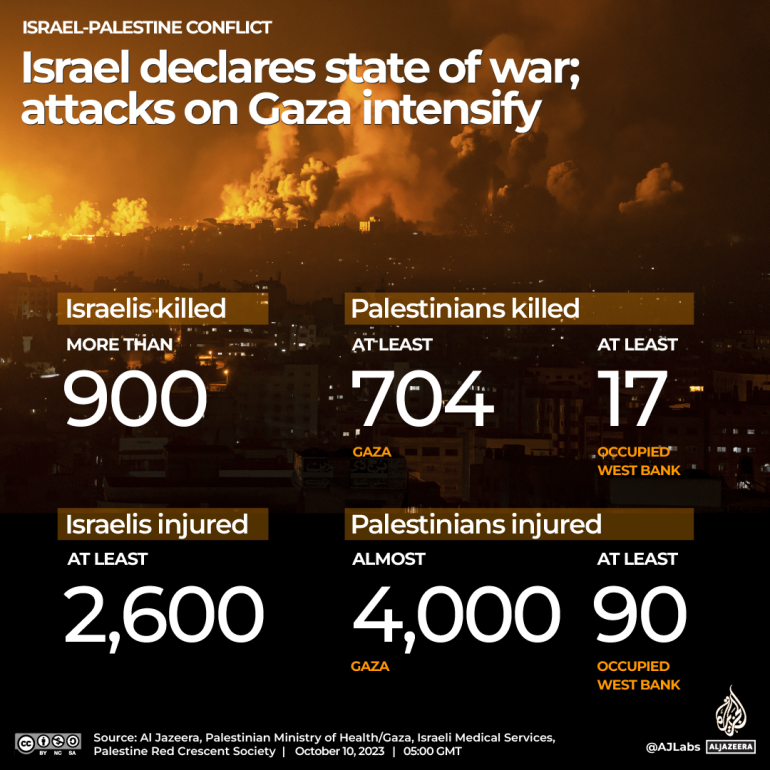
The warning from Hamas came on Monday as the death toll from the armed group’s surprise weekend attack climbed to 900 in Israel and revenge attacks by Israeli forces on the besieged Gaza Strip killed more than 700 people and left some 3,700 others wounded.
Residential apartment blocks, hospitals, schools and a mosque have been among the sites attacked by Israeli fighter jets, artillery and drones, according to media reports and witnesses.
Hamas spokesperson Abu Ubaida issued the threat to kill Israelis from the dozens held captive by the armed group. He said an Israeli hostage would be killed for every Israeli bombing of a civilian house without warning.
Israeli Foreign Minister Eli Cohen said more than 100 people were taken captive by Hamas during the deadly cross-border incursion over the weekend.
As Israeli forces conducted intense retaliatory attacks on Gaza on Monday, Israel’s Defence Minister Yoav Gallant drew international condemnation by announcing a total blockade of the densely populated and besieged enclave, which is home to 2.3 million people.
Gallant said Israel would impose a “complete siege” on Gaza. “No electricity, no food, no water, no gas – it’s all closed.”
United Nations Secretary-General Antonio Guterres said he was “deeply distressed” by the siege announcement and warned that Gaza’s already dire humanitarian situation will now “only deteriorate exponentially”.
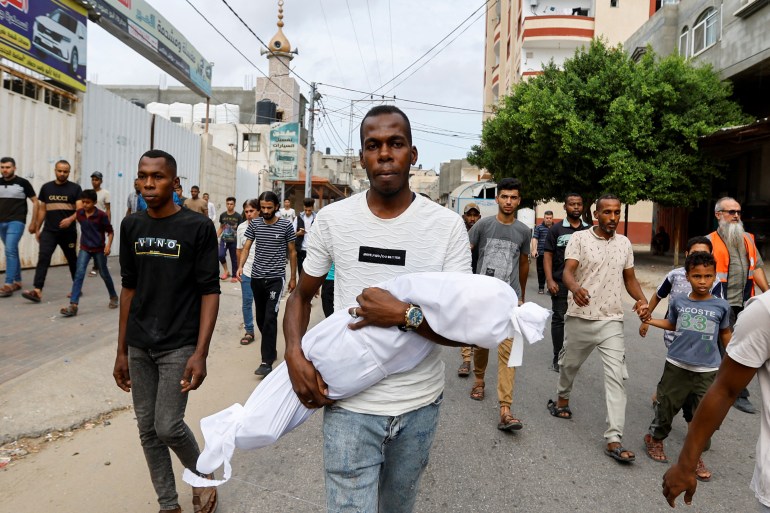
Guterres also said some 137,000 people were taking shelter with the UN Relief and Works Agency for Palestinian Refugees (UNRWA) at schools across Gaza.
UNRWA said on Tuesday that almost 190,000 people have been displaced in Gaza amid the Israeli attacks and the figure is expected to grow further as the violence intensifies.
Nearly half a million people have also not received food rations this week in Gaza as UN food distribution centres have been forced to remain closed amid the Israeli onslaught, UNRWA said.
Human Rights Watch said Israel’s total blockade on the necessities of life for everyday people in Gaza was a war crime.
“Defense Minister Gallant’s statements are abhorrent,” Omar Shakir, Israel and Palestine director at Human Rights Watch, said in a statement.
“Depriving the population in an occupied territory of food and electricity is collective punishment, which is a war crime, as is using starvation as a weapon of war. The International Criminal Court should take note of this call to commit a war crime,” he said.
Abhorrent. This is a call to commit a war crime by @yoavgallant. The @IntlCrimCourt should take note.
Quote by @OmarSShakir ⤵️ https://t.co/kKVo6YtpI1 pic.twitter.com/neHQMwnXVn
— Human Rights Watch (@hrw) October 9, 2023
Shakir also condemned the threat by Hamas to kill hostages, warning that such action was also a war crime.
“All hostages should be safely released to their families,” he said.
Grotesque. These threatened acts would amount to flagrant war crimes by Hamas’ armed wing. The @IntlCrimCourt will be watching.
Quote from @OmarSShakir ⤵️ https://t.co/FuNtvHe0YG pic.twitter.com/6cnHODLWyZ
— Human Rights Watch (@hrw) October 9, 2023
On the diplomatic front, Egyptian President Abdel Fattah el-Sisi and his Turkish counterpart Recep Tayyip Erdogan called on Hamas and Israel to immediately end violence and protect civilians, the Egyptian presidency said.
Erdogan urged Israel against “indiscriminately” attacking civilians and delivered measured criticism of Hamas, urging both sides to respect the “ethics” of war.
The United Kingdom, French, German, Italian and US governments issued a joint statement on Monday recognising the “legitimate aspirations” of the Palestinian people and supporting equal measures of justice and freedom for Israelis and Palestinians alike.
But the prospect that fighting could spread also alarmed the region and the world.
Lebanese armed group Hezbollah fired rockets into northern Israel in response to at least three of its members being killed in Israeli shelling of Lebanon.
Israel said one of its deputy commanders was also killed in an earlier cross-border raid from Lebanon.

US President Joe Biden holds a bilateral meeting with Israeli Prime Minister Benjamin Netanyahu on the sidelines of the 78th United Nations General Assembly in New York City, the US, September 20, 2023
Social media users, including journalists and observers, are calling out what they call a ‘double standard’.
After Saturday’s surprise attack by the Palestinian group Hamas on Israel, Ukrainian President Volodymyr Zelenskyy took to the social media platform X to offer “condolences go out to everyone who lost relatives or close ones in the terrorist attack”.
He also stated, “Israel’s right to self-defence is unquestionable.”
Many world leaders, including US President Joe Biden and UK Prime Minister Rishi Sunak, shared similar sentiments.
The world is seeing appalling images.
Thousands of rockets raining down on Israeli cities. Hamas terrorists killing not only Israeli soldiers, but civilians on the streets and in their homes.
It’s unconscionable. Israel has a right to defend itself – full stop.
— President Biden (@POTUS) October 7, 2023
European Commission President Ursula von der Leyen stated, “Israel has the right to defend itself – today and in the days to come. The European Union stands with Israel.”
Accusations of Western ‘double standards’
Some social media users have criticised these statements, saying they highlight a double standard.
The world is seeing appalling images.
Thousands of rockets raining down on Israeli cities. Hamas terrorists killing not only Israeli soldiers, but civilians on the streets and in their homes.
It’s unconscionable. Israel has a right to defend itself – full stop.
— President Biden (@POTUS) October 7, 2023
Ukraine’s right to defend itself is praised by most international leaders while Russia’s invasion is condemned, but commentators said the same cannot be said about Israel’s occupation of the West Bank and Gaza.
Aaron Bastani, a leftist British journalist, said on X that there’s a “clear double standard in endorsing terrorism against civilian targets in Ukraine … and condemning it by Palestinians”.
Many users said Western diplomats and media support the Ukrainians who defend their land, but label the Palestinians fighting against Israel as “terrorists”.
https://twitter.com/KhaledBeydoun/status/1710787817415082349?ref_src=twsrc%5Etfw%7Ctwcamp%5Etweetembed%7Ctwterm%5E1710787817415082349%7Ctwgr%5E6acf829869e993177f32aa38aa48c02f38cb7f61%7Ctwcon%5Es1_&ref_url=https%3A%2F%2Fwww.aljazeera.com%2Fnews%2F2023%2F10%2F9%2Fwestern-leaders-accused-of-hypocrisy-over-response-to-palestine-ukraine
An illustration of a woman’s face, in which one eye is closed beside a Palestinian flag, and one eye open beside a Ukrainian flag, has been regularly shared as a symbol of the West’s alleged double standards in how the two conflicts are viewed.
https://twitter.com/OnlinePalEng/status/1710994682883273172?ref_src=twsrc%5Etfw%7Ctwcamp%5Etweetembed%7Ctwterm%5E1710994682883273172%7Ctwgr%5E6acf829869e993177f32aa38aa48c02f38cb7f61%7Ctwcon%5Es1_&ref_url=https%3A%2F%2Fwww.aljazeera.com%2Fnews%2F2023%2F10%2F9%2Fwestern-leaders-accused-of-hypocrisy-over-response-to-palestine-ukraine
Clips also emerged on social media from a CNN interview with Mustafa Barghouti, the general secretary of the Palestinian National Initiative, in which he posed the rhetorical question, “Why does the United States support Ukraine in fighting occupation – while here they support the occupier, who continues to occupy us?”
The hypocrisy and double standards of western governments and media platforms dealing with situations in Ukraine-Russia and Palestine-Israel blow the mind. Absolute disgrace.
— Said Yacoubi (@AlyacoubiSaid) October 8, 2023
It is not the first time Western nations have been accused of double standards in their stance on the Ukraine war.
Earlier in the year, Amnesty International published a report highlighting the West’s “double standards” on global human rights.
Agnes Callamard, Amnesty’s secretary-general, told Al Jazeera at the time that the occupation of Palestinian territory was a “particularly important one”.
“Without making any comparison between Russia’s aggression and Israel … it is clear the Palestinian people are under a regime of oppression – a regime of occupation and a regime of apartheid,” Callamard told Al Jazeera.
Over the last three days, X users recirculated earlier statements calling out what they called Western hypocrisy, sharing video by the Irish lawmaker Richard Boyd Barrett from March 2022 in which he berated the Irish government’s double standards regarding Ukraine and Palestine:
“You’re happy to use the most strong and robust language to describe the crimes against humanity of [Russian President] Vladimir Putin, but you will not use the same strength of language when it comes to describing Israel’s treatment of the Palestinians.”
Barrett on Sunday again called out what he described as “shocking double standards of Western leaders supporting Ukraine resistance but condemning Palestinian[s].”
Meanwhile, others warned against comparing conflicts.
https://twitter.com/denfordauthor/status/1710993737738768607?ref_src=twsrc%5Etfw%7Ctwcamp%5Etweetembed%7Ctwterm%5E1710993737738768607%7Ctwgr%5E6acf829869e993177f32aa38aa48c02f38cb7f61%7Ctwcon%5Es1_&ref_url=https%3A%2F%2Fwww.aljazeera.com%2Fnews%2F2023%2F10%2F9%2Fwestern-leaders-accused-of-hypocrisy-over-response-to-palestine-ukraine
And some cautioned that Hamas and the Palestinians should not be seen as one and the same.
Just to clarify:
Palestine did not mount an attack on Israel. An Iranian proxy militia did. Palestinians are by and large huddled in their homes praying that an Israeli airstrike won't kill them or theirs. Hamas is the culprit here. This isn't a decentralized grassroots thing.
— Romeo Kokriatski (@VagrantJourno) October 9, 2023
Ukrainian footballer Oleksandr Zinchenko, who plays for Arsenal, posted on Instagram, stating he “stands with Israel”.
Zinchenko has been a vocal supporter of his home country in its ongoing defence against Russia, and he participated in a Game4Ukraine charity match in London earlier this year to raise money for Ukraine.
After online backlash, with some questioning an alleged double standard in his support of Israel, the footballer removed the post and switched his social media account to private.
Several people claimed that Zinchenko’s football club, in not responding to his comments, was guilty of hypocrisy after they had distanced themselves from former player Mesut Ozil’s comments in 2019 over alleged human rights abuses against Uighur Muslims in China.
-
 Audio10 years ago
Page – Day Break Everywhere Burst
-
 Audio5 years ago
Shadykarz – Forever
-
 Audio10 years ago
Juniorboy ft. 9ice – IRAPADA
-
 Entertainment Gists6 years ago
Ex-Beauty Queen, Sandra Benede Shares Sexy Photo
-
 Audio5 years ago
Simi – Happy Birthday ft. Adekunle Gold, DeJa
-
 Audio6 years ago
Ruger – Bounce
-
 Mixtapes4 years ago
Mixtape: DJ DimpleNipple – The Best Of Amapiano Thrills
-
 Editorials4 years ago
Sa’eedah Imam On Creating Her Imprint In The Nigerian Music Industry As An Emerging Creative Writer