






























Connect with us

Cigarette and oil illustration

White line 10 pixels
As climate change becomes a focus of the US election, energy companies stand accused of trying to downplay their contribution to global warming. In June, Minnesota’s Attorney General sued ExxonMobil, among others, for launching a “campaign of deception” which deliberately tried to undermine the science supporting global warming. So what’s behind these claims? And what links them to how the tobacco industry tried to dismiss the harms of smoking decades earlier?
To understand what’s happening today, we need to go back nearly 40 years.
Marty Hoffert leaned closer to his computer screen. He couldn’t quite believe what he was seeing. It was 1981, and he was working in an area of science considered niche.
“We were just a group of geeks with some great computers,” he says now, recalling that moment.
But his findings were alarming.
“I created a model that showed the Earth would be warming very significantly. And the warming would introduce climatic changes that would be unprecedented in human history. That blew my mind.”
White line 10 pixels
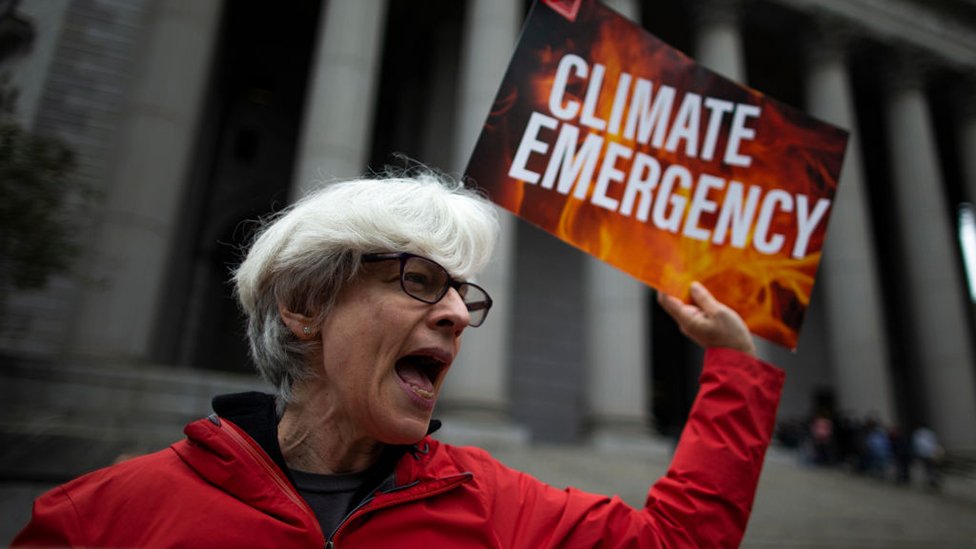
A climate change protester outside the New York State Supreme Court building on the first day of the ExxonMobil trial on 22 October, 2019
A climate change protester outside the New York State Supreme Court during the ExxonMobil trial in October, 2019
White line 10 pixels
Marty Hoffert was one of the first scientists to create a model which predicted the effects of man-made climate change. And he did so while working for Exxon, one of the world’s largest oil companies, which would later merge with another, Mobil.
At the time Exxon was spending millions of dollars on ground-breaking research.
It wanted to lead the charge as scientists grappled with the emerging understanding that the warming planet could cause the climate to change in ways that could make life pretty difficult for humans.
Hoffert shared his predictions with his managers, showing them what might happen if we continued burning fossil fuels in our cars, trucks and planes.
White line 10 pixels
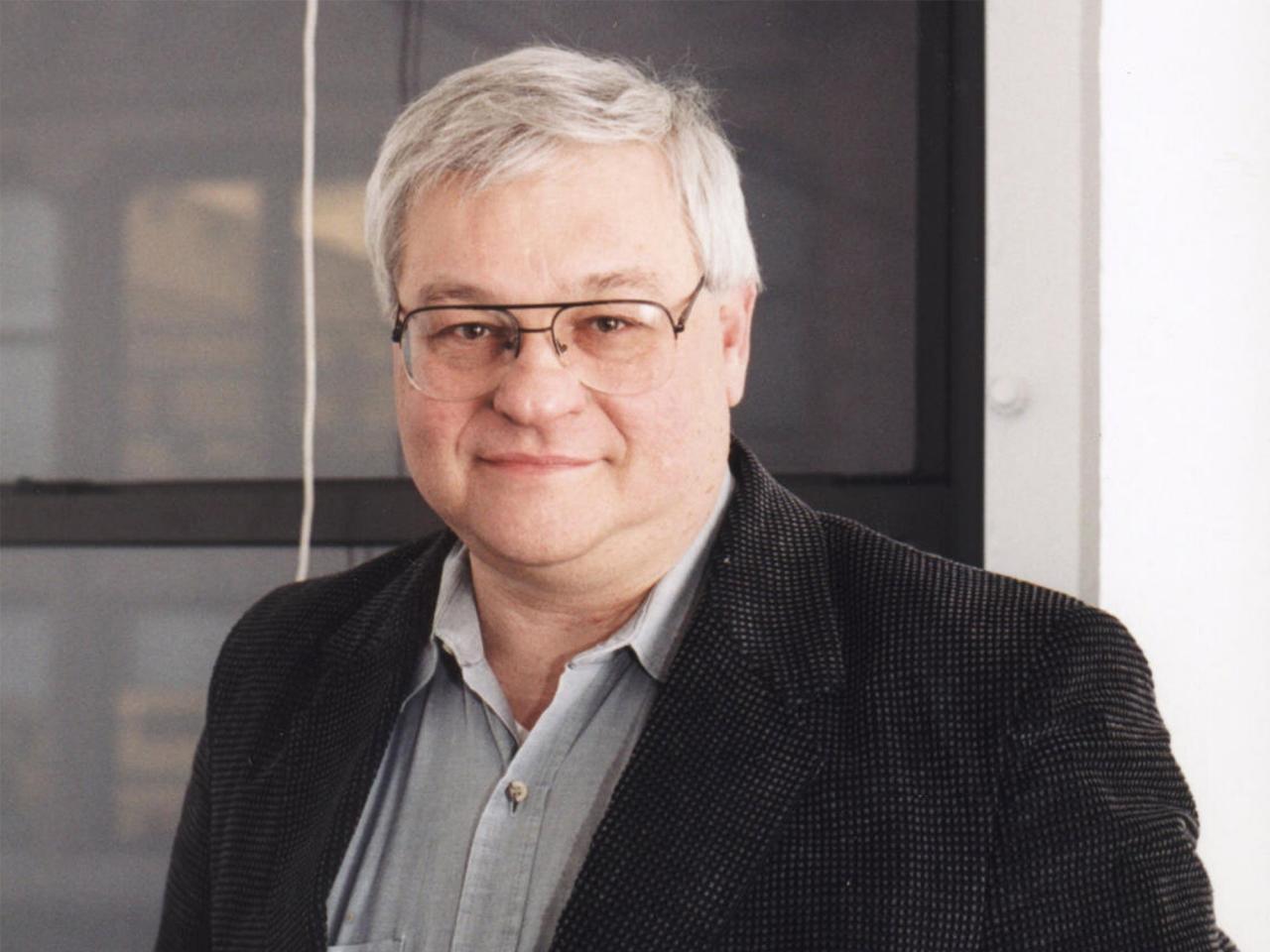
Martin Hoffert
              Martin Hoffert
But he noticed a clash between Exxon’s own findings, and public statements made by company bosses, such as the then chief executive Lee Raymond, who said that “currently, the scientific evidence is inconclusive as to whether human activities are having a significant effect on the global climate”.
“They were saying things that were contradicting their own world-class research groups,” said Hoffert.
Angry, he left Exxon, and went on to become a leading academic in the field.
“What they did was immoral. They spread doubt about the dangers of climate change when their own researchers were confirming how serious a threat it was.”
So what changed? The record-breaking hot summer of 1988 was key. Big news in America, it gave extra weight to warnings from Nasa scientist Dr Jim Hansen that “the greenhouse effect has been detected, and is changing our climate now”.
Political leaders took notice. Then UK Prime Minister Margaret Thatcher acknowledged the great new global threat: “The environmental challenge which confronts the whole world demands an equivalent response from the whole world.”
In 1989, Exxon’s strategy chief Duane Levine drew up a confidential presentation for the company’s board, one of thousands of documents in the company’s archive which were later donated to The University of Texas at Austin.
Levine’s presentation is an important document, often cited by researchers investigating Exxon’s record on climate change science.
“We’re starting to hear the inevitable call for action,” it said, which risked what it called “irreversible and costly draconian steps”.
“More rational responses will require efforts to extend the science and increase emphasis on costs and political realities.”
White line 10 pixels
Presentational grey line
How they made us doubt everything
Presentational grey line
White line 10 pixels
Kert Davies has scoured through Exxon’s archive. He used to work as a research director at the environmental pressure group Greenpeace, where he looked into corporate opposition to climate change.
This inspired him to set up The Climate Investigations Centre. He explains why this Exxon presentation mattered:
“They are worried the public will take this on, and enact radical changes in the way we use energy and affect their business, that’s the bottom line.”
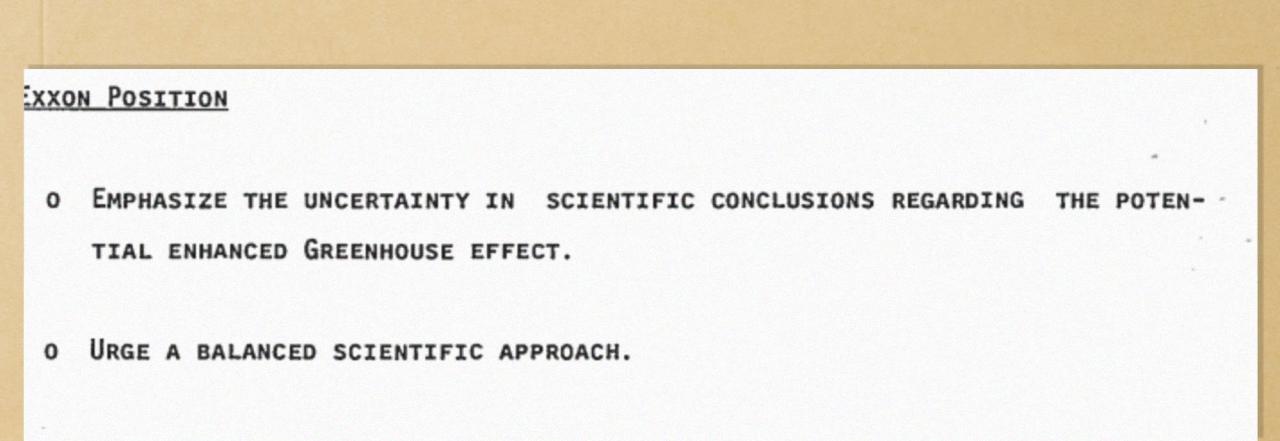
He says this fear can also be seen in another document from the archive that sets out the so-called “Exxon position”, which was to “emphasise the uncertainty” regarding climate change.
White line 10 pixels
Exxon position
White line 10 pixels
Researchers argue this was just the start of a decades-long campaign to shape public opinion and to spread doubt about climate change.
In June 2020, the General Attorney of Minnesota Keith Ellison sued ExxonMobil, the American Petroleum Institute (API) and Koch Industries for misleading the public over climate change. The lawsuit claims that “previously unknown internal documents confirm that the defendant well understood the devastating effects that their products would cause to the climate”.
It says that despite this knowledge, the industry “engaged in a public-relations campaign that was not only false, but also highly effective,” which served to “deliberately [undermine] the science” of climate change.
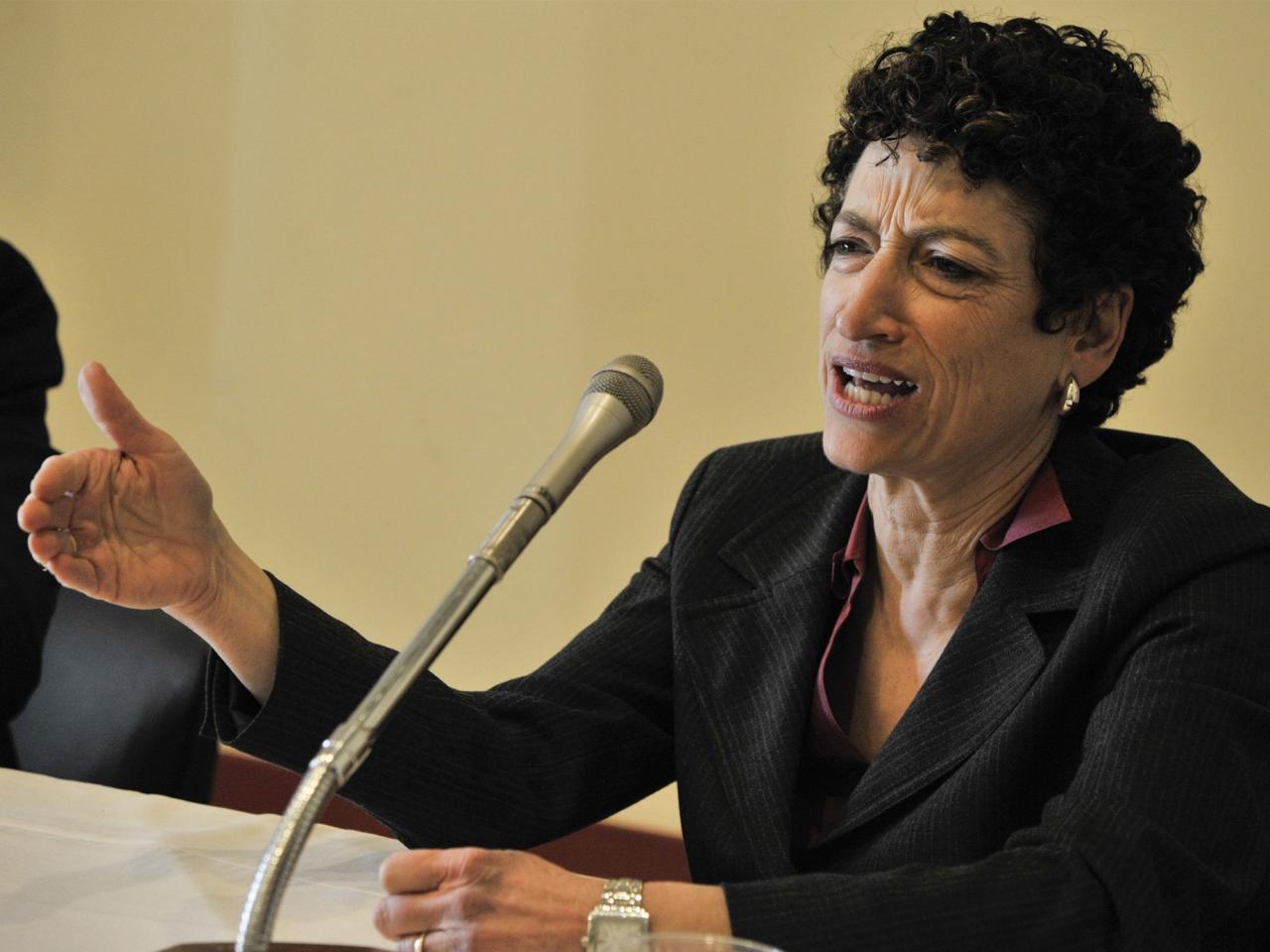
The accusations against Exxon and others – which the company has called “baseless and without merit” – build on years of painstaking research by people like Kert Davies and Naomi Oreskes, professor of the history of science at Harvard University and co-author of Merchants of Doubt.
White line 10 pixels
Naomi Oreskes
             Naomi Oreskes
White line 10 pixels
“Rather than accept the scientific evidence, they made the decision to fight the facts,” she said.
But this isn’t just about Exxon’s past actions. In the same year as the Levine presentation, 1989, many energy companies and fossil fuel dependent industries came together to form the Global Climate Coalition, which aggressively lobbied US politicians and media.
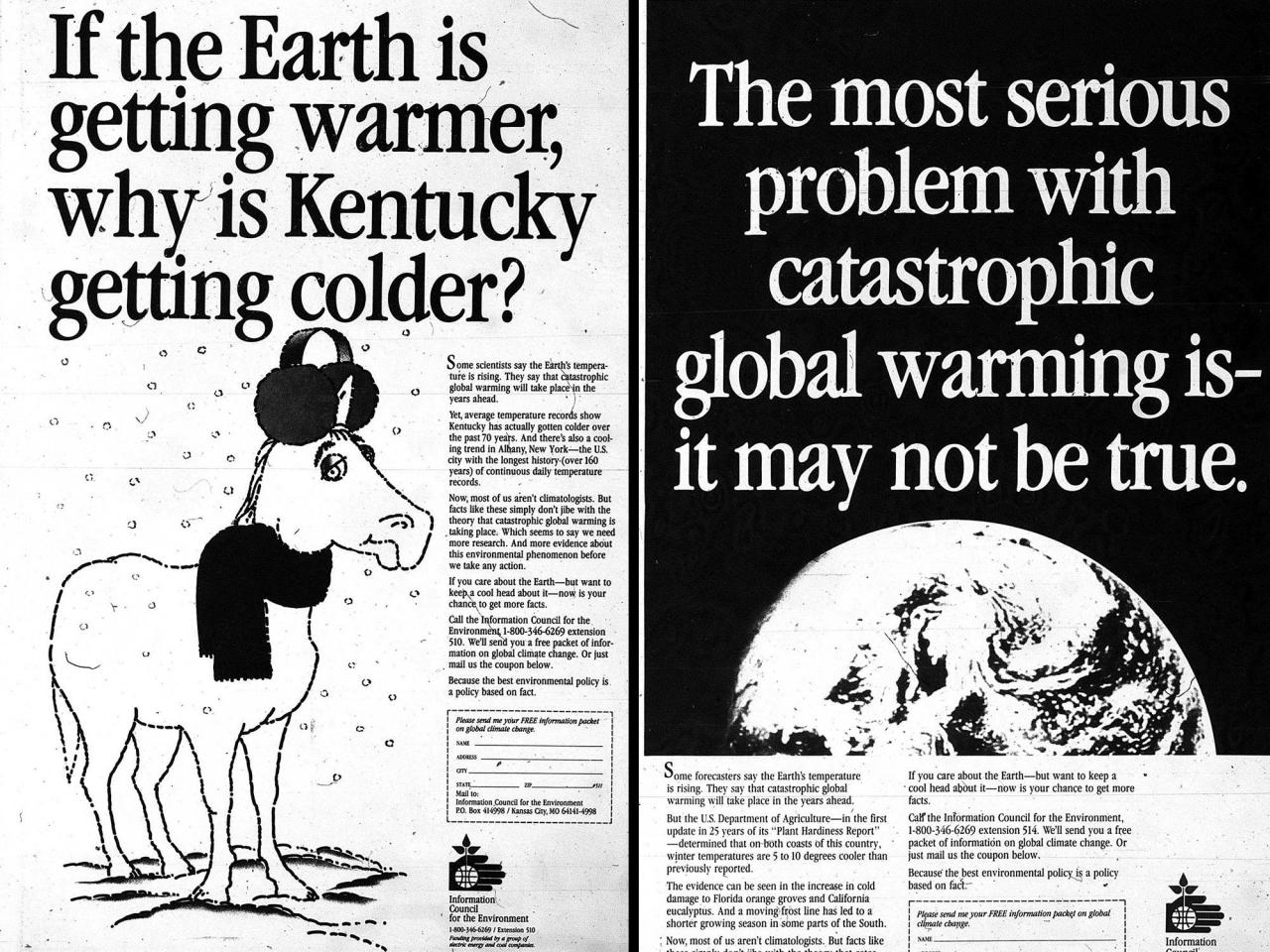
Then in 1991, the trade body that represents electrical companies in the US, the Edison Electric Institute, created a campaign called the Information Council for the Environment (ICE) which aimed to “Reposition global warming as theory (not fact)”. Some details of the campaign were leaked to the New York Times.
“They ran advertising campaigns designed to undermine public support, cherry picking the data to say, ‘Well if the world is warming up, why is Kentucky getting colder?’ They asked rhetorical questions designed to create confusion, to create doubt,” argued Naomi Oreskes.
White line 10 pixels
Global warming
White line 10 pixels
The ICE campaign identified two groups which would be most susceptible to its messaging. The first was “older, lesser educated males from larger households who are not typically information seekers”.
The second group was “younger, low-income women,” who could be targeted with bespoke adverts which would liken those who talked about climate change to a hysterical doom-saying cartoon chicken.
The Edison Electric Institute didn’t respond to questions about ICE, but told the BBC that its members are “leading a clean energy transformation, and are united in their commitment to get the energy they provide as clean as they can, as fast as they can”.
But back in the 1990 there were many campaigns like this.
“Unless ‘climate change’ becomes a non-issue,” says another, leaked to the New York Times in 1997, “there may be no moment when we can declare victory”.
To achieve victory, the industry planned to “identify, recruit and train a team of five independent scientists to participate in media outreach”.
White line 10 pixels
Exxon sign
White line 10 pixels
This important tactic assumed the public would be suspicious if oil industry executives dismissed climate change, but might trust the views of seemingly independent scientists.
These would be put forward to take part in debates on TV, potentially confusing a general audience who would see opposing scientists in white coats arguing about complex technical details without knowing who to believe.
The problem was, sometimes these “white coats” weren’t truly independent. Some climate sceptic researchers were taking money from the oil industry.
Drexel University emeritus professor Bob Brulle studied the funding for the climate change “counter movement”. He identified 91 institutions which he says either denied or downplayed the risks of climate change, including the Cato Institute and the now-defunct George C Marshall Institute.
He found that between 2003 and 2007, ExxonMobil gave $7.2m (£5.6m) to such bodies, while between 2008 and 2010, the American Petroleum Institute trade body (API) donated just under $4m (£3m).
In its 2007 Corporate Citizenship Report, ExxonMobil said it would stop funding such groups in 2008.
Of course many researchers would argue such money didn’t influence their climate contrarian work. It seems some may have been motivated by something else.
Most of the organisations opposing or denying climate change science were right-wing think tanks, who tended to be passionately anti-regulation.
These groups made convenient allies for the oil industry, as they would argue against action on climate change on ideological grounds.
White line 10 pixels
Jerry Taylor
                  Jerry Taylor
White line 10 pixels
Jerry Taylor spent 23 years with the Cato Institute – one of those right wing think tanks – latterly as vice president. Before he left in 2014, he would regularly appear on TV and radio, insisting that the science of climate change was uncertain and there was no need to act. Now, he realises his arguments were based on a misinterpretation of the science, and he regrets the impact he’s had on the debate.
“For 25 years, climate sceptics like me made it a core matter of ideological identity that if you believe in climate change, then you are by definition a socialist. That is what climate sceptics have done.”
The BBC asked the Cato Institute about its work on climate change, but it did not respond.
This ideological divide has had far-reaching consequences. Polls conducted in May 2020 showed that just 22% of Americans who vote Republican believed climate change is man-made, compared with 72% of Democrats.
Unfortunately many of the “expert scientists” quoted by journalists to try to offer balance in their coverage of climate change were – like Jerry Taylor – making arguments based on their beliefs rather than relevant research.
“Usually these people have some scientific credentials, but they’re not actually experts in climate science,” says Harvard historian Naomi Oreskes.
She began digging into the background of leading climate sceptics, including Fred Seitz, a nuclear physicist and former president of the US National Academy of Sciences. She found he was deeply anti-communist, believing any government intervention in the marketplace “would put us on the slippery slope to socialism”.
She also discovered that he had been active in the debates around smoking in the 1980s.
“That was a Eureka moment. We realised this was not a scientific debate. A person with expertise about climate change would in no way be an expert about oncology or public health or cardiovascular disease, or any of the key issues associated with tobacco.
“The fact that the same people were arguing in both cases was a clue that something fishy was going on. That’s what led us to discover this pattern of disinformation that gets systemically used again and again.”
Naomi Oreskes spent years going through the tobacco archive at the University of California at San Francisco. It contains more than 14 million documents that were made available thanks to litigation against US tobacco firms.
A strikingly familiar story emerged. Decades before the energy industry tried to undermine the case for climate change, tobacco companies had used the same techniques to challenge the emerging links between smoking and lung cancer in the 1950s.
White line 10 pixels
Plaza Hotel (Right), Central Park, New York
White line 10 pixels
The story began at Christmas 1953. In New York’s luxurious Plaza Hotel, the heads of the tobacco companies met to discuss a new threat to their business model.
Details of the night’s anxious conversations were recorded in a document written by public relations guru John Hill from Hill and Knowlton.
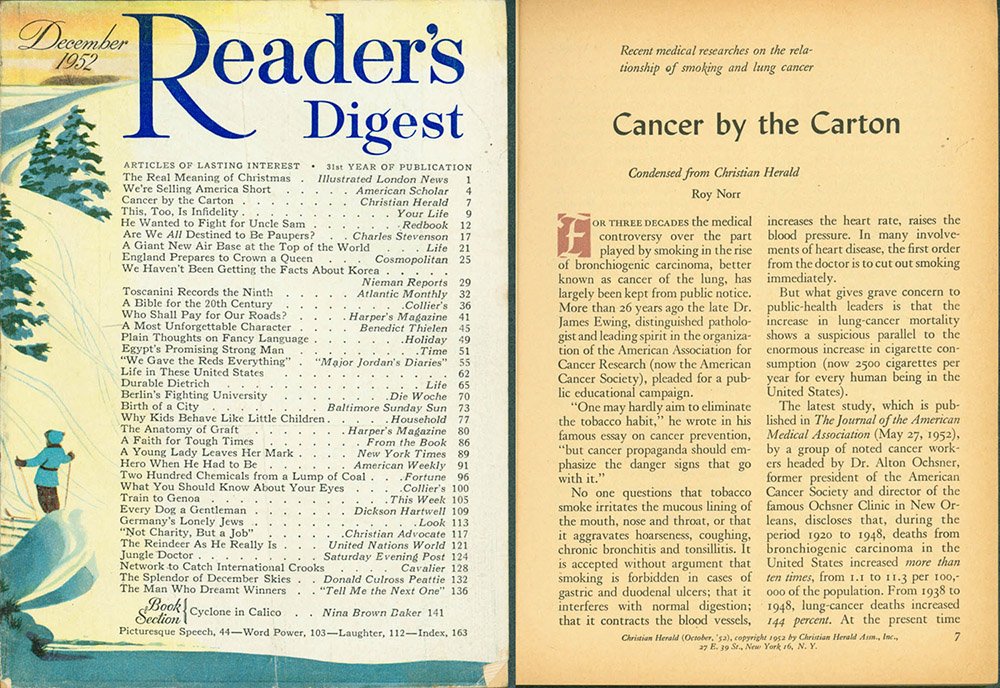
Widely read mass-market magazines like Readers Digest and Time Life had begun publishing articles about the association between smoking and lung cancer. And researchers like those who had found that lab mice painted with cigarette tar got cancer were attracting increasing attention.
White line 10 pixels
Cancer by the Carton
White line 10 pixels
As John Hill wrote in the 1953 document, “salesmen in the industry are frantically alarmed, and the decline in tobacco stocks on the stock exchange market has caused grave concern”.
Hill recommended fighting science with science. “We do not believe the industry should indulge in any flashy or spectacular ballyhoo. There is no public relations [medicine] known to us at least, which will cure the ills of the industry.”
As a later document by tobacco company Brown and Williamson summarised the approach: “Doubt is our product, since it is the best means of competing with the ‘body of fact’ that exists in the minds of the general public.”
White line 10 pixels
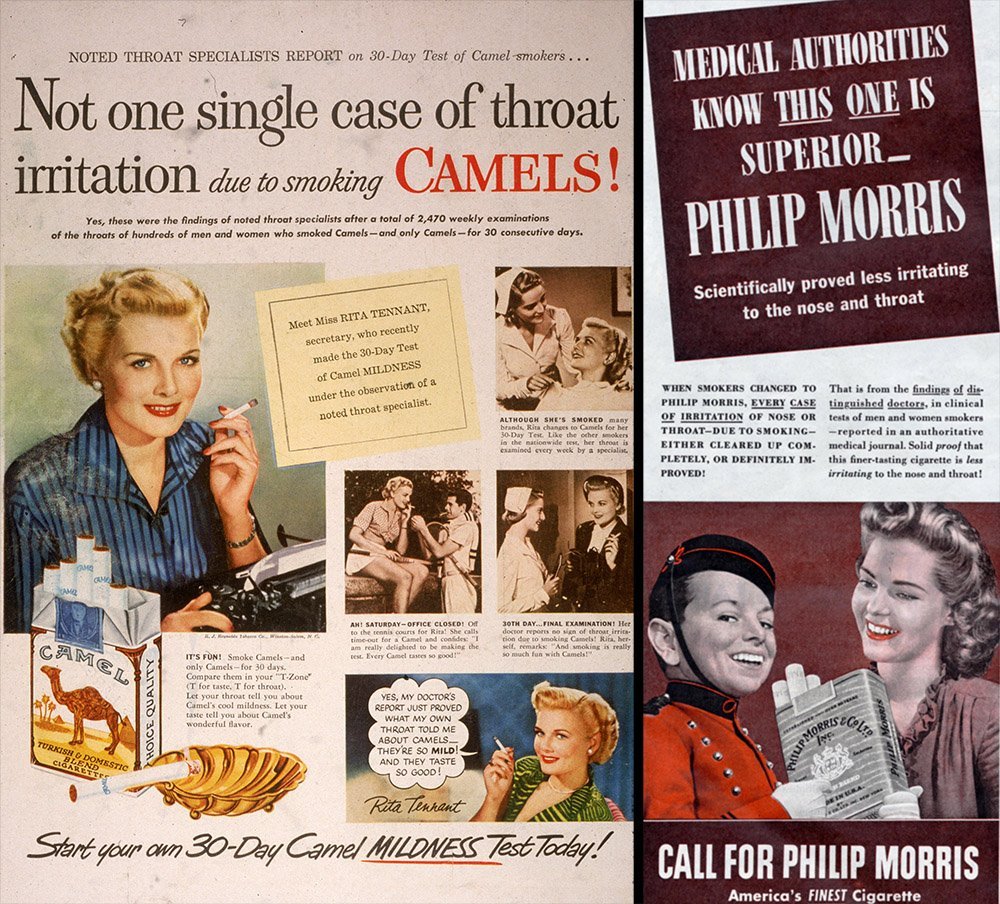
Cigarette advert, left 1950, right 1944White line 10 pixels
Naomi Oreskes says this understanding of the power of doubt is vital.
“They realise they can’t win this battle by making a false claim that sooner or later would be exposed. But if they can create doubt, that would be sufficient – because if people are confused about the issue, there’s a good chance they’ll just keep smoking.”
Hill advised setting up the “Tobacco Industry Research Committee” to promote “the existence of weighty scientific views which hold there is no proof that cigarette smoking is a cause of lung cancer”.
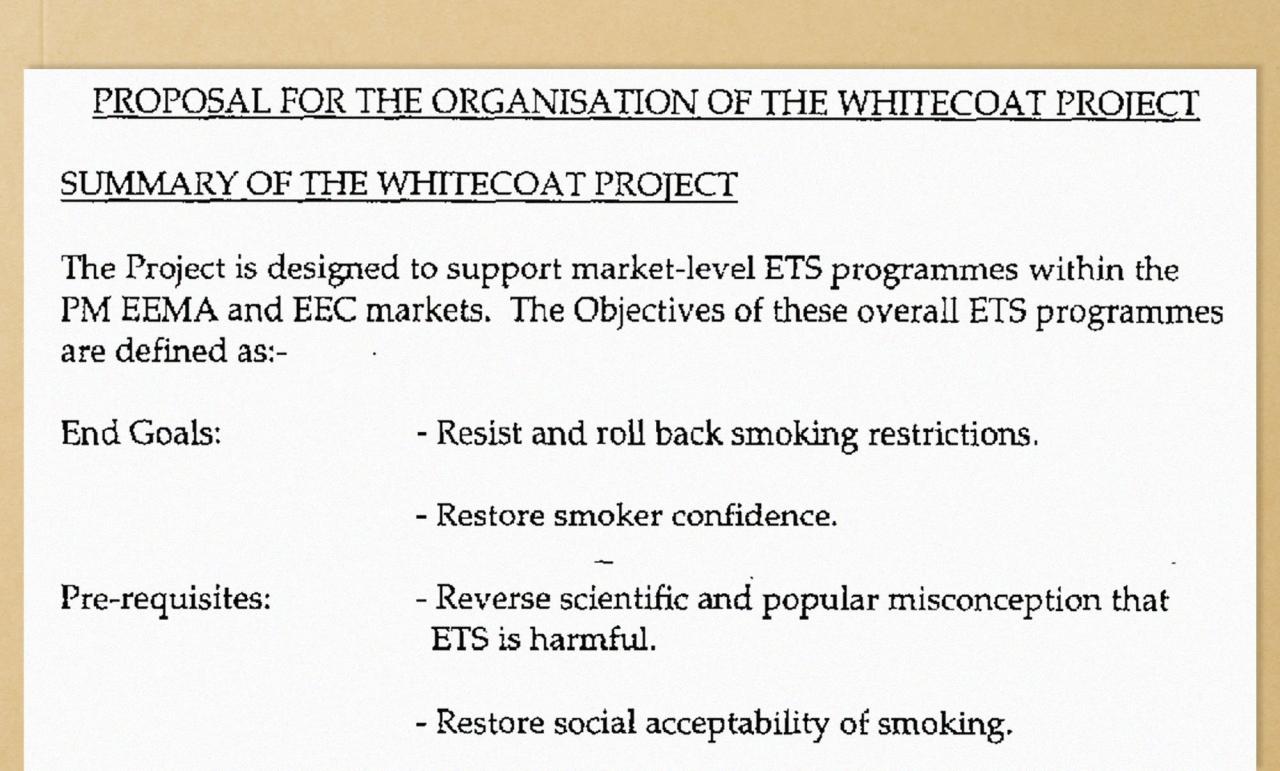
As in the climate change debate decades later, “Project Whitecoat” would pit scientist against scientist.
White line 10 pixels
Operation Whitecoat
White line 10 pixels
According to Oreskes, the project targeted those who were already doing research into other causes of cancer or lung conditions – such as asbestos – which the tobacco industry could fund.
“The purpose of these programmes was not to advance scientific understanding, it was to create enough confusion that the American people would doubt the existing scientific evidence.”
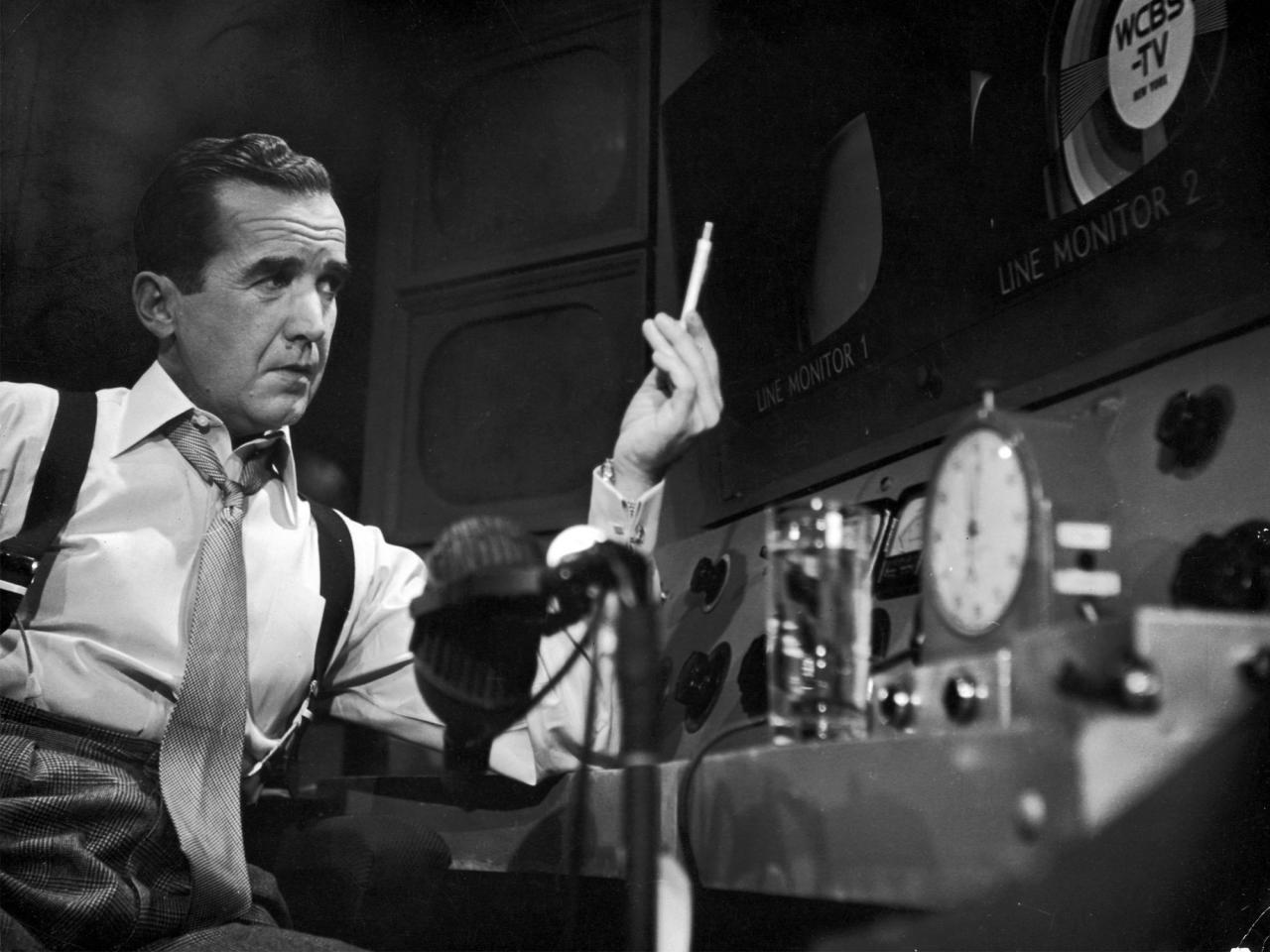
Journalists were one of the tobacco industry’s main targets. The Tobacco Industry Research Committee held meetings in its offices in the Empire State Building for major newspaper editors. It even persuaded one of the most famous broadcast journalists of the time, Edward R Murrow, to interview its experts.
The eventual edition of Murrow’s celebrated television programme “See It Now” – broadcast in 1955 -shows Project Whitecoat in action, with tobacco industry funded scientists set against independent researchers.
Ed Murrow
White line 10 pixels
But as would happen later with climate change, it was difficult for the audience at home to form an opinion when opposing scientists contradicted each other. Even Murrow ended up on the fence. “We have no credentials for reaching conclusions on this subject,” he said.
If doubt was the industry’s true product, then it appeared to be a roaring success.
For decades, none of the legal challenges launched against the tobacco companies themselves succeeded.
This was partly due to the effectiveness of Project Whitecoat, as an internal memo from tobacco firm RJ Reynolds in May 1979 concludes: “Due to favourable scientific testimony, no plaintiff has ever collected a penny from any tobacco company in lawsuits claiming that smoking causes lung cancer or cardiovascular illness – even though 117 such cases have been brought since 1954.”
But pressure on the tobacco companies continued to mount. In 1997, the industry paid $350m (£272m) to settle a class action brought by flight attendants who had developed lung cancer and other illnesses which they argued were caused by second-hand cigarette smoke from passengers.
This settlement paved the way to a landmark ruling in 2006, when Judge Gladys Kessler found US tobacco companies guilty of fraudulently misrepresenting the health risks associated with smoking.
Judge Kessler detailed how the industry “marketed and sold their lethal products with zeal, with deception, with a single-minded focus on their financial success, and without regard for the human tragedy or social costs”.
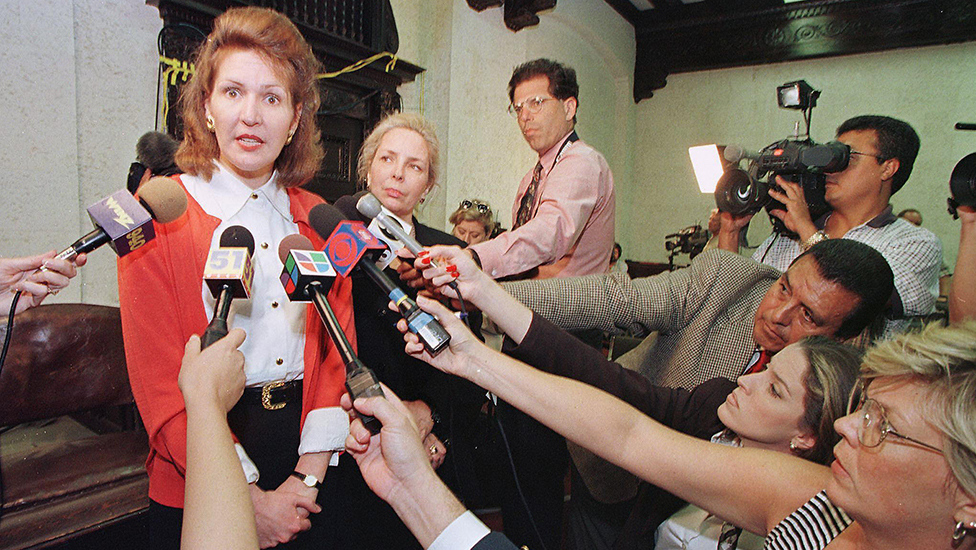
Norma Broin
Flight attendant Norma Broin was the lead plaintiff in the passive smoking class action after developing lung cancer, despite being a non-smoker
The tobacco companies may have eventually lost their battle to hide the harms of smoking, but the blueprint drawn up by John Hill and his colleagues proved to be very effective.
“What he wrote is the same memo we have seen in multiple industries subsequently,” says David Michaels, author of The Triumph of Doubt, which details how the pesticides, plastics and sugar industries have also used these tactics.
“We called it ‘the tobacco playbook’, because the tobacco industry was so successful.
“They made a product that killed millions of people across the world, and the science has been very strong [about that] for many years, but through this campaign to manufacture uncertainty, they were able to delay first, formal recognition of the terrible impact of tobacco, and then delay regulation and defeat litigation for decades, with obviously terrible consequences.”
We asked Hill and Knowlton about its work for the tobacco companies, but it did not respond.
In a statement, ExxonMobil told the BBC that “allegations about the company’s climate research are inaccurate and deliberately misleading”.
“For more than 40 years, we have supported development of climate science in partnership with governments and academic institutions. That work continues today in an open and transparent way.
“Deliberately cherry-picked statements attributed to a small number of employees wrongly suggest definitive conclusions were reached decades ago.”
ExxonMobil added that it recently won the court case brought by the New York Attorney General which had accused the company of fraudulently accounting for the costs of climate change regulation.
But academics like David Michaels fear the use of uncertainty in the past to confuse the public and undermine science has contributed to a dangerous erosion of trust in facts and experts across the globe today, far beyond climate science or the dangers of tobacco.
He cites public attitudes to modern issues like the safety of 5G, vaccinations – and coronavirus.
“By cynically manipulating and distorting scientific evidence, the manufacturers of doubt have seeded in much of the public a cynicism about science, making it far more difficult to convince people that science provides useful – in some cases, vitally important – information.
“There is no question that this distrust of science and scientists is making it more difficult to stem the coronavirus pandemic.”
It seems the legacy of “the tobacco playbook” lives on.
All images subject to copyright.

Foreign

Israel’s War On Gaza: List of Key Events, Day 101

Published

on

Israel's war on Gaza: List of key events, day 101 | Israel War on Gaza News  | Al Jazeera

Dozens of Palestinians killed in overnight Israeli strikes in central and south Gaza as Red Sea tensions rise.

Here’s how things stand on Monday, January 15, 2024:

Latest updates and human impact

  • Israeli attacks continue unabated overnight killing and wounding dozens of civilians in central and southern Gaza. At least 22 people were killed and a large number injured as a result of Israeli forces targeting al-Thalatheni Street in the central Gaza Strip.
  • Yemen’s Houthi rebels fired an antiship cruise missile toward an American destroyer in the Red Sea, which was shot down by a US fighter jet, announced US Central Command (CENTCOM) on X.
  • This was the first US-acknowledged Houthi attack since the US strikes on Yemen on Friday.
  • Hamas released a 37-second video showing three Israeli captives held in Gaza on Sunday, saying they would reveal the fate of the captives on Monday and urging the Israeli government to stop the offensive.
  • The Israeli military says it has shifted to a new phase of the war focused on the southern end of Gaza, where almost 2 million internally displaced Palestinians are running out of safe spaces to shelter.
  • The Gaza Ministry of Health has said almost 24,000 people have been killed in the Israeli offensive. More than 60,000 people have been wounded in 100 days of war.

Diplomacy

  • Israeli Prime Minister Benjamin Netanyahu said on Sunday that his country will pursue its war against Hamas until victory and will not be stopped by anyone, including the International Court of Justice (ICJ).
  • The White House said on Sunday that “it’s the right time” for Israel to scale back its military offensive in the Gaza Strip.
  • Egypt’s State Information Service (SIS) said in a statement on Sunday that one of the biggest obstacles to the timely delivery of sufficient aid to Gaza was Israeli inspection of the aid. The statement came after Israel blamed Cairo for the delay in aid delivery to Gaza during its defence at the ICJ.
  • US Secretary of State Antony Blinken posted on X on Monday, calling for the release of the remaining captives held in Gaza on the 100th day since they were taken by Hamas. He did not mention the Palestinian casualties.
  • Australia’s Foreign Minister Penny Wong, who described herself as a “friend of Israel” to the press, will travel to Jordan, Israel, the occupied Palestinian Territories and the United Arab Emirates this week, her office said on Monday.

West Bank raids and violence

  • Israeli forces arrested 25 students staging a sit-in in protest against high tuition fees at An-Najah University in Nablus. Al Jazeera’s Hamdah Salhut reported that the protesting students received a text message from Israeli forces telling them to “surrender now”.
  • Israeli forces have reportedly raided the family home of Nael al-Barghouti, the longest-serving Palestinian prisoner, in the village of Kobar, in Ramallah, in the occupied West Bank.
  • The Israeli army said on Friday that it killed three Palestinian men who infiltrated a West Bank settlement and fired upon soldiers.
  • The Israeli military killed two Palestinians after accusing them of ramming their car through a checkpoint near Hebron.
  • Local sources reported that Israeli forces bulldozed two Palestinian-owned houses during a Sunday midnight raid in the city of Qalqilya, Palestinian news agency Wafa reported.
  • Armed Israeli settlers broke into the village of Burin, south of Nablus, and attacked Palestinian residents’ houses and properties after midnight on Sunday, Wafa reported.
  • “Violent raids and arrests have become part of the fabric of daily life in the occupied West Bank,” Al Jazeera’s Mohammed Jamjoom, reporting from Ramallah in the occupied West Bank, said. At least 347 Palestinians have been killed and thousands have been arrested since October 7.


SOURCE: AL JAZEERA AND NEWS AGENCIES
Continue Reading

Foreign

Hamas Says Will Kill Hostages if Israeli Attacks On Gaza Civilians Continue

Published

on

Flames and smoke billow during Israeli attacks against Gaza on October 9, 2023

Human Rights Watch terms Israeli Defence Minister Yoav Gallant’s call for a ‘complete siege’ on Gaza a ‘war crime’.

The Hamas movement has threatened to kill an Israeli hostage every time Israel bombs a Palestinian home without warning as Israel mobilised some 300,000 reservists and imposed a total blockade of the Gaza Strip, denying the enclave’s millions of residents access to food, water and fuel.

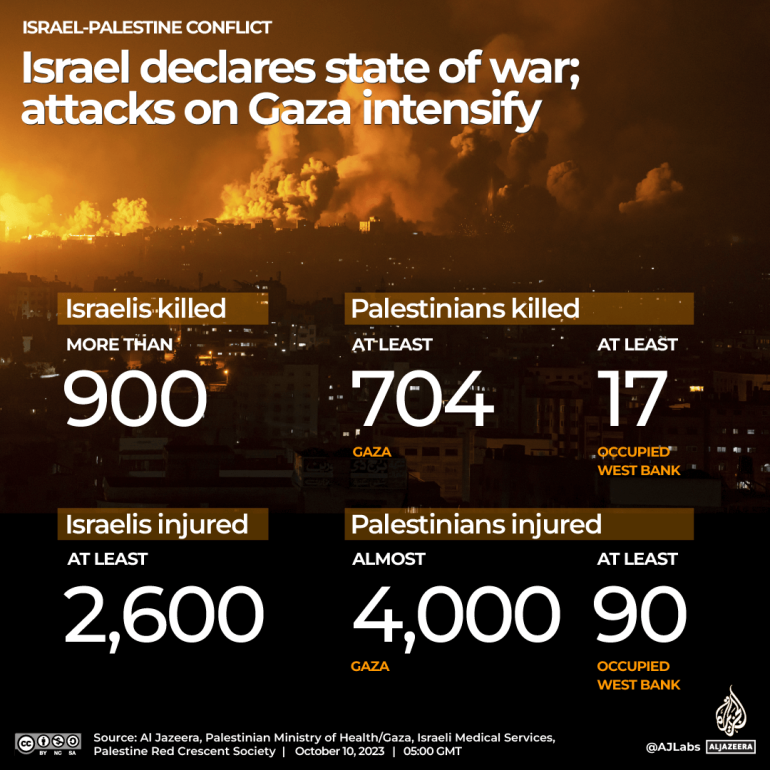
The warning from Hamas came on Monday as the death toll from the armed group’s surprise weekend attack climbed to 900 in Israel and revenge attacks by Israeli forces on the besieged Gaza Strip killed more than 700 people and left some 3,700 others wounded.

Residential apartment blocks, hospitals, schools and a mosque have been among the sites attacked by Israeli fighter jets, artillery and drones, according to media reports and witnesses.

Hamas spokesperson Abu Ubaida issued the threat to kill Israelis from the dozens held captive by the armed group. He said an Israeli hostage would be killed for every Israeli bombing of a civilian house without warning.

Israeli Foreign Minister Eli Cohen said more than 100 people were taken captive by Hamas during the deadly cross-border incursion over the weekend.

As Israeli forces conducted intense retaliatory attacks on Gaza on Monday, Israel’s Defence Minister Yoav Gallant drew international condemnation by announcing a total blockade of the densely populated and besieged enclave, which is home to 2.3 million people.

Gallant said Israel would impose a “complete siege” on Gaza. “No electricity, no food, no water, no gas – it’s all closed.”

United Nations Secretary-General Antonio Guterres said he was “deeply distressed” by the siege announcement and warned that Gaza’s already dire humanitarian situation will now “only deteriorate exponentially”.
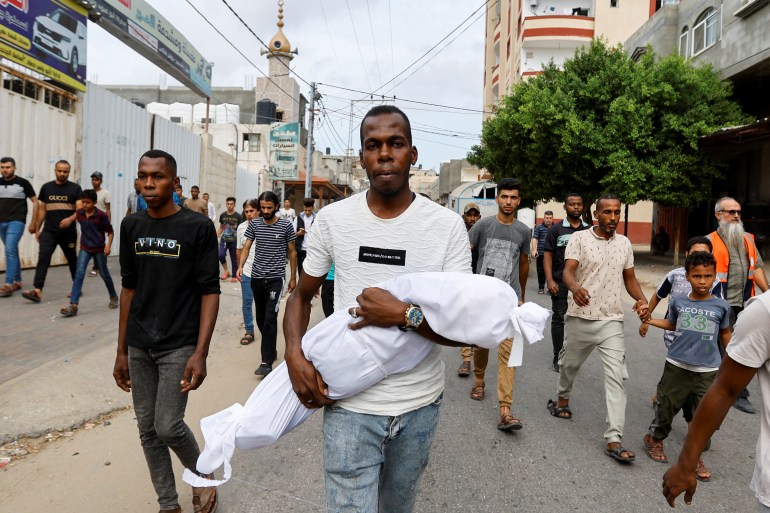
A mourner carries the body of Palestinian boy Saad Lubbad, who health officials said was killed in Israeli strikes, during his funeral in Rafah, in the southern Gaza Strip, October 9, 2023. REUTERS/Ibraheem Abu Mustafa
A mourner carries the body of Palestinian boy Saad Lubbad, who health officials said was killed in an Israeli attack, during his funeral in Rafah, in the southern Gaza Strip, on October 9, 2023 [Ibraheem Abu Mustafa/Reuters]

Guterres also said some 137,000 people were taking shelter with the UN Relief and Works Agency for Palestinian Refugees (UNRWA) at schools across Gaza.

UNRWA said on Tuesday that almost 190,000 people have been displaced in Gaza amid the Israeli attacks and the figure is expected to grow further as the violence intensifies.

Nearly half a million people have also not received food rations this week in Gaza as UN food distribution centres have been forced to remain closed amid the Israeli onslaught, UNRWA said.

Human Rights Watch said Israel’s total blockade on the necessities of life for everyday people in Gaza was a war crime.

“Defense Minister Gallant’s statements are abhorrent,” Omar Shakir, Israel and Palestine director at Human Rights Watch, said in a statement.

“Depriving the population in an occupied territory of food and electricity is collective punishment, which is a war crime, as is using starvation as a weapon of war. The International Criminal Court should take note of this call to commit a war crime,” he said.

Shakir also condemned the threat by Hamas to kill hostages, warning that such action was also a war crime.

“All hostages should be safely released to their families,” he said.

On the diplomatic front, Egyptian President Abdel Fattah el-Sisi and his Turkish counterpart Recep Tayyip Erdogan called on Hamas and Israel to immediately end violence and protect civilians, the Egyptian presidency said.

Erdogan urged Israel against “indiscriminately” attacking civilians and delivered measured criticism of Hamas, urging both sides to respect the “ethics” of war.

The United Kingdom, French, German, Italian and US governments issued a joint statement on Monday recognising the “legitimate aspirations” of the Palestinian people and supporting equal measures of justice and freedom for Israelis and Palestinians alike.
INTERACTIVE_DEATH_TOLL_INJURED_ISRAEL_PALESTINE_OCT10_2023_0415
They said they would remain “united and coordinated” to ensure Israel can defend itself.

But the prospect that fighting could spread also alarmed the region and the world.

Lebanese armed group Hezbollah fired rockets into northern Israel in response to at least three of its members being killed in Israeli shelling of Lebanon.

Israel said one of its deputy commanders was also killed in an earlier cross-border raid from Lebanon.

SOURCE: AL JAZEERA AND NEWS AGENCIES


Continue Reading

Foreign

Western Leaders Accused of Hypocrisy Over Response To Palestine, Ukraine

Published

on

US President Joe Biden holds a bilateral meeting with Israeli Prime Minister Benjamin Netanyahu on the sidelines of the 78th United Nations General Assembly in New York City, the US, September 20, 2023

Social media users, including journalists and observers, are calling out what they call a ‘double standard’.

After Saturday’s surprise attack by the Palestinian group Hamas on Israel, Ukrainian President Volodymyr Zelenskyy took to the social media platform X to offer “condolences go out to everyone who lost relatives or close ones in the terrorist attack”.

He also stated, “Israel’s right to self-defence is unquestionable.”

Many world leaders, including US President Joe Biden and UK Prime Minister Rishi Sunak, shared similar sentiments.

European Commission President Ursula von der Leyen stated, “Israel has the right to defend itself – today and in the days to come. The European Union stands with Israel.”

Accusations of Western ‘double standards’

Some social media users have criticised these statements, saying they highlight a double standard.

Ukraine’s right to defend itself is praised by most international leaders while Russia’s invasion is condemned, but commentators said the same cannot be said about Israel’s occupation of the West Bank and Gaza.

Aaron Bastani, a leftist British journalist, said on X that there’s a “clear double standard in endorsing terrorism against civilian targets in Ukraine … and condemning it by Palestinians”.

Many users said Western diplomats and media support the Ukrainians who defend their land, but label the Palestinians fighting against Israel as “terrorists”.

https://twitter.com/KhaledBeydoun/status/1710787817415082349?ref_src=twsrc%5Etfw%7Ctwcamp%5Etweetembed%7Ctwterm%5E1710787817415082349%7Ctwgr%5E6acf829869e993177f32aa38aa48c02f38cb7f61%7Ctwcon%5Es1_&ref_url=https%3A%2F%2Fwww.aljazeera.com%2Fnews%2F2023%2F10%2F9%2Fwestern-leaders-accused-of-hypocrisy-over-response-to-palestine-ukraine

An illustration of a woman’s face, in which one eye is closed beside a Palestinian flag, and one eye open beside a Ukrainian flag, has been regularly shared as a symbol of the West’s alleged double standards in how the two conflicts are viewed.

https://twitter.com/OnlinePalEng/status/1710994682883273172?ref_src=twsrc%5Etfw%7Ctwcamp%5Etweetembed%7Ctwterm%5E1710994682883273172%7Ctwgr%5E6acf829869e993177f32aa38aa48c02f38cb7f61%7Ctwcon%5Es1_&ref_url=https%3A%2F%2Fwww.aljazeera.com%2Fnews%2F2023%2F10%2F9%2Fwestern-leaders-accused-of-hypocrisy-over-response-to-palestine-ukraine

Clips also emerged on social media from a CNN interview with Mustafa Barghouti, the general secretary of the Palestinian National Initiative, in which he posed the rhetorical question, “Why does the United States support Ukraine in fighting occupation – while here they support the occupier, who continues to occupy us?”

It is not the first time Western nations have been accused of double standards in their stance on the Ukraine war.

Earlier in the year, Amnesty International published a report highlighting the West’s “double standards” on global human rights.

Agnes Callamard, Amnesty’s secretary-general, told Al Jazeera at the time that the occupation of Palestinian territory was a “particularly important one”.

“Without making any comparison between Russia’s aggression and Israel … it is clear the Palestinian people are under a regime of oppression – a regime of occupation and a regime of apartheid,” Callamard told Al Jazeera.

Over the last three days, X users recirculated earlier statements calling out what they called Western hypocrisy, sharing video by the Irish lawmaker Richard Boyd Barrett from March 2022 in which he berated the Irish government’s double standards regarding Ukraine and Palestine:

“You’re happy to use the most strong and robust language to describe the crimes against humanity of [Russian President] Vladimir Putin, but you will not use the same strength of language when it comes to describing Israel’s treatment of the Palestinians.”

Barrett on Sunday again called out what he described as “shocking double standards of Western leaders supporting Ukraine resistance but condemning Palestinian[s].”

Meanwhile, others warned against comparing conflicts.

https://twitter.com/denfordauthor/status/1710993737738768607?ref_src=twsrc%5Etfw%7Ctwcamp%5Etweetembed%7Ctwterm%5E1710993737738768607%7Ctwgr%5E6acf829869e993177f32aa38aa48c02f38cb7f61%7Ctwcon%5Es1_&ref_url=https%3A%2F%2Fwww.aljazeera.com%2Fnews%2F2023%2F10%2F9%2Fwestern-leaders-accused-of-hypocrisy-over-response-to-palestine-ukraine

And some cautioned that Hamas and the Palestinians should not be seen as one and the same.

Ukrainian footballer Oleksandr Zinchenko, who plays for Arsenal, posted on Instagram, stating he “stands with Israel”.

Zinchenko has been a vocal supporter of his home country in its ongoing defence against Russia, and he participated in a Game4Ukraine charity match in London earlier this year to raise money for Ukraine.

After online backlash, with some questioning an alleged double standard in his support of Israel, the footballer removed the post and switched his social media account to private.

Several people claimed that Zinchenko’s football club, in not responding to his comments, was guilty of hypocrisy after they had distanced themselves from former player Mesut Ozil’s comments in 2019 over alleged human rights abuses against Uighur Muslims in China.

SOURCE: AL JAZEERA
Continue Reading

Trending

Copyright © 2013 - 2020, 47vibez Media.