
News
How A Rejected Thanksgiving Speech Forged An Indigenous Holiday Tradition


Indigenous peoples and allies come together on Cole’s Hill in Plymouth, Massachusetts, to hold a National Day of Mourning, timed to coincide with the US holiday of Thanksgiving
Indigenous leader Mahtowin Monro speaks about how the National Day of Mourning offers a corrective to settler myths in the US.
When Mahtowin Monro thinks back to the Thanksgivings of her childhood, she remembers the pageants.
It was an elementary school tradition to divide the class in two, with some children dressed as Pilgrims — in bonnets and tall hats — and others assigned to represent Indigenous peoples, with paper feathers and headbands.
Together, they were meant to act out the holiday myth: that early settlers in the United States embraced their newfound Indigenous neighbours with open arms and a hearty feast.
But even as a child, Monro could sense that depiction was wrong. Now, she helps lead a ceremony meant to honour the real history of Indigenous peoples in North America — a history she believes Thanksgiving plays a part in erasing.
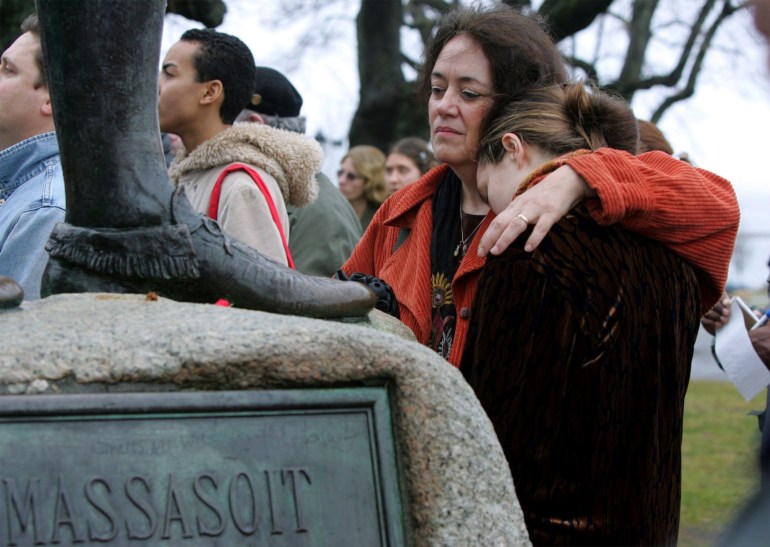
On the fourth Thursday of November, timed to the US Thanksgiving holiday, she and other members of the group United American Indians of New England (UAINE) gather in Plymouth, Massachusetts, to hold a National Day of Mourning.
The event is part protest, part remembrance, part spiritual ceremony. It not only acknowledges the ongoing violence against Indigenous people but also brings together speakers on a range of issues, from environmental destruction to fishing rights.
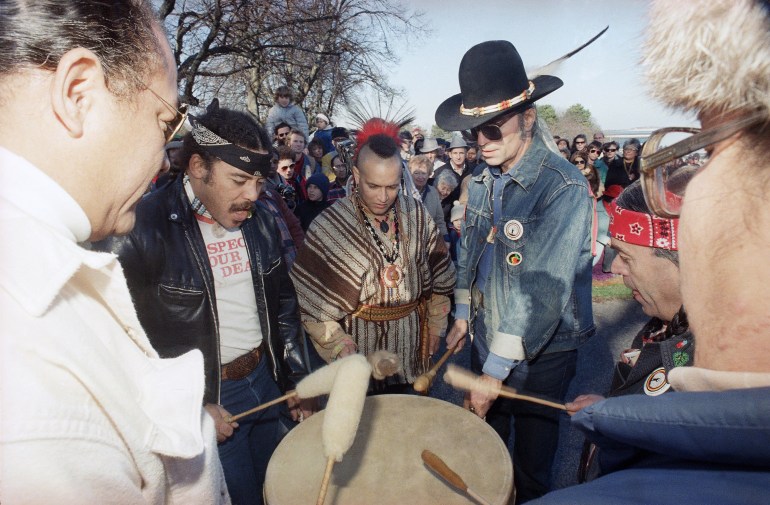
Monro, who identifies as Oglala Sioux, attended her first National Day of Mourning in the mid-1980s and said she was instantly hooked.
“It was, to me, so amazing,” Monro said. “I really liked the idea that there were Native people in New England — some of whom had been told growing up that they were extinct — that were there speaking about their history and what was going on with them now.”
It was at the ceremony that she met the late Indigenous leader Wamsutta Frank James, who would eventually be the grandfather to her twin children.
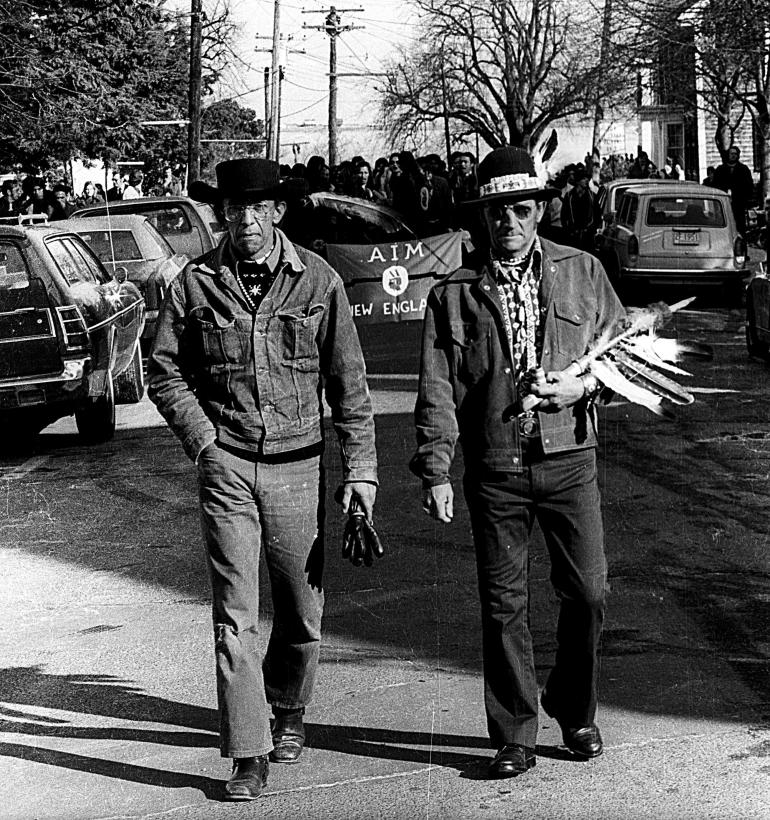
An Aquinnah Wampanoag man, James was among the founders of the National Day of Mourning in 1970.
At the time, he had been invited to speak at the 350th anniversary of the Pilgrims’ arrival to Plymouth — but event organisers revoked the offer after screening his remarks, which referenced the atrocities committed against Indigenous peoples.
“Our lands have fallen into the hands of the aggressor. We have allowed the white man to keep us on our knees,” Frank wrote in his suppressed speech.
“What has happened cannot be changed, but today we must work towards a more humane America, a more Indian America, where men and nature once again are important.”
Rejected from the anniversary event, Frank instead organised a protest on Cole’s Hill, overlooking Plymouth Bay — a tradition Monro and her daughter Kisha James carry on to this day.
Monro spoke to Al Jazeera about her memories of Frank and why reimagining holidays can be a tool for empowerment.
This interview has been edited for length and clarity.

Mahtowin Monro: Well, he was very well known in the area as the head of the Federated Eastern Indian League. He was quite prominent. And I think there was this idea that he was going to come and praise the Pilgrims.
They thought that he would come and say, “Oh, we’re so grateful that the Pilgrims came, and we all got along, and everything has been great.”
He wrote his speech along with his wife. I want to give her credit. It wasn’t just him. But he very carefully used Pilgrim sources such as Mourt’s Relation and other things they had written. He certainly couldn’t go and praise the Pilgrims, but he also felt it was important to tell the truth about what had happened.
Thanksgiving was not a happy time for him or other Wampanoag people because it represents a celebration of the invasion and all the devastation that would follow for Indigenous people in the region. So he was very clear about that.
By today’s standards, his suppressed speech is actually pretty tame. People now would say things even more forcefully, but the state wanted to see his remarks in advance. And when he sent them, they said, “Oh no, you can’t go and give that.”

Al Jazeera: How do you think that the rejection of the speech shaped him as a person and as a leader?
Monro: Certainly he was not going to go give a speech that would be palatable to these state officials. He was not going to give a speech in praise of the Pilgrims and all the good that they had supposedly done for Indigenous peoples, when that was completely counter to any historical reality.
He had been somebody whose family had suffered a lot of discrimination. I’ll give you an example. He was, we believe, the first Native man to graduate from the New England Conservatory of Music. He was an incredibly talented musician, a trumpet player.
When he got to the end of his courses at the New England Conservatory, he was told by his primary teacher, who cared about him very much: “You’re the best trumpet player in this class, but no symphony orchestra in the country will hire you because of the colour of your skin.”
And that was true because he was dark-skinned. At the time, all the orchestras in the country were all white, right? So, given all his talent, he couldn’t get a job.
He experienced tremendous discrimination in his life, as did his family. All his siblings, all of them would talk about how they had to run faster and study harder and do everything better to try to overcome all the prejudice that they dealt with.
I think that’s why he felt strongly — well before 1970 — that it was important for Indigenous people in the region to be united and to work together to assert themselves as Indigenous people and to demand respect from the white people.
Al Jazeera: You and your daughter Kisha are very much keeping his legacy alive and keeping this ceremony alive. How did he inspire you? How did he shape your work today?
Monro: I learned everything about the Day of Mourning from him — how to do things and what the traditions were, that sort of thing. I spent many hours talking to him about that, to understand them more fully.
I didn’t at the time know that I would end up being a leader in the organization, but certainly it led to that. And he was very supportive. He also felt that it would be important to have more women out front. To be honest, although women had always done a lot of the work, they weren’t necessarily out front as speakers or leaders within the organization.
What I learned from him is to just keep doing this, because it’s really important to do this kind of educational work and speak truth to power and tell the truth about our history.

Al Jazeera: There’s this larger push to question holidays like Thanksgiving and Columbus Day and, in some cases, reimagine those holidays entirely. Why is it important to interrogate holidays and question the history that they celebrate?
Monro: Our organization obviously does more in the year than just organising the National Day of Mourning. One of the things that we do is we do work on Indigenous Peoples’ Day campaigns — that is, campaigns to abolish Columbus Day and celebrate Indigenous Peoples’ Day instead.
We’ve been doing that for several years now. In Massachusetts, for instance, we have managed to get resolutions passed in at least 30 towns. But we’re also trying to get it passed on a statewide basis.
The celebration of [European explorer Christopher] Columbus is really harmful. It gives us the idea that Native people were these passive people, just waiting for Columbus to arrive — just waiting to be discovered — when, in fact, they had many, many different cultures and were perfectly successful on their own.
But it continues to be presented that Columbus and all the Europeans who came somehow brought civilisation to us. All of this is really damaging. It is damaging if you’re a kid and you’re Native. You know, Columbus was a genocidal maniac. We don’t hide that from our kids.
It is damaging not just to our kids but any kid to learn nonsense like that. It’s the worst kind of settler colonial nonsense. It erases us and presents their version of history as the only true history. So these things are really embedded throughout American culture, and it’s really important to resist that and to call it out.
Monro: Well, we address them individually, or sometimes we don’t address them at all.
There are people who absolutely resist any truth-telling. They don’t want to hear about the genocide of Indigenous people. They want to have this very pretty George-Washington-and-cherry-pie kind of history that doesn’t tell the truth.
So we’re not going to change their minds and really don’t waste our time fighting with them. But there are a lot of other people: settlers who’ve grown up with all this mythology, with all this nonsense. When they start to find out the truth, they’re actually pretty mad that they were lied to for so long.
So I think it’s really important for non-Native people to experience being with Native people and listening to us and getting a better understanding. They don’t understand whose land they are on. And believe me, we make that clear.






itel, the technology empowerment brand for masses, officially unveiled its new product A300+, brand’s first interactive dual-screen smartphone in its price range. itel A300+ comes with a comprehensive set of features — a 7000mAh marathon battery, IP65 military-grade durability, and satellite communication capability, demonstrating that innovation and complete product strength can coexist at an accessible price point.

A First-of-Its-Kind Rear Screen Experience: Interactive Innovation for a New Generation
itel A300+ coming with an interactive rear display is a rare feature in this price category, designed to deliver a smart entertainment experience for young generations. Far from being a cosmetic gimmick, the rear screen provides practical functions built around real everyday scenarios. Users can frame selfies using the higher-quality rear camera with a live preview on the back screen, glance at incoming messages and alerts without waking the main display, and play, pause, or skip tracks directly from the rear screen. The rear display also supports customizable clocks, photos, and designs, giving users a personal window to express their individual style. Complementing the rear screen, the A300+ features a 6.78-inch immersive punch-hole main display, offering a cleaner, more expansive viewing experience for streaming, gaming, browsing, and social media.

Performance and Value in Balance: Delivering Fresh Technology Despite Industry Pressure
Even amid rising industry costs, itel has chosen to bring fresh technology to its products while continuously improving performance and keeping pricing accessible. The A300+ is powered by a 7000mAh marathon battery engineered for long-term reliability, supporting up to 1,200 charging cycles — far exceeding the industry standard, and designed to retain healthy capacity. AI Charging Protection intelligently manages charging patterns to reduce battery degradation, while Smart Power Management optimizes power consumption across apps and hardware to extend usage time between charges.

The device also features 300% ultra-volume DTS stereo speakers, delivering rich, room-filling sound for music, videos, FM radio, and everyday entertainment. Built to withstand daily life and beyond, the A300+ carries IP65 water and dust resistance certification and meets military-grade durability standards, resisting splashes, dust, and accidental drops. Notably, the A300+ includes satellite communication capability, ensuring users can still send basic messages via satellite when cellular networks are unavailable — a safety net in remote areas, during natural disasters, or in other critical situations, setting it apart in its price segment.

The A300+ is built on a clear product philosophy, rather than relying on a single headline feature, it combines its key strengths into one complete product story. The rear screen captures attention first, while battery life, durability, and practical usability make the overall value proposition convincing. With the A300+, itel once again demonstrates its commitment to using innovation to meet the needs and desire for novelty among young users in emerging markets.
The itel A300+ is available in two variants: the 64GB ROM and 128GB ROM and they are both available in all phone retail stores in Nigeria or via online store HERE


DJ ROBOT teams up with TMP OFFISIAL and FATEOFTHEYOUTH for NDSM DELUXE, a new DJ mixtape that expands the world of NDSM — No Dey Stress Me into a bigger, more energetic listening experience.
Built around DJ ROBOT’s approach to sequencing, mixing, and controlling energy, NDSM DELUXE transforms the NDSM mindset into a full sonic journey. The mixtape explores nightlife, pressure, temptation, confidence, freedom, desire, and the decision to simply refuse to let life overwhelm you.
Bringing together DJ ROBOT’s DJ-driven vision with the creative energy of TMP OFFISIAL and FATEOFTHEYOUTH, the deluxe edition adds new dimensions to the original NDSM message while maintaining its central philosophy: No Dey Stress Me.
Rather than simply extending the original project, NDSM DELUXE is designed as an experience — moving through different moods, rhythms, and moments while allowing each transition to contribute to the story.
For DJ ROBOT, the project represents an opportunity to communicate through energy as much as words.
“The original NDSM had more energy and stories to explore. I wanted to take the ‘No Dey Stress Me’ mindset beyond the song and turn it into a full DJ experience — something that captures nightlife, freedom, pressure, temptation, and the moments when you simply choose to enjoy yourself and live in the present.”
Listen below;

Nigerian artist N8TAN is set to unveil his highly anticipated ‘UPRISING EP’, a body of work that chronicles his journey from the streets to the heights of his musical ambition.
Built around themes of struggle, resilience, ambition, survival, and triumph, UPRISING captures the realities of an artist determined to turn adversity into momentum. The project reflects N8TAN’s experiences, the challenges that shaped him, and the relentless drive that continues to push him forward.
More than a collection of songs, UPRISING is presented as a story of transformation—from navigating the streets and confronting uncertainty to finding purpose, embracing growth, and rising toward the top.
With its blend of raw storytelling, infectious energy, and personal perspective, the EP offers listeners an intimate look into N8TAN’s world while reinforcing his determination to carve out his own place in the music industry.
‘UPRISING EP’ is a statement of elevation: a reminder that where you start does not have to determine where you finish.
As N8TAN continues to build his musical identity, UPRISING marks another significant chapter in his journey—and an invitation for listeners to rise with him.
-
 Audio10 years ago
Page – Day Break Everywhere Burst
-
 Audio5 years ago
Shadykarz – Forever
-
 Audio10 years ago
Juniorboy ft. 9ice – IRAPADA
-
 Entertainment Gists6 years ago
Ex-Beauty Queen, Sandra Benede Shares Sexy Photo
-
 Audio5 years ago
Simi – Happy Birthday ft. Adekunle Gold, DeJa
-
 Audio5 years ago
Ruger – Bounce
-
 Mixtapes4 years ago
Mixtape: DJ DimpleNipple – The Best Of Amapiano Thrills
-
 Editorials3 years ago
Sa’eedah Imam On Creating Her Imprint In The Nigerian Music Industry As An Emerging Creative Writer