
News
Henry Kissinger: 10 Conflicts, Countries That Define A Blood-stained Legacy

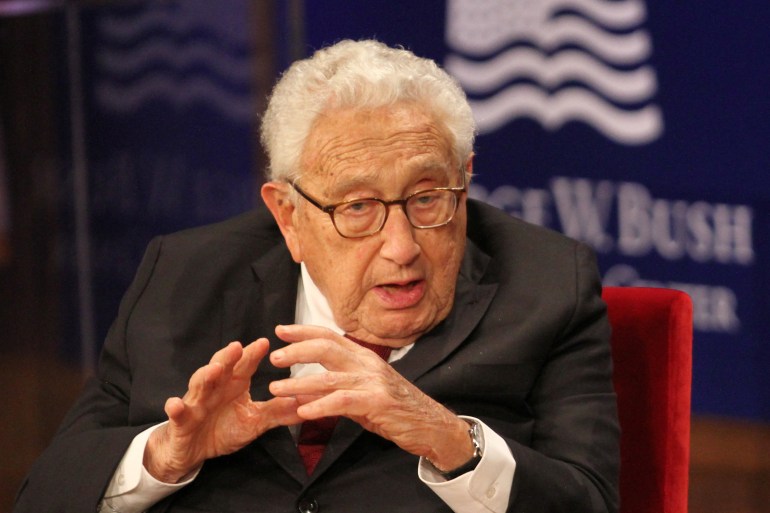
Former US Secretary of State Henry Kissinger speaks at the George W Bush Presidential Center’s 2019 Forum on Leadership in Dallas, Texas, on April 11, 2019
The master of cold realpolitik left a legacy of destruction that is still playing out across the world.
To some, he was a titan of foreign policy, the Holocaust survivor who built a glittering career as the top diplomat of the United States and national security adviser during Presidents Richard Nixon’s and Gerald Ford’s administrations, leaving an enduring mark on history.
But to others, Henry Kissinger was a war criminal, whose brutal exercise of realpolitik left a trail of blood around the world – an estimated 3 million bodies in far flung places from Argentina to East Timor.
As the late British author and journalist Christopher Hitchens once wrote: “Henry Kissinger should have the door shut in his face by every decent person and should be shamed, ostracised, and excluded.”
Here are 10 nations, regions and conflicts that Kissinger intervened in, leaving an often blood-stained legacy that in many cases still lives on.
Vietnam
Kissinger won a Nobel Peace Prize for negotiating a ceasefire in Vietnam in 1973. But that war might actually have ended four years earlier had he not enabled Nixon’s plan to “monkey wrench” President Lyndon B Johnson’s peace negotiations. In 1969, Nixon was elected president, and Kissinger was promoted to the role of national security adviser. The prolonged war cost the lives of millions of Vietnamese, Cambodians and Laotians.
Cambodia
Kissinger’s expansion of the war set the scene for the genocidal rule of the Khmer Rouge in Cambodia, which seized power from a US-backed military regime and went on to kill a fifth of the population – two million people. Cambodians had been driven into the hands of the communist movement by Kissinger and Nixon’s carpet-bombing campaign, which killed hundreds of thousands of people. To this day, people are still dying from unexploded US ordinance.
Bangladesh
In 1970, Bengali nationalists in what was then known as East Pakistan won elections. Fearing a loss of control, the military government in West Pakistan launched a murderous crackdown. Kissinger and Nixon stood staunchly behind the slaughter, choosing not to warn the generals to hold back. Motivated by Pakistan’s usefulness as a counterweight to China and to Soviet-leaning India, Kissinger was unmoved by the killing of 300,000 to three million people. Captured in a secret recording, he voiced disdain for people who “bleed” for “the dying Bengalis”.
Chile
Nixon and Kissinger disapproved of Salvador Allende, a self-proclaimed Marxist, who was democratically elected as Chile’s president in 1970. Over the ensuing three years, they invested millions of dollars into fomenting a coup. Then-CIA chief William Colby told a secret 1974 hearing of the Armed Services Special Subcommittee on Intelligence in the House of Representatives that the US government had spent $11m to “destabilise” Allende’s government. That included $1.5m that the CIA funnelled into Santiago newspaper El Mercurio, which was opposed to Allende. CIA operatives also forged links with the Chilean military. In 1973, General Augusto Pinochet came to power in a military coup. During his 17-year-long rule, more than 3,000 people were disappeared or killed, and tens of thousands of opponents were imprisoned. As Kissinger told Nixon: “We didn’t do it. I mean we helped them.” More than three decades after Pinochet was finally forced out of office, Chile is still grappling with the former dictator’s US-enabled legacy.
Cyprus
Home to Greek and Turkish populations, Cyprus had seen ethnic violence throughout the 1960s. In 1974, after a coup by Greece’s ruling military government, Turkish troops moved in. Kissinger effectively encouraged a crisis between the two NATO allies, advising newly installed President Ford to appease Turkey. “The Turkish tactics are right – grab what they want and then negotiate on the basis of possession,” he is reported to have said. Together, the Greek coup and the Turkish invasion resulted in thousands of casualties.
East Timor
In 1975, Kissinger greenlit President Suharto of Indonesia’s invasion of East Timor, a former Portuguese colony moving towards independence. During a visit to Jakarta, Kissinger and Ford told Suharto, a brutal dictator and close ally in the battle against communism, that they understood his reasons, advising him to get it over and done with quickly. The next day, Suharto moved in with his US-equipped army, killing 200,000 East Timorese.
Israel
When the October War in 1973 broke out when a coalition of Arab nations led by Egypt and Syria attacked Israel, Kissinger led the Nixon administration’s response. He pushed back against the Pentagon’s attempts to delay the shipment of arms to Israel, rushing through weapons that helped the Israeli army reverse early losses and reach within 100km (62 miles) of Cairo. A ceasefire followed. His shuttle diplomacy between Egypt, other Arab nations and Israel is often credited with paving the way for the eventual signing of the Camp David Accords in 1978. By then, Kissinger was out of office, but in 1981, he explained that at the heart of his diplomacy in the Middle East was a simple policy objective — to “isolate the Palestinians” from their Arab neighbours and friends.
Argentina
No longer in office after Jimmy Carter succeeded Ford as president in 1976, Kissinger continued to endorse murder, giving his seal of approval to the neo-fascist Argentinian military, which had overthrown the government of President Isabel Peron that same year. The military government waged a dirty war against leftists, branding dissidents as “terrorists”. During a visit to Argentina in 1978, Kissinger flattered dictator Jorge Rafael Videla, lauding him for his efforts in combatting “terrorism”. Videla would oversee the disappearance of up to 30,000 opponents. About 10,000 people died during the military’s rule, which lasted until 1983.
Southern Africa
During most of his time in the Nixon and Ford administrations, Kissinger didn’t appear to have given Africa much thought. But in 1976, as his time in office drew to a close, he visited South Africa, bestowing political legitimacy on the apartheid government shortly after the Soweto uprising, which saw Black schoolchildren and others gunned down by police. While he did force Rhodesian Prime Minister Ian Smith into accepting majority Black rule, he cleaved close to South Africa’s apartheid government in its support for Unita rebels fighting the Marxist-Leninist People’s Movement for the Liberation of Angola. That war lasted 27 years, one of the longest and most brutal of the past century.
China
Kissinger is often praised for brokering the US-China detente. After an initial visit to Beijing in 1972, he helped re-establish diplomatic ties in 1979. Chinese President Xi Jinping has described him as an “old friend”. However, the protesters who camped out at Tiananmen Square in 1989 remember him less fondly. In the immediate aftermath of the massacre – which killed anywhere between several hundred and several thousand people – he offered a glimpse of the cold, hard realpolitik that characterised his approach to diplomacy. The crackdown, he said, was “inevitable”. “No government in the world would have tolerated having the main square of its capital occupied for eight weeks by tens of thousands of demonstrators,” he said. China, he said, needed the US, and the US needed China.



itel, the technology empowerment brand for masses, officially unveiled its new product A300+, brand’s first interactive dual-screen smartphone in its price range. itel A300+ comes with a comprehensive set of features — a 7000mAh marathon battery, IP65 military-grade durability, and satellite communication capability, demonstrating that innovation and complete product strength can coexist at an accessible price point.

A First-of-Its-Kind Rear Screen Experience: Interactive Innovation for a New Generation
itel A300+ coming with an interactive rear display is a rare feature in this price category, designed to deliver a smart entertainment experience for young generations. Far from being a cosmetic gimmick, the rear screen provides practical functions built around real everyday scenarios. Users can frame selfies using the higher-quality rear camera with a live preview on the back screen, glance at incoming messages and alerts without waking the main display, and play, pause, or skip tracks directly from the rear screen. The rear display also supports customizable clocks, photos, and designs, giving users a personal window to express their individual style. Complementing the rear screen, the A300+ features a 6.78-inch immersive punch-hole main display, offering a cleaner, more expansive viewing experience for streaming, gaming, browsing, and social media.

Performance and Value in Balance: Delivering Fresh Technology Despite Industry Pressure
Even amid rising industry costs, itel has chosen to bring fresh technology to its products while continuously improving performance and keeping pricing accessible. The A300+ is powered by a 7000mAh marathon battery engineered for long-term reliability, supporting up to 1,200 charging cycles — far exceeding the industry standard, and designed to retain healthy capacity. AI Charging Protection intelligently manages charging patterns to reduce battery degradation, while Smart Power Management optimizes power consumption across apps and hardware to extend usage time between charges.

The device also features 300% ultra-volume DTS stereo speakers, delivering rich, room-filling sound for music, videos, FM radio, and everyday entertainment. Built to withstand daily life and beyond, the A300+ carries IP65 water and dust resistance certification and meets military-grade durability standards, resisting splashes, dust, and accidental drops. Notably, the A300+ includes satellite communication capability, ensuring users can still send basic messages via satellite when cellular networks are unavailable — a safety net in remote areas, during natural disasters, or in other critical situations, setting it apart in its price segment.

The A300+ is built on a clear product philosophy, rather than relying on a single headline feature, it combines its key strengths into one complete product story. The rear screen captures attention first, while battery life, durability, and practical usability make the overall value proposition convincing. With the A300+, itel once again demonstrates its commitment to using innovation to meet the needs and desire for novelty among young users in emerging markets.
The itel A300+ is available in two variants: the 64GB ROM and 128GB ROM and they are both available in all phone retail stores in Nigeria or via online store HERE


DJ ROBOT teams up with TMP OFFISIAL and FATEOFTHEYOUTH for NDSM DELUXE, a new DJ mixtape that expands the world of NDSM — No Dey Stress Me into a bigger, more energetic listening experience.
Built around DJ ROBOT’s approach to sequencing, mixing, and controlling energy, NDSM DELUXE transforms the NDSM mindset into a full sonic journey. The mixtape explores nightlife, pressure, temptation, confidence, freedom, desire, and the decision to simply refuse to let life overwhelm you.
Bringing together DJ ROBOT’s DJ-driven vision with the creative energy of TMP OFFISIAL and FATEOFTHEYOUTH, the deluxe edition adds new dimensions to the original NDSM message while maintaining its central philosophy: No Dey Stress Me.
Rather than simply extending the original project, NDSM DELUXE is designed as an experience — moving through different moods, rhythms, and moments while allowing each transition to contribute to the story.
For DJ ROBOT, the project represents an opportunity to communicate through energy as much as words.
“The original NDSM had more energy and stories to explore. I wanted to take the ‘No Dey Stress Me’ mindset beyond the song and turn it into a full DJ experience — something that captures nightlife, freedom, pressure, temptation, and the moments when you simply choose to enjoy yourself and live in the present.”
Listen below;

Nigerian artist N8TAN is set to unveil his highly anticipated ‘UPRISING EP’, a body of work that chronicles his journey from the streets to the heights of his musical ambition.
Built around themes of struggle, resilience, ambition, survival, and triumph, UPRISING captures the realities of an artist determined to turn adversity into momentum. The project reflects N8TAN’s experiences, the challenges that shaped him, and the relentless drive that continues to push him forward.
More than a collection of songs, UPRISING is presented as a story of transformation—from navigating the streets and confronting uncertainty to finding purpose, embracing growth, and rising toward the top.
With its blend of raw storytelling, infectious energy, and personal perspective, the EP offers listeners an intimate look into N8TAN’s world while reinforcing his determination to carve out his own place in the music industry.
‘UPRISING EP’ is a statement of elevation: a reminder that where you start does not have to determine where you finish.
As N8TAN continues to build his musical identity, UPRISING marks another significant chapter in his journey—and an invitation for listeners to rise with him.
-
 Audio10 years ago
Page – Day Break Everywhere Burst
-
 Audio5 years ago
Shadykarz – Forever
-
 Audio10 years ago
Juniorboy ft. 9ice – IRAPADA
-
 Entertainment Gists6 years ago
Ex-Beauty Queen, Sandra Benede Shares Sexy Photo
-
 Audio5 years ago
Simi – Happy Birthday ft. Adekunle Gold, DeJa
-
 Audio5 years ago
Ruger – Bounce
-
 Mixtapes4 years ago
Mixtape: DJ DimpleNipple – The Best Of Amapiano Thrills
-
 Editorials3 years ago
Sa’eedah Imam On Creating Her Imprint In The Nigerian Music Industry As An Emerging Creative Writer