
News
Gaza’s Kidney Patients Face Dialysis Crisis At Jam-packed Hospitals


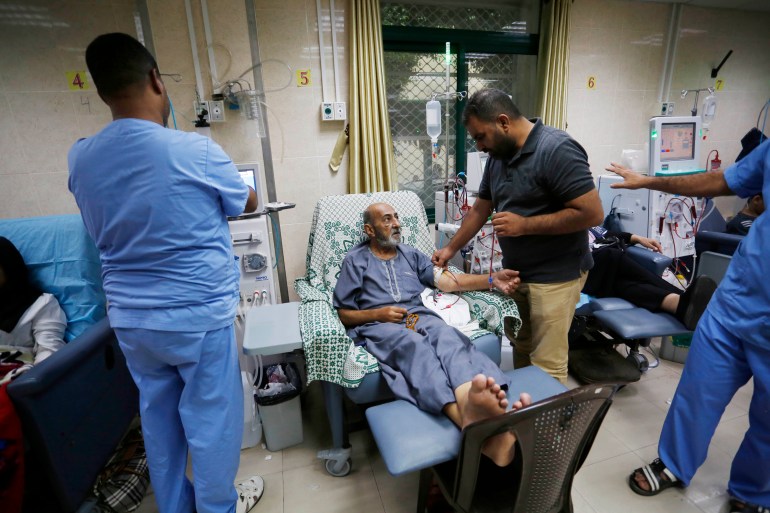
Haniyeh Wishah, 77, is among the hundreds of kidney dialysis patients who now receive treatment once or twice a week instead of the usual three weekly sessions
The number of kidney dialysis patients has more than doubled at the Al-Aqsa Martyrs Hospital, with hundreds of people now receiving reduced treatment sessions from just 24 machines.
Deir el-Balah, Gaza Strip – Al Aqsa Martyrs Hospital, the only hospital still functioning in the central Gaza Strip, reached full capacity days ago. Injured people lie on the hospital floors, medical tents and mattresses holding patients occupy the space outside the building, while dead bodies continue to arrive at the facility.
Thousands of displaced Palestinians have taken refuge here, squeezing themselves in corridors and waiting rooms. Meanwhile, many patients with chronic diseases who were being treated at hospitals in the north of the besieged enclave are now at Al Aqsa Martyrs, having fled their homes after evacuation orders from the Israeli military.
For kidney patients, dialysis treatment is a matter of life and death.
Before the latest Israeli offensive began on October 7, the hospital had 143 patients requiring dialysis. Now, the number of patients has more than doubled to about 300, including 11 children who all have just 24 dialysis machines between them.
Iyad Issa Abu Zaher, the hospital’s director general, said the facility is overwhelmed.
“We have resorted to rationing of all resources and medical supplies,” he told Al Jazeera. “A kidney dialysis patient now undergoes treatment once or twice a week for an hour or two, but before they used to come in three times a week.”

Even before the war, Gaza’s health ministry had warned that the lives of 1,100 kidney failure patients, including 38 children, were at risk due to a lack of fuel and an acute shortage of the necessary medical supplies needed for dialysis.
Last month, Alaa Helles, the director of the Hospital Pharmacy Department at Gaza’s Ministry of Health, said the territory’s hospitals provided 13,000 dialysis sessions every month.
This requires more than 13,000 filters, 13,000 blood collection tubes and 26,000 blood cannulas per month, but since Israel and Egypt control the territory’s border crossings, even before the war patients were often left to wonder whether there would be enough supplies to treat them.
The Gaza Strip has been under an Israeli blockade for 16 years with the movement of goods severely curtailed by Israel and Egypt. The blockade has only tightened since October 7, following an attack by the armed wing of the Palestinian group Hamas in southern Israel. So far, only several dozen aid trucks have been allowed in – a “drop in the ocean” in terms of the aid needed. Before the war, some 450 trucks entered daily with supplies.
Breaking point
Abu Zaher said the Gaza Strip’s healthcare system has reached a breaking point, echoing the health ministry’s statement on Tuesday regarding the remaining operating hospitals.
Already, 12 hospitals and 32 health centres have been forced to stop functioning, the ministry statement said. “And we fear that more will stop due to the Israeli targeting and the lack of fuel,” it added.
But keeping the doors of the remaining hospitals in the Gaza Strip open does not in itself mean these facilities are able to treat the wounded who flock to them, the statement said, saying that many medicines and medical supplies have already run out in hospitals.

Abu Zaher said that without fuel, patients in operating rooms, intensive care units, babies being kept alive in incubators and others who rely on lifesaving machines are all at risk.
“Patients are stacked outside operating rooms as we don’t have enough beds,” he said. Meanwhile, others recovering after operations have been moved to the outdoor tents – “a field hospital of sorts,” he explained.
But Abu Zaher also stressed that recovery for patients who have been treated is not guaranteed given that the overcrowded environment and lack of medical supplies can lead to serious infections.
“The outbreak of disease is inevitable,” he said. “There will be a humanitarian disaster after the war ends.”
‘Exhausted from this reality’
Manar Shreir from the Zeitoun neighbourhood in Gaza City used to go to the Al-Quds Hospital for kidney dialysis.
She and her family fled the intense Israeli bombardment of the city and made their way to Deir el-Balah in the central Gaza Strip, where her sister lives, after the Israeli military ordered 1.1 million Palestinians from the north to evacuate to the south.
The Al-Quds Hospital also received warnings from the Israeli military to evacuate, indicating that it could be targeted, the Palestinian Red Crescent has said. The hospital’s director responded to the Israeli military saying a large-scale evacuation would be possible only if Israel provided buses to transport the 12,000 people taking shelter at Al-Quds – including patients – to the southern Gaza Strip and ensured a safe space for them there. The Israeli official reportedly hung up.
But even those like Shreir, who have managed to make it to the south, face a struggle to get treatment.
“My sister’s house [in Deir el-Balah] is close to Al Aqsa Martyrs Hospital, but I still have to queue for hours since the early morning, just waiting [for] my turn,” said Shreir as she sits up in a hospital bed with a red blanket around her legs.
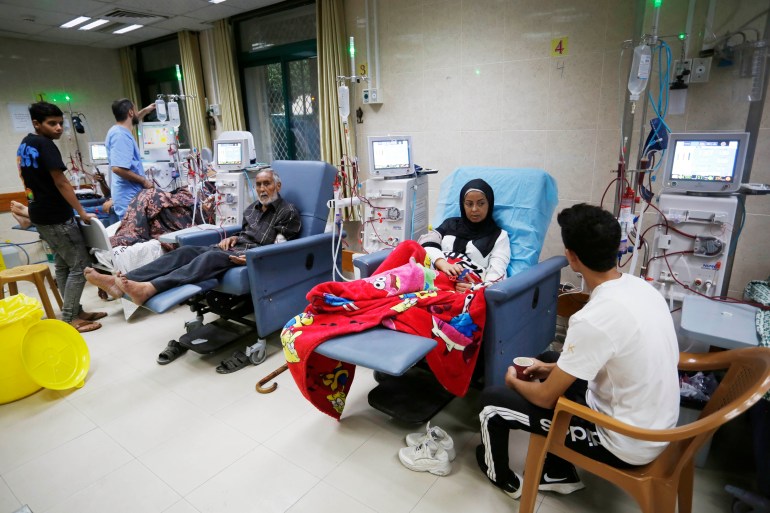
Shreir has been on dialysis since 2015, going to the hospital three times a week for four-hour sessions. Now, she is lucky if she can get dialysis twice a week, for up to two and a half hours per session.
“It’s a huge difference,” she said. “The session is barely enough to get the toxins and accumulated fluids out of my blood. I have to watch what I eat and drink, and I barely let water pass my lips because I don’t want to have shortness of breath or swelling.”
After her last treatment, Shreir was on her way back to her sister’s house when Israeli air attacks hit the street parallel to the one she was on.
“It’s terrifying,” she said. “Even when you are in the hospital you’re scared. Windows have shattered before, the destruction is all around you, not to mention the horrific sound of the bombs. Inside, it’s not any better, with bodies of people killed piled up, blood on the floor, people missing limbs.
“We are exhausted from this reality. Enough criminality, enough war.”

‘Not enough’
Hajj Salah al-Din Ahmed Suleiman Abu Iyadeh, 61, a displaced patient from Gaza City receiving dialysis at Al Aqsa Martyrs Hospital, said that without regular treatment, patients will suffer from severe fatigue and swelling.
“Dialysis that is two and a half hours once or twice a week is not enough,” he said.
“These are toxins in the body which can’t be allowed to stay. Right now, we are making do, but if this war continues, there will be serious problems due to the capacity and immense pressure the hospital is under.”
According to the health ministry, Israeli air attacks have killed 5,791 Palestinians in 18 days, including 2,360 children and 1,292 women. More than 16,000 others have been wounded.
About 1,500 people are trapped under rubble, including 830 children, according to the health ministry.

The Al Aqsa Martyrs Hospital alone has received 2,850 injured people and the bodies of almost 1,000 Palestinians, Abu Zaher said.
“Most of the casualties are men, women and children who were killed inside their own homes after an Israeli air raid targeted their building,” he said.
Staff at the hospital work under constant, tremendous pressure due to the overwhelming health situation as well as their personal circumstances.
“Some of our staff have received news that their families were targeted or killed in Israeli air attacks,” he said. “No hospital in the world operates like this.”





For today’s students and Gen Zs, a smartphone is more than just a communication device—it’s a study partner, entertainment hub, camera and productivity tool. From attending virtual classes and researching assignments to creating content and staying connected with friends, students need a phone that can keep up with their fast-paced lifestyle.
The itel A300+ is designed to do exactly that. Combining a 2.01-inch Smart Secondary Screen, a 7000mAh Ultra-Large Battery, and IP65 dust and water resistance, it delivers practical features that make everyday student life easier.
Power through every lecture and moment
Whether you’re moving between lecture halls, spending hours in the library or commuting across town, battery life matters. The 7000mAh battery keeps you connected throughout the day!
Smart convenience at a glance
The itel A300+’s standout feature is its 2.01-inch Smart Secondary Screen. It lets you quickly view notifications, control your music, personalise watch faces and even preview selfies using the rear camera—all without constantly unlocking your phone.
It’s a smarter, faster way to stay connected while keeping distractions to a minimum.

Built for everyday Life
Life can be unpredictable. From rushing between classes to unexpected rain showers, students need a phone that can handle everyday challenges. With IP65 dust and water resistance, the itel A300+ is built to offer added confidence wherever the day takes you.
When it’s time to relax, the hole-punch display and dual speakers provide an immersive experience for streaming, gaming and enjoying your favourite content.
Get the itel A300+ Now
Whether you’re preparing for a new semester or simply looking for a smartphone that can keep up with your daily routine, the itel A300+ offers the right balance of innovation, performance and convenience.
Visit your nearest itel Home Store today, Click HERE or check out a retail store near you and experience the itel A300+. Plus, enjoy FREE 1GB on your MTN line and 50% bonus data on every recharge for the next six months when you purchase the device.



Fitness meets cultural expression as GOOD SWEAT prepares to bring its CULTURE RUN experience to Lagos on Saturday, October 31, 2026.
Designed around the connection between physical wellness and cultural identity, CULTURE RUN offers participants an opportunity to embrace an active lifestyle while celebrating the richness of African culture. The event brings together fitness enthusiasts, culture lovers, and individuals looking for a refreshing way to connect through movement and shared experiences.
The run is scheduled to begin at 4:30 PM, setting the stage for an evening that extends beyond fitness. At 6:00 PM, participants can look forward to the CULTURE PARTY, the event’s post-run celebration.
Adding to the experience is a distinctive dress code that encourages attendees to wear their regular running kits with a touch of cultural wear. This creative blend of athletic apparel and traditional-inspired fashion gives participants an opportunity to express their individuality while celebrating their cultural roots.
The event will take place at Bistrot Samantha’s, located at 7/12 Rumen’s Road, Ikoyi, Lagos.
With its combination of fitness, fashion, culture, and social interaction, CULTURE RUN aims to create an experience that extends beyond the running track, bringing people together through a shared appreciation for wellness and cultural expression.
As Lagos continues to embrace lifestyle experiences that combine fitness with social engagement, CULTURE RUN offers an opportunity for participants to stay active, celebrate their heritage, and connect with like-minded individuals in a vibrant setting.
EVENT DETAILS
Event: CULTURE RUN
Presented by: GOOD SWEAT
Date: Saturday, October 31, 2026
Run Time: 4:30 PM
Post-Run Party: 6:00 PM
Dress Code: Running kit with a touch of cultural wear
Venue: Bistrot Samantha’s
Address: 7/12 Rumen’s Road, Ikoyi, Lagos, Nigeria

-
 Audio10 years ago
Page – Day Break Everywhere Burst
-
 Audio5 years ago
Shadykarz – Forever
-
 Audio10 years ago
Juniorboy ft. 9ice – IRAPADA
-
 Entertainment Gists6 years ago
Ex-Beauty Queen, Sandra Benede Shares Sexy Photo
-
 Audio5 years ago
Simi – Happy Birthday ft. Adekunle Gold, DeJa
-
 Audio5 years ago
Ruger – Bounce
-
 Mixtapes4 years ago
Mixtape: DJ DimpleNipple – The Best Of Amapiano Thrills
-
 Editorials4 years ago
Sa’eedah Imam On Creating Her Imprint In The Nigerian Music Industry As An Emerging Creative Writer