
News
Does Israel Have The Right To Self-Defence in Gaza?

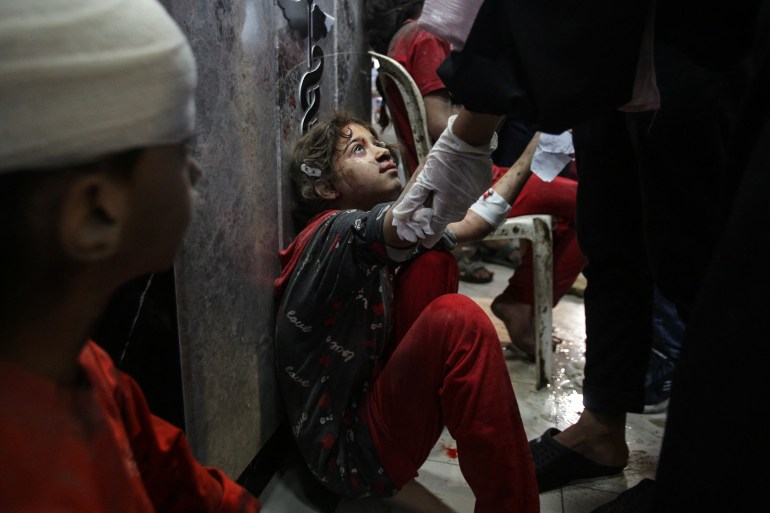
An injured girl awaits treatment at the emergency ward of al-Shifa Hospital after an Israeli strike in Gaza City on November 5, 2023
Many experts believe Israel’s case is weak because Gaza has in effect been under Israeli control.
Israel has stormed Gaza’s largest hospital and bombed residential areas and refugee camps in attacks the United Nations human rights chief Volker Turk says have unleashed a “nightmarish” situation in the besieged Palestinian enclave.
There are growing calls for a ceasefire as the humanitarian situation worsens with risks of starvation facing thousands due to the Israeli blockade of the territory – home to 2.3 million people.
Israel and its allies, meanwhile, have insisted the bombings are justified because it has the right to self-defence in response to the October 7 Hamas attacks that killed 1,200 people and injured more than 5,600 in southern Israel.
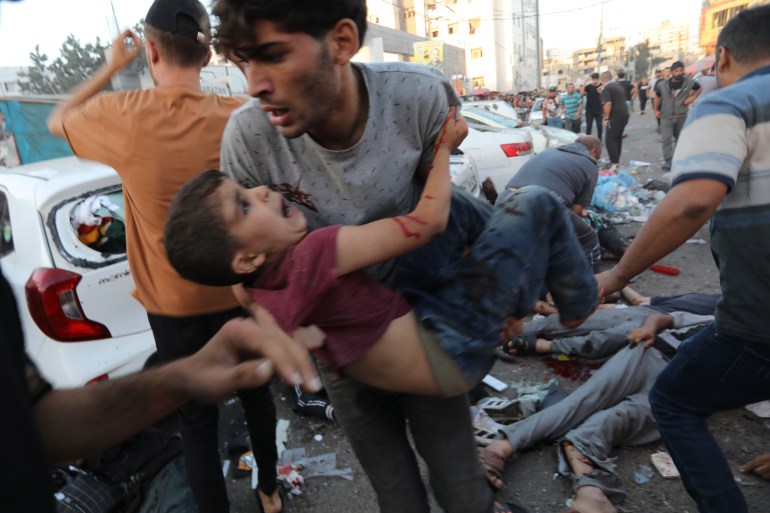
What is the right to self-defence?
According to Article 51 of the UN Charter, until the UN Security Council takes measures to maintain international peace and security, “nothing in the charter shall impair the inherent right of individual or collective self-defence if an armed attack occurs against a member of the United Nations.”
Ever since Israel embarked on the bombardment of the Gaza Strip, its officials and its Western allies – from the United States and United Kingdom to the European Union – have defended Israeli actions by pointing to Article 51.
Does it apply to Israel against Gaza?
Many experts aren’t convinced that it does apply.
“The right to self-defence can be invoked when the state is threatened by another state, which is not the case,” Francesca Albanese, UN special rapporteur on human rights in the occupied Palestinian territories, said in an address to the Australian Press Club on Tuesday.
The attack Israel faced on October 7 came from an armed group in a territory, Gaza, that Israel has effectively controlled.
That, according to Albanese, amounts to occupation – although Israel and its allies disagree with that assessment.
“Israel does not claim it has been threatened by another state. It has been threatened by an armed group within an occupied territory. It cannot claim the right of self-defence against a threat that emanates from a territory it occupies, from a territory kept under belligerent occupation,” Albanese said.
Albanese was referring to a 2004 advisory opinion by the International Court of Justice (ICJ), which said the construction of Israel’s separation wall in the occupied West Bank was illegal. The ICJ rejected the Israeli argument to build the wall, saying it could not invoke the right to self-defence in an occupied territory.
Are there other challenges to Israel’s argument?
Other experts point to the devastating scale of Israeli attacks on Gaza.
“The death of a reported 4,710 children, attacks on healthcare, the withholding of water and electricity – these cannot be merely justified as a ‘right to self-defence’,” said Iain Overton, executive director of the London-based Action on Armed Violence, which conducts research and advocacy on armed violence against civilians.
He added that for Israel to claim this right without being challenged “would be a mockery of the international humanitarian law”.

Armed conflicts are governed by international humanitarian law (IHL), a set of rules contained in international agreements like the Fourth Geneva Convention of 1949 as well as other agreements and conventions meant to ensure that all member nations subscribe to a list of fundamental rules during conflicts.
But member states do not always act by the rules, most recently during the Ukraine-Russia war. Israel has been accused of war crimes in its previous military assaults on Gaza, but it has not been held accountable.
In the current conflict, though, experts said Israel’s actions seem to violate all of the four main principles of IHL: distinction between civilians and combatants, proportionality between anticipated loss of civilian life and damage and the strategic military advantage of an attack, legitimate military purposes and the humane treatment of all individuals from civilians to detainees and hostages.
Among the dead Palestinians in the current conflict as of Thursday are 4,710 children and 3,160 women.
“The scale of the bombardment and its impact on civilians raises questions about Israel’s adherence to proportionality,” Overton told Al Jazeera.
Israel’s bombing of Gaza has also killed 102 aid workers with the UN Relief and Works Agency for Palestine Refugees (UNRWA), making this the deadliest conflict ever for UN staff in the organisation’s history.
Is it justifiable to attack civilians during a conflict?
IHL underlines the fundamental rule of all wars – that parties in a conflict must always make a distinction between civilians and combatants and that civilians and civilian objects must never be attacked.
Hence, there is no justification for civilians being attacked by either side in the current conflict, and it is unlawful.
Neve Gordon, a professor of international law and human rights at Queen Mary University of London, said both Hamas’s and Israel’s actions were “clearly war crimes”, adding that it was “obvious to anyone” that Hamas’s actions on October 7 violated IHL.
“It is also obvious that Israel has committed war crimes in Gaza since October 7,” he said.
“There is the collective punishment through the stopping of water and electricity, the compelled movement of populations and then the unleashing of eruptive violence that is killing thousands of civilians while destroying the very infrastructure of existence in the Gaza Strip,” Gordon added.
Israel controls what goes in and out of Gaza. Even the fuel for its sole power plant, which has since shut down, has been supplied with Israel’s permission.
Israel’s claims that Hamas is operating out of civilian facilities, however, are aimed at justifying civilian casualties, Gordon said.
“When Israel claims Hamas targets in refugee camps and hospitals, the idea in both cases is to underscore that the value of the target is extremely high and, therefore, that Israel is abiding by the principle of proportionality even if many civilians die,” Gordon said.
What about Israeli attacks on hospitals, schools and refugee camps? Are such tactics lawful?
International humanitarian law insists that medical units must be protected. Similarly, international law also disallows attacks against places that are indispensable to the survival of the civilian population, such as drinking water installations and farmland.
Attacking schools and hospitals during the conflict, as Israel has done, is “one of the six grave violations”, according to the UN Office of the Special Representative of the Secretary-General for Children and Armed Conflict.
Yet Israel has been unrelenting in these attacks despite facing heavy criticism. Experts have pointed to how it has relied on the claim, backed by the US and EU, that Hamas is using civilians in these places as “human shields”.
US President Joe Biden on Wednesday reiterated the Israeli claim of a Hamas base at al-Shifa Hospital, Gaza’s largest medical facility. He offered no proof, and Israel has so far not shown any evidence for that claim either.
But what if Hamas is using civilians as ‘human shields’?
One way Hamas uses civilians as “human shields”, Israel insists, is by allegedly operating out of schools, hospitals, refugee camps and shelters.
But many experts believe that painting civilians as human shields is a convenient argument that Israel has used to create legitimacy for its attacks.
“When a person in a battlefield is defined as a human shield, …he or she loses some of the protections assigned to civilians by the laws of war,” Gordon said.
“What many legal commentators say is that once a warring party uses human shields, lethal forms of violence that might otherwise be prohibited in a civilian setting can be used,” he added.
Others, like Overton, said that even if Israel’s claims about Palestinian civilians being used as human shields are accurate, Israeli actions are still not justified.
“The claim that civilians are being used as human shields does not absolve a party from its obligations under IHL. Even if combatants are present, attacks must still adhere to the principles of distinction and proportionality,” Overton said, pointing to how UN Secretary-General Antonio Guterres called Gaza a “graveyard for children” on November 7.
“This underscores the severe impact on civilians, suggesting that the claim of human shields may not justify the scale and nature of the attacks on civilian areas,” he added.

What are some other laws that Israel has potentially violated?
Israel has also been accused of using white phosphorus, which could trigger fires as well as lead to severe, potentially fatal burns. Firing white phosphorus is akin to an indiscriminate attack, according to Amnesty International, which affects civilians and military targets alike and hence is prohibited under international law.
IHL makes it clear that parties to a conflict “may not order the displacement of the civilian population, in whole or part” except if military reasons demand or if their security is involved.
On October 13, Israel ordered more than 1 million Palestinians in northern Gaza to evacuate and move to the besieged enclave’s south despite the UN warning that Gaza faced a “real catastrophe” due to such an order. Israel has justified this order by saying it was aimed at limiting civilian casualties during its military operation in northern Gaza.
IHL also lays out that all parties in a conflict must ensure that humanitarian relief operations are allowed and facilitated “unimpeded”. However, Israel had refused to allow essential aid into Gaza despite widespread warnings of a humanitarian crisis.
Israel’s decision to impose a “complete siege” of Gaza’s power, food and water supplies has also been widely criticised for triggering a humanitarian crisis as thousands of Palestinians face “death by starvation”, according to the ActionAid charity. Humanitarian law prohibits the use of starvation of the civilian population “as a method of warfare”.
“The complete siege now lasting over one month has made it an agony for residents in Gaza to find basic necessities and frankly to survive,” Turk said last week, adding that “all forms of collective punishment must come to an end”.
Are Israel and Hamas likely to be held to account for any legal violations?
While lawyers and experts have pointed to likely violations by Israel and Hamas of international law and international humanitarian law in particular, that might not ensure legal action against them.
Experts point to the lack of action against Israel for its 2008 assault on Gaza, named Operation Cast Lead, during which Israel was accused of war crimes. The 22-day Israeli offensive killed 1,400 Palestinians. At least 13 Israelis were killed in retaliatory rocket attacks by Palestinian armed groups.
“Historical precedents, such as the inquiries following Operation Cast Lead and others, show that while investigations into Israeli actions in Gaza have occurred, they often have not led to significant preventative measures or accountability,” Overton said.
In the current conflict, the UN Commission of Inquiry on the Occupied Palestinian Territory had announced on October 10 that there was “clear evidence of war crimes” from both sides and added that it had been “collecting and preserving evidence of war crimes” because it is “intent on ensuring legal accountability, including individual criminal and command responsibility”.
“The killing of so many civilians cannot be dismissed as collateral damage. Not in a kibbutz. Not in a refugee camp. And not in a hospital,” the UN human rights chief said.
At least three Palestinian rights groups have filed a lawsuit with the International Criminal Court (ICC) against Israel during the ongoing war. And this week, French lawyer Gilles Devers submitted a complaint to the prosecutor at the ICC on behalf of Gaza victims.
A US-based civil rights group, the Center for Constitutional Rights, has also sued Biden and senior members of his cabinet for “complicity” in the “unfolding genocide”.






Josh2Funny’s Album Has Fans Talking — But Should He Stick To Music Or Skits? 😂🎶

Nigerian comedian and content creator Josh2Funny has taken his comedy game into music, and Nigerians are definitely having something to say about it.
The comedian released his 15-track album, “On Behalf of Josh,” on July 10, 2026, but instead of fading away after release, the project has continued to generate conversations on X.
And the big question now is:
Should Josh2Funny continue with music or go back to skits? 😂
Fans have been divided. While some listeners openly criticized the album and told him to return to comedy, others found songs they genuinely enjoyed.
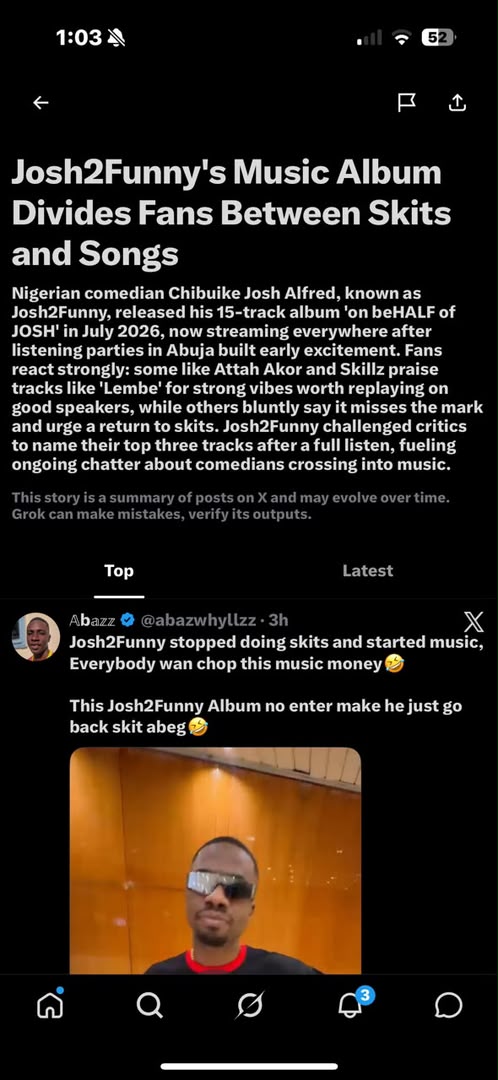
One X user joked:
“Josh2Funny stopped doing skits and started music, Everybody wan chop this music money 😂”
Another simply said:
“This Josh2Funny Album no enter make he just go back skit abeg 😂”
But then came “Lembe.” 🔥
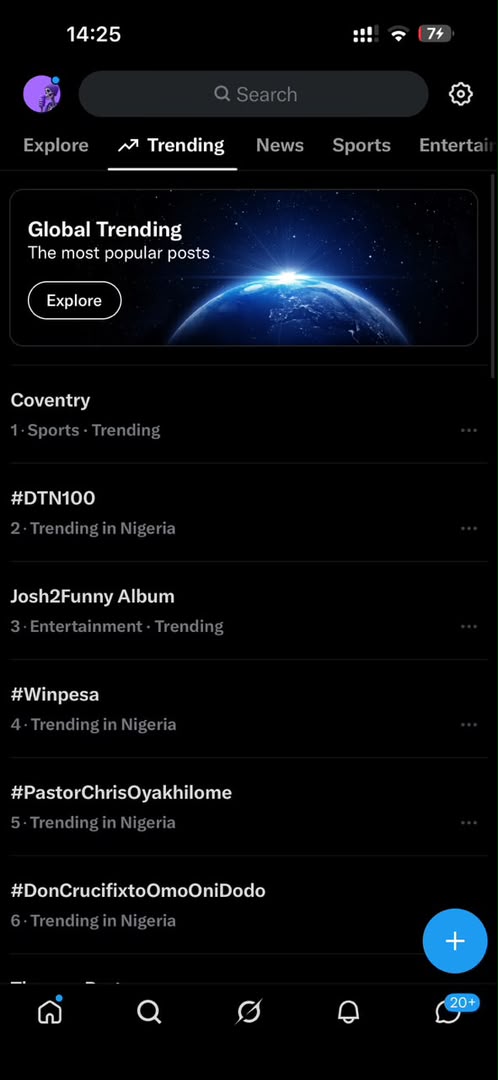
The track caught fire on X and eventually became a trending topic in Nigeria. The #LembeChallenge also gained momentum as creators began jumping on the song.
Josh2Funny later announced ₦1 million for winners of the challenge, giving the song another major push.
And it didn’t stop there.
‘INTERNATIONAL’ FT. ICE PRINCE ALSO TRENDED
On another day, “International” featuring Ice Prince generated its own buzz on X.
One fan even called it their favourite song from the album, while praising the collaboration. The post itself pulled thousands of views, showing that people weren’t only talking about Lembe.
From album criticism to trending songs and challenges, “On Behalf of Josh” has kept Josh2Funny’s name in the conversation.
Whether you love the album or think he should return to skits, one thing is clear:
Josh2Funny has succeeded in getting Nigerians talking. 😂🔥

So, let’s settle this once and for all:
Should Josh2Funny continue with MUSIC 🎶 or return to SKITS 😂?
Music or Skits? Drop your answer! 👇


East Ham, East London — 8 August 2026: The vibrant Igbo community in the UK came together for an unforgettable evening of entertainment, culture and social connection at Igbotic Game Night, one of the biggest social gatherings celebrating the Igbo community in the United Kingdom.
Among the night’s standout moments was an electrifying performance by Afrobeats artist Obeena, who took the stage and immediately captured the attention of the crowd.
Obeena delivered performances of two of his hit songs, “Wara Wara” and “Banging,” bringing his energetic sound and distinctive stage presence to the event. From the opening moments of his set, fans responded with excitement, singing along, dancing and enthusiastically supporting the artist.

His performance of “Wara Wara” created an instant connection with the audience, while “Banging” took the energy to another level. Obeena’s ability to engage the crowd transformed his set into one of the most memorable entertainment moments of the evening.
Held in East Ham, East London, on 8 August 2026, Igbotic Game Night provided a unique platform for members of the Igbo community to celebrate their heritage while enjoying music, games and social interaction. Events such as this continue to play an important role in bringing together Nigerians and the wider African diaspora in the UK.
For Obeena, the performance was another opportunity to showcase his growing artistry and connect directly with fans. His energetic delivery, stage confidence and ability to command the audience demonstrated why his live performances continue to attract attention.
By the end of his set, Obeena had left the crowd amazed and added another memorable chapter to his journey as an Afrobeats artist. His appearance at Igbotic Game Night was not simply a performance—it was a celebration of Nigerian music, culture and community.
With performances like this, Obeena continues to demonstrate his ambition to take his sound beyond the studio and onto major stages, connecting with audiences through music, energy and an unmistakable African identity.
Igbotic Game Night brought the Igbo community together. Obeena gave them a performance to remember.
-
 Audio10 years ago
Page – Day Break Everywhere Burst
-
 Audio5 years ago
Shadykarz – Forever
-
 Audio10 years ago
Juniorboy ft. 9ice – IRAPADA
-
 Entertainment Gists6 years ago
Ex-Beauty Queen, Sandra Benede Shares Sexy Photo
-
 Audio5 years ago
Simi – Happy Birthday ft. Adekunle Gold, DeJa
-
 Audio5 years ago
Ruger – Bounce
-
 Mixtapes4 years ago
Mixtape: DJ DimpleNipple – The Best Of Amapiano Thrills
-
 Editorials3 years ago
Sa’eedah Imam On Creating Her Imprint In The Nigerian Music Industry As An Emerging Creative Writer