
News
Diseases Spread in Gaza Amid Water And Sewage Crisis, Cholera Feared

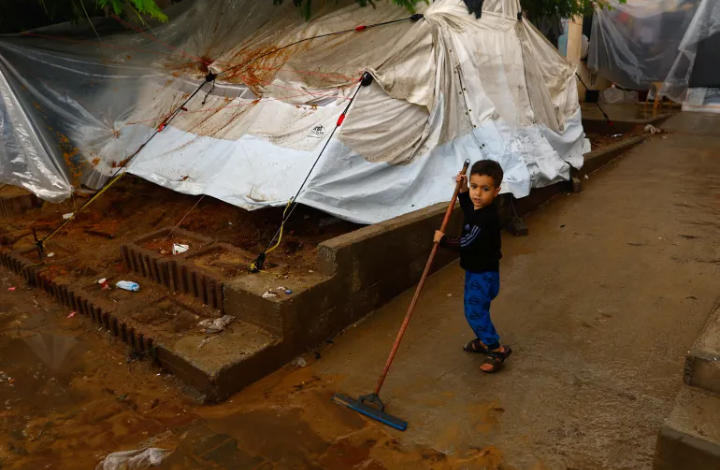
UNRWA estimates that about 70 percent of Gaza’s 2.3 million people – more than half of whom are children – no longer have access to clean water
Gastrointestinal diseases, and respiratory and skin infections are rising, UN agencies say.
Khan Younis, Gaza – Sewage flows in the streets of Gaza as all key sanitation services have ceased operating, raising the alarming prospect of an enormous surge of gastrointestinal and infectious diseases among the local populations – including cholera.
For Gaza’s 2.3 million residents, finding drinkable water has become close to impossible.
At a school run by the United Nations relief agency for Palestinian refugees (UNRWA) in Khan Younis, 33-year-old Osama Saqr attempted to fill some bottles with water for his thirsty children.
He took a sip and grimaced in disgust at the saltiness of the fluid, before letting out a long sigh.
“It’s polluted and unsuitable, but my children always drink it, there’s no alternative,” he told Al Jazeera.
Saqr’s one-year-old son has diarrhoea but he cannot find medicines in hospitals or pharmacies to treat him. “Even if I find it, the problem remains, the water is polluted and salty water, not suitable for drinking,” he said.
“I’m afraid that eventually, I’m going to lose one of my children to this poisoning.”
The World Health Organization (WHO) has recorded more than 44,000 cases of diarrhoea and 70,000 acute respiratory infections, but real numbers may be significantly higher. On Friday, the UN agency said it was extremely concerned that rains and floods during the approaching winter season will make an already dire situation even worse.
“We are hearing about several hundred people per toilet at the UNRWA centres and those have been overflowing, so people are doing open defecation,” Richard Brennan, regional emergency director for the Eastern Mediterranean region at WHO, told Al Jazeera. “They have to find a place to go to the bathroom in the grounds where they are staying. That’s a huge public health risk and also very humiliating.”
Brennan said overcrowding, lack of solid waste management, poor sanitation and open-air defecation were all contributing to the spread of diseases including diarrhoea, respiratory infections and skin infections, including scabies.
UN agencies have warned that the collapse of water and sanitation services could even spark bouts of cholera if urgent humanitarian aid is not delivered. If nothing changes, “there will be more and more people falling sick and the risk of major outbreaks will increase dramatically,” Brennan said.
Out of fuel
Gaza’s essential water and sanitation infrastructure has either been destroyed by Israeli bombardment or has run out of fuel. In the southern governorates of Deir el-Balah, Khan Younis and Rafah, all 76 water wells have stopped functioning, as well as two main drinking water plants and 15 sewage pumping stations, according to the UNRWA.
WHO estimates that the average person in Gaza is currently consuming just 3 litres of water per day for drinking and sanitation. This compares with the minimum of 7.5 litres recommended by the agency in emergency situations.
The halt of key services including water desalination plants, sewage treatment and hospitals has led to a 40 percent increase in diarrhoea for people taking shelter in UNRWA schools, the agency said. It estimated that about 70 percent of Gaza’s 2.3 million people – more than half of whom are children – no longer have access to clean water.
On Wednesday, Israeli authorities allowed just over 23,000 litres (6,000 gallons) of fuel to be brought into the Strip via Egypt. But they restricted the use of this fuel to trucks transporting the little aid coming in. The UNRWA said it needed 160,000 litres (42,000 gallons) of fuel a day for basic humanitarian operations.
“This fuel cannot be used for the overall humanitarian response, including for medical and water facilities or the work of UNRWA,” the agency’s Commissioner General Philippe Lazzarini told a press conference. “It is appalling that fuel continues to be used as a weapon of war. This seriously paralyses our work and the delivery of assistance to the Palestinian communities in Gaza.”
The Ministry of Health in Gaza has warned that the lack of clean water caused by fuel shortages has put the lives of 1,100 patients with kidney failure, including 38 children, particularly at risk.
Among them is Samer Abdeen’s 22-year-old brother, Muhammad, who has been suffering from acute renal colic due to the poor water quality. “When he is in great pain, he screams,” Abdeen, 40, told Al Jazeera as he searched the streets of Khan Younis for bottled water to buy.
While bottled water is now expensive and very hard to find, he refused to give up the search.
“I don’t want to lose him in this unjust war,” he said.
Dying of thirst
Sixty-year-old Samir Asaad, from Deir el-Balah camp, suffers from high blood pressure, which is exacerbated by drinking salty water. “I heat up the water over a fire to drink it so I don’t feel its saltiness,” he said.
“They are killing us from thirst or forcing us to drink any water so that we die anyway,” he said, referring to the Israeli siege on Gaza.
Humanitarian officials are calling for more aid to enter Gaza. The World Food Programme warned on Thursday that supplies of food and water were almost non-existent in Gaza and that civilians were facing the immediate possibility of dehydration and starvation.
Some residents resorted to digging wells to extract water, despite it being contaminated by the sewage and solid waste piling up untreated on the streets. Asaad said his family prefers to line up for hours to fill bottles at filling stations, but they are under no illusion that the water there will be any safer to drink.
Umi al-Abadla, deputy director general of primary care at Gaza’s health ministry, said water reaching the filling station used to be treated before being pumped, but this is no longer possible due to the lack of fuel.
“As a result of the power outage, water is distributed from random wells whose water is contaminated,” he said. “This has caused diarrhoea among children, more than the annual average.”
He added that the lack of personal hygiene as a result of the mass displacement was causing a spread of skin diseases as well as viral diseases including chickenpox, and raising the threat of epidemics of diseases including cholera.
Drinking dirty seawater
Desperate to quench their thirst, some in Gaza have resorted to drinking seawater.
But, with sewage systems and wastewater treatment plants out of operation due to the lack of fuel, more than 130,000 cubic metres of wastewater are being discharged into the Mediterranean Sea each day.
Salwa Islim, 45, said she and her family go to the sea to bathe and sometimes drink from it. “I am forced to drink seawater and people here also do that,” she told Al Jazeera.
“Where is our right to water? What is this war that prevents all citizens from eating, drinking and all the other necessities of life?” she said.
“Is this a punishment for the children, who ask every day when the war will end? They stand in the streets and ask for bottles of water to drink. But there is no drinking water in Gaza”.






East Ham, East London — 8 August 2026: The vibrant Igbo community in the UK came together for an unforgettable evening of entertainment, culture and social connection at Igbotic Game Night, one of the biggest social gatherings celebrating the Igbo community in the United Kingdom.
Among the night’s standout moments was an electrifying performance by Afrobeats artist Obeena, who took the stage and immediately captured the attention of the crowd.
Obeena delivered performances of two of his hit songs, “Wara Wara” and “Banging,” bringing his energetic sound and distinctive stage presence to the event. From the opening moments of his set, fans responded with excitement, singing along, dancing and enthusiastically supporting the artist.

His performance of “Wara Wara” created an instant connection with the audience, while “Banging” took the energy to another level. Obeena’s ability to engage the crowd transformed his set into one of the most memorable entertainment moments of the evening.
Held in East Ham, East London, on 8 August 2026, Igbotic Game Night provided a unique platform for members of the Igbo community to celebrate their heritage while enjoying music, games and social interaction. Events such as this continue to play an important role in bringing together Nigerians and the wider African diaspora in the UK.
For Obeena, the performance was another opportunity to showcase his growing artistry and connect directly with fans. His energetic delivery, stage confidence and ability to command the audience demonstrated why his live performances continue to attract attention.
By the end of his set, Obeena had left the crowd amazed and added another memorable chapter to his journey as an Afrobeats artist. His appearance at Igbotic Game Night was not simply a performance—it was a celebration of Nigerian music, culture and community.
With performances like this, Obeena continues to demonstrate his ambition to take his sound beyond the studio and onto major stages, connecting with audiences through music, energy and an unmistakable African identity.
Igbotic Game Night brought the Igbo community together. Obeena gave them a performance to remember.

Audio
KenryWhite Releases “Kilometers” & “The King” A Powerful Double Release Celebrating Faith, Purpose, and the Journey to Greatness


Nigerian Afrofusion artist KenryWhite unveils his compelling two-track release, “Kilometers & The King,” a project that explores the realities of life’s journey while affirming identity, faith, and purpose.
Leading the release is “Kilometers,” an uplifting anthem that reflects on the distance between dreams and fulfillment. Through heartfelt lyrics, captivating melodies, and vibrant Afrobeats production, KenryWhite encourages listeners to embrace the process, remain resilient, and keep moving forward despite life’s challenges.
Complementing the project is “The King,” featuring Wonder J. The record is a bold declaration of confidence, royalty, and divine purpose, blending infectious Afrobeats rhythms with inspiring lyricism. Together, the duo delivers a record that celebrates self-belief, leadership, and the mindset required to overcome every obstacle.
With rich storytelling, memorable melodies, and contemporary African sounds, “Kilometers & The King” showcases KenryWhite’s artistic growth while delivering music that inspires, motivates, and connects with audiences across the globe.
Now available on all major streaming platforms, “Kilometers & The King” invites listeners to embrace the journey, recognize their worth, and walk confidently into their purpose.
-
 Audio10 years ago
Page – Day Break Everywhere Burst
-
 Audio5 years ago
Shadykarz – Forever
-
 Audio10 years ago
Juniorboy ft. 9ice – IRAPADA
-
 Entertainment Gists5 years ago
Ex-Beauty Queen, Sandra Benede Shares Sexy Photo
-
 Audio5 years ago
Simi – Happy Birthday ft. Adekunle Gold, DeJa
-
 Audio5 years ago
Ruger – Bounce
-
 Mixtapes4 years ago
Mixtape: DJ DimpleNipple – The Best Of Amapiano Thrills
-
 Editorials3 years ago
Sa’eedah Imam On Creating Her Imprint In The Nigerian Music Industry As An Emerging Creative Writer