
Foreign
COP26: Document Leak Reveals Nations Lobbying To Change Key Climate Report

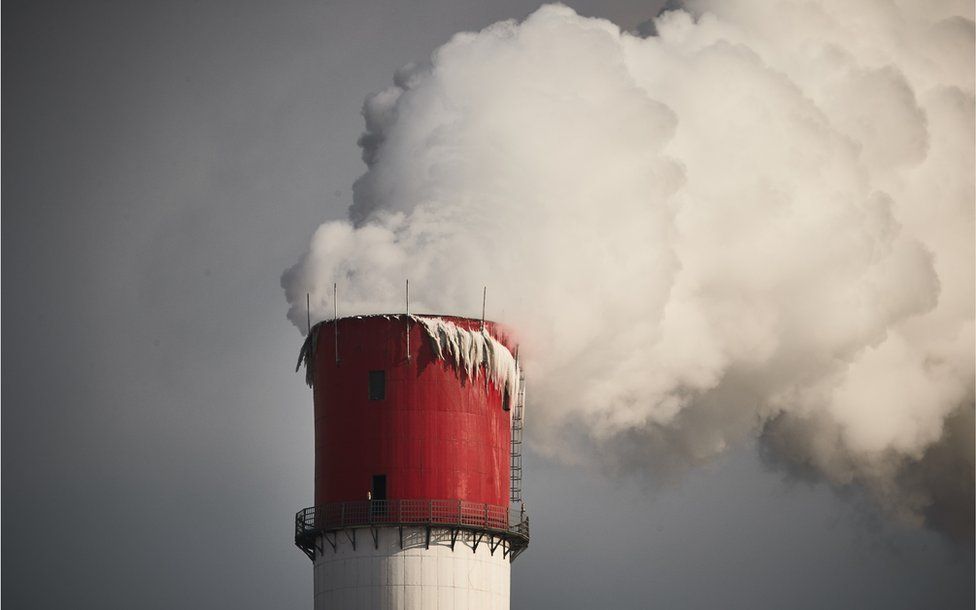
A huge leak of documents seen by BBC News shows how countries are trying to change a crucial scientific report on how to tackle climate change.
The leak reveals Saudi Arabia, Japan and Australia are among countries asking the UN to play down the need to move rapidly away from fossil fuels.
It also shows some wealthy nations are questioning paying more to poorer states to move to greener technologies.
This “lobbying” raises questions for the COP26 climate summit in November.
The leak reveals countries pushing back on UN recommendations for action and comes just days before they will be asked at the summit to make significant commitments to slow down climate change and keep global warming to 1.5 degrees.
The leaked documents consist of more than 32,000 submissions made by governments, companies and other interested parties to the team of scientists compiling a UN report designed to bring together the best scientific evidence on how to tackle climate change.
These “assessment reports” are produced every six to seven years by the Intergovernmental Panel on Climate Change (IPCC), the UN body tasked with evaluating the science of climate change.
These reports are used by governments to decide what action is needed to tackle climate change, and the latest will be a crucial input to negotiations at the Glasgow conference.
The authority of these reports derives in part from the fact that virtually all the governments of the world participate in the process to reach consensus.
The comments from governments the BBC has read are overwhelmingly designed to be constructive and to improve the quality of the final report.
The cache of comments and the latest draft of the report were released to Greenpeace UK’s team of investigative journalists, Unearthed, which passed it on to BBC News.
Fossil fuels
The leak shows a number of countries and organisations arguing that the world does not need to reduce the use of fossil fuels as quickly as the current draft of the report recommends.
An adviser to the Saudi oil ministry demands “phrases like ‘the need for urgent and accelerated mitigation actions at all scales…’ should be eliminated from the report”.

One senior Australian government official rejects the conclusion that closing coal-fired power plants is necessary, even though ending the use of coal is one of the stated objectives the COP26 conference.
Saudi Arabia is the one of the largest oil producers in the world and Australia is a major coal exporter.
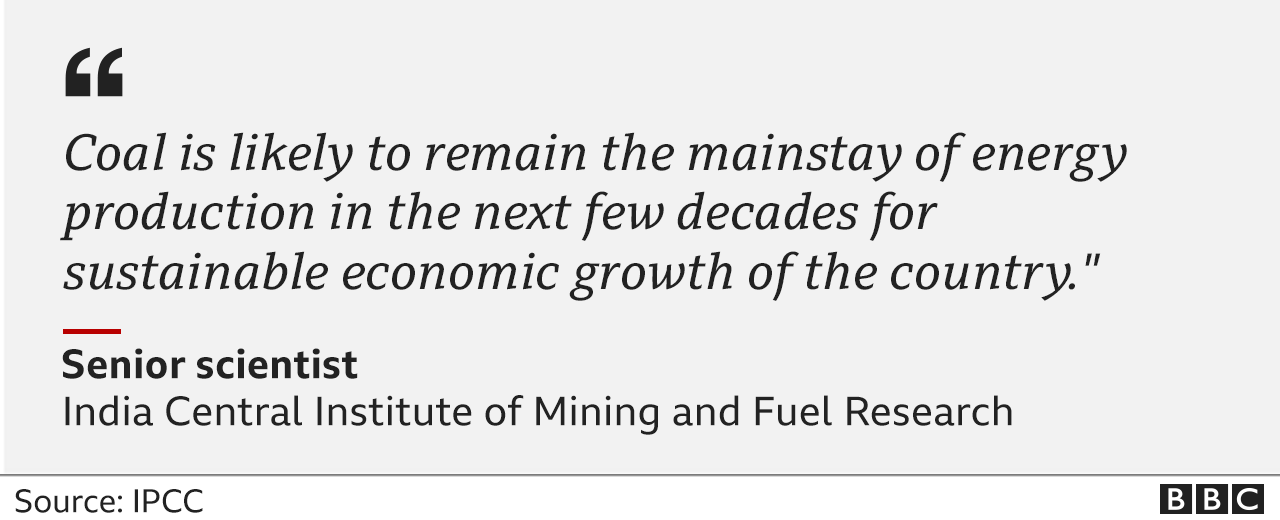
A senior scientist from India’s Central Institute of Mining and Fuel Research, which has strong links to the Indian government, warns coal is likely to remain the mainstay of energy production for decades because of what they describe as the “tremendous challenges” of providing affordable electricity. India is already the world’s second biggest consumer of coal.
A number of countries argue in favour of emerging and currently expensive technologies designed to capture and permanently store carbon dioxide underground. Saudi Arabia, China, Australia and Japan – all big producers or users of fossil fuels – as well as the organisation of oil producing nations, Opec, all support carbon capture and storage (CCS).
It is claimed these CCS technologies could dramatically cut fossil fuel emissions from power plants and some industrial sectors.
Saudi Arabia, the world’s biggest oil exporter, requests the UN scientists delete their conclusion that “the focus of decarbonisation efforts in the energy systems sector needs to be on rapidly shifting to zero-carbon sources and actively phasing out fossil fuels”.
Argentina, Norway and Opec also take issue with the statement. Norway argues the UN scientists should allow the possibility of CCS as a potential tool for reducing emissions from fossil fuels.
The draft report accepts CCS could play a role in the future but says there are uncertainties about its feasibility. It says “there is large ambiguity in the extent to which fossil fuels with CCS would be compatible with the 2C and 1.5C targets” as set out by the Paris Agreement.
 The offshore Sleipner gas field in Norway has been using CCS since 1996
Australia asks IPCC scientists to delete a reference to analysis of the role played by fossil fuel lobbyists in watering down action on climate in Australia and the US. Opec also asks the IPCC to “delete ‘lobby activism, protecting rent extracting business models, prevent political action’.”
When approached about its comments to the draft report, Opec told the BBC: “The challenge of tackling emissions has many paths, as evidenced by the IPCC report, and we need to explore them all. We need to utilise all available energies, as well as clean and more efficient technological solutions to help reduce emissions, ensuring no one is left behind.”
The IPCC says comments from governments are central to its scientific review process and that its authors have no obligation to incorporate them into the reports.
“Our processes are designed to guard against lobbying – from all quarters”, the IPCC told the BBC. “The review process is (and always has been) absolutely fundamental to the IPCC’s work and is a major source of the strength and credibility of our reports.
Professor Corinne le Quéré of the University of East Anglia, a leading climate scientist who has helped compile three major reports for the IPCC, has no doubts about the impartiality of the IPCC’s reports.
She says all comments are judged solely on scientific evidence regardless of where they come from.
“There is absolutely no pressure on scientists to accept the comments,” she told the BBC. “If the comments are lobbying, if they’re not justified by the science, they will not be integrated in the IPCC reports.”
She says it is important that experts of all kinds – including governments – have a chance to review the science.
“The more the reports are scrutinised”, says Professor le Quéré, “the more solid the evidence is going to be in the end, because the more the arguments are brought and articulated forward in a way that is leaning on the best available science”.
Christiana Figueres, the Costa Rican diplomat who oversaw the landmark UN climate conference in Paris in 2015, agrees
it is crucial that governments are part of the IPCC process.
“Everybody’s voice has to be there. That’s the whole purpose. This is not a single thread. This is a tapestry woven by many, many threads.”
The United Nations was awarded a Nobel Prize in 2007 for the IPCC’s work on climate science and the crucial role it has played in the effort to tackle climate change.
Eating less meat
Brazil and Argentina, two of the biggest producers of beef products and animal feed crops in the world, argue strongly against evidence in the draft report that reducing meat consumption is necessary to cut greenhouse gas emissions.
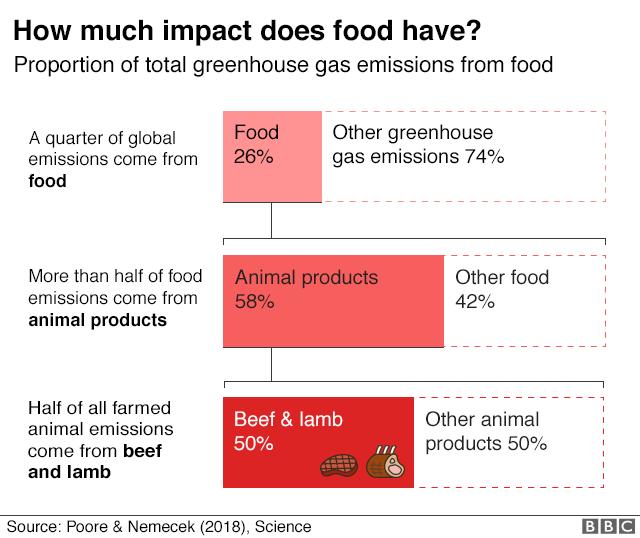
The draft report states “plant-based diets can reduce greenhouse gas emissions by up to 50% compared to the average emission intensive Western diet”. Brazil says this is incorrect.
Both countries call on the authors to delete or change some passages in the text referring to “plant-based diets” playing a role in tackling climate change, or which describe beef as a “high carbon” food. Argentina also asked that references to taxes on red meat and to the international “Meatless Monday” campaign, which urges people to forgo meat for a day, be removed from the report.
The South American nation recommends “avoiding generalisation on the impacts of meat-based diets on low-carbon options”, arguing there is evidence that meat-based diets can also reduce carbon emissions.
On the same theme, Brazil says “plant-based diets do not for themselves guarantee the reduction or control of related emissions” and maintains the focus of debate should be on the levels of emissions from different production systems, rather than types of food.
Brazil, which has seen significant increases in the rate of deforestation in the Amazon and some other forest areas, also disputes a reference to this being a result of changes in government regulations, claiming this is incorrect.
Money for poorer countries
A significant number of Switzerland’s comments are directed at amending parts of the report that argue developing countries will need support, particularly financial support, from rich countries in order to meet emission reduction targets.
It was agreed at the climate conference in Copenhagen in 2009 that developed nations would provide $100bn a year in climate finance for developing countries by 2020, a target that has yet to be met.

Australia makes a similar case to Switzerland. It says developing countries’ climate pledges do not all depend on receiving outside financial support. It also describes a mention in the draft report of the lack of credible public commitments on finance as “subjective commentary”.
The Swiss Federal Office for the Environment told the BBC: “While climate finance is a critical tool to increase climate ambition, it is not the only relevant tool.
“Switzerland takes the view that all Parties to the Paris Agreement with the capacity to do so should provide support to those who need such support.”
Going nuclear
A number of mostly eastern European countries argue the draft report should be more positive about the role nuclear power can play in meeting the UN’s climate targets.
India goes even further, arguing “almost all the chapters contain a bias against nuclear energy”. It argues it is an “established technology” with “good political backing except in a few countries”.
The Czech Republic, Poland and Slovakia criticise a table in the report which finds nuclear power only has a positive role in delivering one of 17 UN Sustainable Development goals. They argue it can play a positive role in delivering most of the UN’s development agenda.





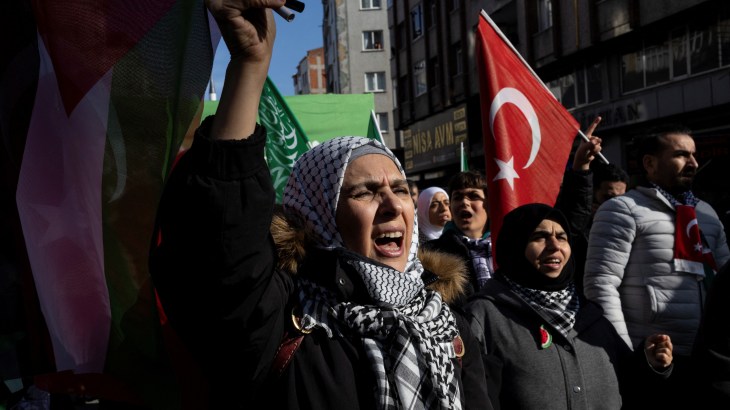
Dozens of Palestinians killed in overnight Israeli strikes in central and south Gaza as Red Sea tensions rise.
Here’s how things stand on Monday, January 15, 2024:
Latest updates and human impact
- Israeli attacks continue unabated overnight killing and wounding dozens of civilians in central and southern Gaza. At least 22 people were killed and a large number injured as a result of Israeli forces targeting al-Thalatheni Street in the central Gaza Strip.
- Yemen’s Houthi rebels fired an antiship cruise missile toward an American destroyer in the Red Sea, which was shot down by a US fighter jet, announced US Central Command (CENTCOM) on X.
- This was the first US-acknowledged Houthi attack since the US strikes on Yemen on Friday.
- Hamas released a 37-second video showing three Israeli captives held in Gaza on Sunday, saying they would reveal the fate of the captives on Monday and urging the Israeli government to stop the offensive.
- The Israeli military says it has shifted to a new phase of the war focused on the southern end of Gaza, where almost 2 million internally displaced Palestinians are running out of safe spaces to shelter.
- The Gaza Ministry of Health has said almost 24,000 people have been killed in the Israeli offensive. More than 60,000 people have been wounded in 100 days of war.
Diplomacy
- Israeli Prime Minister Benjamin Netanyahu said on Sunday that his country will pursue its war against Hamas until victory and will not be stopped by anyone, including the International Court of Justice (ICJ).
- The White House said on Sunday that “it’s the right time” for Israel to scale back its military offensive in the Gaza Strip.
- Egypt’s State Information Service (SIS) said in a statement on Sunday that one of the biggest obstacles to the timely delivery of sufficient aid to Gaza was Israeli inspection of the aid. The statement came after Israel blamed Cairo for the delay in aid delivery to Gaza during its defence at the ICJ.
- US Secretary of State Antony Blinken posted on X on Monday, calling for the release of the remaining captives held in Gaza on the 100th day since they were taken by Hamas. He did not mention the Palestinian casualties.
- Australia’s Foreign Minister Penny Wong, who described herself as a “friend of Israel” to the press, will travel to Jordan, Israel, the occupied Palestinian Territories and the United Arab Emirates this week, her office said on Monday.
West Bank raids and violence
- Israeli forces arrested 25 students staging a sit-in in protest against high tuition fees at An-Najah University in Nablus. Al Jazeera’s Hamdah Salhut reported that the protesting students received a text message from Israeli forces telling them to “surrender now”.
- Israeli forces have reportedly raided the family home of Nael al-Barghouti, the longest-serving Palestinian prisoner, in the village of Kobar, in Ramallah, in the occupied West Bank.
- The Israeli army said on Friday that it killed three Palestinian men who infiltrated a West Bank settlement and fired upon soldiers.
- The Israeli military killed two Palestinians after accusing them of ramming their car through a checkpoint near Hebron.
- Local sources reported that Israeli forces bulldozed two Palestinian-owned houses during a Sunday midnight raid in the city of Qalqilya, Palestinian news agency Wafa reported.
- Armed Israeli settlers broke into the village of Burin, south of Nablus, and attacked Palestinian residents’ houses and properties after midnight on Sunday, Wafa reported.
- “Violent raids and arrests have become part of the fabric of daily life in the occupied West Bank,” Al Jazeera’s Mohammed Jamjoom, reporting from Ramallah in the occupied West Bank, said. At least 347 Palestinians have been killed and thousands have been arrested since October 7.

Flames and smoke billow during Israeli attacks against Gaza on October 9, 2023
Human Rights Watch terms Israeli Defence Minister Yoav Gallant’s call for a ‘complete siege’ on Gaza a ‘war crime’.
The Hamas movement has threatened to kill an Israeli hostage every time Israel bombs a Palestinian home without warning as Israel mobilised some 300,000 reservists and imposed a total blockade of the Gaza Strip, denying the enclave’s millions of residents access to food, water and fuel.
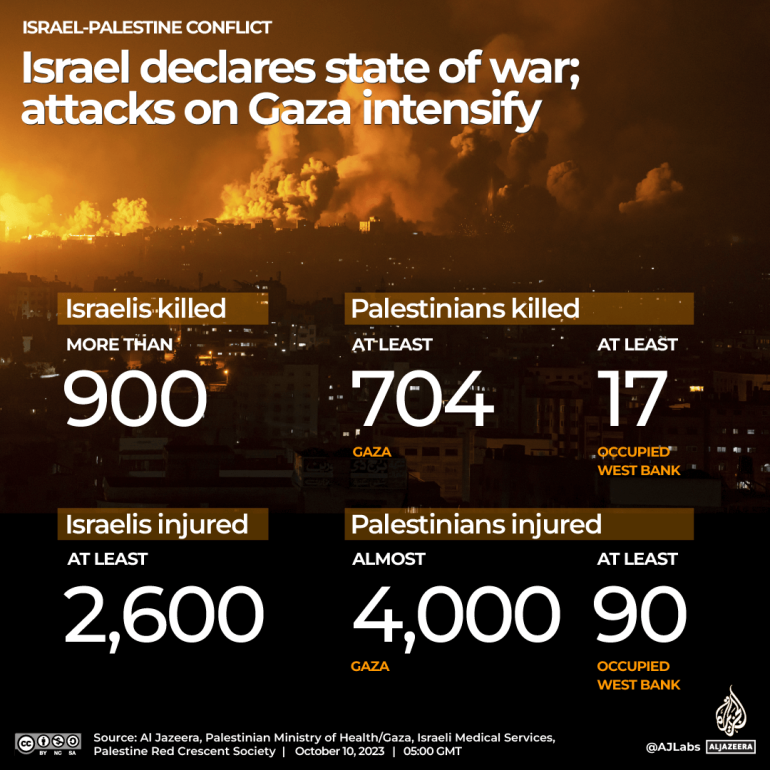
The warning from Hamas came on Monday as the death toll from the armed group’s surprise weekend attack climbed to 900 in Israel and revenge attacks by Israeli forces on the besieged Gaza Strip killed more than 700 people and left some 3,700 others wounded.
Residential apartment blocks, hospitals, schools and a mosque have been among the sites attacked by Israeli fighter jets, artillery and drones, according to media reports and witnesses.
Hamas spokesperson Abu Ubaida issued the threat to kill Israelis from the dozens held captive by the armed group. He said an Israeli hostage would be killed for every Israeli bombing of a civilian house without warning.
Israeli Foreign Minister Eli Cohen said more than 100 people were taken captive by Hamas during the deadly cross-border incursion over the weekend.
As Israeli forces conducted intense retaliatory attacks on Gaza on Monday, Israel’s Defence Minister Yoav Gallant drew international condemnation by announcing a total blockade of the densely populated and besieged enclave, which is home to 2.3 million people.
Gallant said Israel would impose a “complete siege” on Gaza. “No electricity, no food, no water, no gas – it’s all closed.”
United Nations Secretary-General Antonio Guterres said he was “deeply distressed” by the siege announcement and warned that Gaza’s already dire humanitarian situation will now “only deteriorate exponentially”.
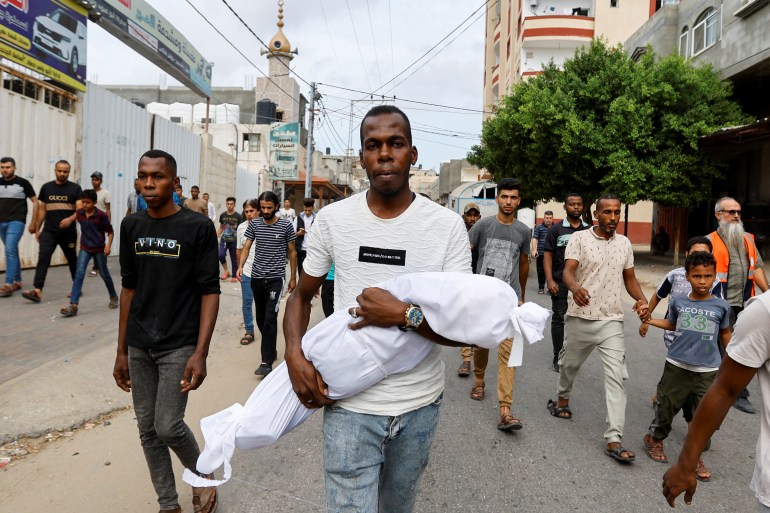
Guterres also said some 137,000 people were taking shelter with the UN Relief and Works Agency for Palestinian Refugees (UNRWA) at schools across Gaza.
UNRWA said on Tuesday that almost 190,000 people have been displaced in Gaza amid the Israeli attacks and the figure is expected to grow further as the violence intensifies.
Nearly half a million people have also not received food rations this week in Gaza as UN food distribution centres have been forced to remain closed amid the Israeli onslaught, UNRWA said.
Human Rights Watch said Israel’s total blockade on the necessities of life for everyday people in Gaza was a war crime.
“Defense Minister Gallant’s statements are abhorrent,” Omar Shakir, Israel and Palestine director at Human Rights Watch, said in a statement.
“Depriving the population in an occupied territory of food and electricity is collective punishment, which is a war crime, as is using starvation as a weapon of war. The International Criminal Court should take note of this call to commit a war crime,” he said.
Abhorrent. This is a call to commit a war crime by @yoavgallant. The @IntlCrimCourt should take note.
Quote by @OmarSShakir ⤵️ https://t.co/kKVo6YtpI1 pic.twitter.com/neHQMwnXVn
— Human Rights Watch (@hrw) October 9, 2023
Shakir also condemned the threat by Hamas to kill hostages, warning that such action was also a war crime.
“All hostages should be safely released to their families,” he said.
Grotesque. These threatened acts would amount to flagrant war crimes by Hamas’ armed wing. The @IntlCrimCourt will be watching.
Quote from @OmarSShakir ⤵️ https://t.co/FuNtvHe0YG pic.twitter.com/6cnHODLWyZ
— Human Rights Watch (@hrw) October 9, 2023
On the diplomatic front, Egyptian President Abdel Fattah el-Sisi and his Turkish counterpart Recep Tayyip Erdogan called on Hamas and Israel to immediately end violence and protect civilians, the Egyptian presidency said.
Erdogan urged Israel against “indiscriminately” attacking civilians and delivered measured criticism of Hamas, urging both sides to respect the “ethics” of war.
The United Kingdom, French, German, Italian and US governments issued a joint statement on Monday recognising the “legitimate aspirations” of the Palestinian people and supporting equal measures of justice and freedom for Israelis and Palestinians alike.
But the prospect that fighting could spread also alarmed the region and the world.
Lebanese armed group Hezbollah fired rockets into northern Israel in response to at least three of its members being killed in Israeli shelling of Lebanon.
Israel said one of its deputy commanders was also killed in an earlier cross-border raid from Lebanon.

US President Joe Biden holds a bilateral meeting with Israeli Prime Minister Benjamin Netanyahu on the sidelines of the 78th United Nations General Assembly in New York City, the US, September 20, 2023
Social media users, including journalists and observers, are calling out what they call a ‘double standard’.
After Saturday’s surprise attack by the Palestinian group Hamas on Israel, Ukrainian President Volodymyr Zelenskyy took to the social media platform X to offer “condolences go out to everyone who lost relatives or close ones in the terrorist attack”.
He also stated, “Israel’s right to self-defence is unquestionable.”
Many world leaders, including US President Joe Biden and UK Prime Minister Rishi Sunak, shared similar sentiments.
The world is seeing appalling images.
Thousands of rockets raining down on Israeli cities. Hamas terrorists killing not only Israeli soldiers, but civilians on the streets and in their homes.
It’s unconscionable. Israel has a right to defend itself – full stop.
— President Biden (@POTUS) October 7, 2023
European Commission President Ursula von der Leyen stated, “Israel has the right to defend itself – today and in the days to come. The European Union stands with Israel.”
Accusations of Western ‘double standards’
Some social media users have criticised these statements, saying they highlight a double standard.
The world is seeing appalling images.
Thousands of rockets raining down on Israeli cities. Hamas terrorists killing not only Israeli soldiers, but civilians on the streets and in their homes.
It’s unconscionable. Israel has a right to defend itself – full stop.
— President Biden (@POTUS) October 7, 2023
Ukraine’s right to defend itself is praised by most international leaders while Russia’s invasion is condemned, but commentators said the same cannot be said about Israel’s occupation of the West Bank and Gaza.
Aaron Bastani, a leftist British journalist, said on X that there’s a “clear double standard in endorsing terrorism against civilian targets in Ukraine … and condemning it by Palestinians”.
Many users said Western diplomats and media support the Ukrainians who defend their land, but label the Palestinians fighting against Israel as “terrorists”.
https://twitter.com/KhaledBeydoun/status/1710787817415082349?ref_src=twsrc%5Etfw%7Ctwcamp%5Etweetembed%7Ctwterm%5E1710787817415082349%7Ctwgr%5E6acf829869e993177f32aa38aa48c02f38cb7f61%7Ctwcon%5Es1_&ref_url=https%3A%2F%2Fwww.aljazeera.com%2Fnews%2F2023%2F10%2F9%2Fwestern-leaders-accused-of-hypocrisy-over-response-to-palestine-ukraine
An illustration of a woman’s face, in which one eye is closed beside a Palestinian flag, and one eye open beside a Ukrainian flag, has been regularly shared as a symbol of the West’s alleged double standards in how the two conflicts are viewed.
https://twitter.com/OnlinePalEng/status/1710994682883273172?ref_src=twsrc%5Etfw%7Ctwcamp%5Etweetembed%7Ctwterm%5E1710994682883273172%7Ctwgr%5E6acf829869e993177f32aa38aa48c02f38cb7f61%7Ctwcon%5Es1_&ref_url=https%3A%2F%2Fwww.aljazeera.com%2Fnews%2F2023%2F10%2F9%2Fwestern-leaders-accused-of-hypocrisy-over-response-to-palestine-ukraine
Clips also emerged on social media from a CNN interview with Mustafa Barghouti, the general secretary of the Palestinian National Initiative, in which he posed the rhetorical question, “Why does the United States support Ukraine in fighting occupation – while here they support the occupier, who continues to occupy us?”
The hypocrisy and double standards of western governments and media platforms dealing with situations in Ukraine-Russia and Palestine-Israel blow the mind. Absolute disgrace.
— Said Yacoubi (@AlyacoubiSaid) October 8, 2023
It is not the first time Western nations have been accused of double standards in their stance on the Ukraine war.
Earlier in the year, Amnesty International published a report highlighting the West’s “double standards” on global human rights.
Agnes Callamard, Amnesty’s secretary-general, told Al Jazeera at the time that the occupation of Palestinian territory was a “particularly important one”.
“Without making any comparison between Russia’s aggression and Israel … it is clear the Palestinian people are under a regime of oppression – a regime of occupation and a regime of apartheid,” Callamard told Al Jazeera.
Over the last three days, X users recirculated earlier statements calling out what they called Western hypocrisy, sharing video by the Irish lawmaker Richard Boyd Barrett from March 2022 in which he berated the Irish government’s double standards regarding Ukraine and Palestine:
“You’re happy to use the most strong and robust language to describe the crimes against humanity of [Russian President] Vladimir Putin, but you will not use the same strength of language when it comes to describing Israel’s treatment of the Palestinians.”
Barrett on Sunday again called out what he described as “shocking double standards of Western leaders supporting Ukraine resistance but condemning Palestinian[s].”
Meanwhile, others warned against comparing conflicts.
https://twitter.com/denfordauthor/status/1710993737738768607?ref_src=twsrc%5Etfw%7Ctwcamp%5Etweetembed%7Ctwterm%5E1710993737738768607%7Ctwgr%5E6acf829869e993177f32aa38aa48c02f38cb7f61%7Ctwcon%5Es1_&ref_url=https%3A%2F%2Fwww.aljazeera.com%2Fnews%2F2023%2F10%2F9%2Fwestern-leaders-accused-of-hypocrisy-over-response-to-palestine-ukraine
And some cautioned that Hamas and the Palestinians should not be seen as one and the same.
Just to clarify:
Palestine did not mount an attack on Israel. An Iranian proxy militia did. Palestinians are by and large huddled in their homes praying that an Israeli airstrike won't kill them or theirs. Hamas is the culprit here. This isn't a decentralized grassroots thing.
— Romeo Kokriatski (@VagrantJourno) October 9, 2023
Ukrainian footballer Oleksandr Zinchenko, who plays for Arsenal, posted on Instagram, stating he “stands with Israel”.
Zinchenko has been a vocal supporter of his home country in its ongoing defence against Russia, and he participated in a Game4Ukraine charity match in London earlier this year to raise money for Ukraine.
After online backlash, with some questioning an alleged double standard in his support of Israel, the footballer removed the post and switched his social media account to private.
Several people claimed that Zinchenko’s football club, in not responding to his comments, was guilty of hypocrisy after they had distanced themselves from former player Mesut Ozil’s comments in 2019 over alleged human rights abuses against Uighur Muslims in China.
-
 Audio10 years ago
Page – Day Break Everywhere Burst
-
 Audio5 years ago
Shadykarz – Forever
-
 Audio10 years ago
Juniorboy ft. 9ice – IRAPADA
-
 Entertainment Gists5 years ago
Ex-Beauty Queen, Sandra Benede Shares Sexy Photo
-
 Audio5 years ago
Simi – Happy Birthday ft. Adekunle Gold, DeJa
-
 Audio5 years ago
Ruger – Bounce
-
 Mixtapes4 years ago
Mixtape: DJ DimpleNipple – The Best Of Amapiano Thrills
-
 Editorials3 years ago
Sa’eedah Imam On Creating Her Imprint In The Nigerian Music Industry As An Emerging Creative Writer