
News
As Israel Pounds Gaza, BBC Journalists Accuse Broadcaster of Bias


BBC, the British public service broadcaster, has been beset by controversies since the Israel-Hamas war began
In the latest newsroom fallout over the war, BBC journalists say the corporation is failing to humanise Palestinians.
London, United Kingdom – The BBC has been accused by its journalists of failing to tell the story of the Israel-Hamas conflict accurately, investing greater effort in humanising Israeli victims compared with Palestinians, and omitting key historical context in coverage.
In a 2,300-word letter written to Al Jazeera by eight UK-based journalists employed by the corporation, the BBC is also said to be guilty of a “double standard in how civilians are seen”, given that it is “unflinching” in its reporting of alleged Russian war crimes in Ukraine.
Fearing reprisal, the journalists requested anonymity. The group does not plan to send the letter to BBC executives, believing such a move was unlikely to lead to meaningful discussions.
They sent Al Jazeera the letter as a humanitarian disaster in Gaza escalates, and as grim milestones are reached at pace. At the time of writing, more than 14,500 Palestinians have been reported as killed by Israeli bombardment, including at least 6,000 children.
“The BBC has failed to accurately tell this story – through omission and lack of critical engagement with Israel’s claims – and it has therefore failed to help the public engage with and understand the human rights abuses unfolding in Gaza,” the letter reads. “Thousands of Palestinians have been killed since October 7. When will the number be high enough for our editorial stance to change?”
Israel declared war against Hamas after the Palestinian group, which governs the densely populated enclave, attacked southern Israel on October 7, killing about 1,200 Israelis and taking more than 200 hostage.
Rights groups and hundreds of thousands of protesters worldwide, outraged by the soaring Palestinian death toll in Gaza, have called for a ceasefire.
The war has also divided newsrooms globally, with disagreements over how each side is being portrayed, the level of empathy shown to Israeli and Palestinian victims, and the use of language.
The BBC journalists said that across British Broadcasting Corporation (BBC) platforms, terms like “massacre” and “atrocity”, have been reserved “only for Hamas, framing the group as the only instigator and perpetrator of violence in the region. This is inaccurate but aligns with the BBC’s overall coverage”.
The Hamas assault, while “appalling and devastating … does not justify the indiscriminate killing of thousands of Palestinian civilians, and the BBC cannot be seen to support – or fail to interrogate – the logic that it does,” their letter reads.
“We are asking the BBC to better reflect and defer to the evidence-based findings of official and unbiased humanitarian organisations.”
‘Humanising coverage of Palestinian civilians has been lacking’
The journalists appealed to the corporation to “ensure that the equal treatment of all civilians is at the heart of its coverage”.
They claimed that the broadcaster carefully portrays Israeli suffering by, for instance, telling audiences the names of victims, covering individual funerals, and interviewing affected families.
“In comparison, humanising coverage of Palestinian civilians has been lacking. It is a poor excuse to say that the BBC could not better cover stories in Gaza because of difficulties gaining access to the [Gaza] Strip … This is achieved, for example, by telling and following individual stories across weeks. Little attempt has also been made to fully utilise the abundance of social media content from brave journalists in Gaza and the West Bank.”
The journalists acknowledged “some strong isolated examples”, but said sensitively told stories about Palestinians were not “consistent”, particularly after the outbreak of war.
“It is largely in the last few weeks – as civilian deaths have exponentially increased and Western countries’ appetite for Israel’s attacks has waned – that the BBC has made more effort to humanise Palestinian civilians. For many, this feels too little too late, and shows that the positions taken by governments in the UK and US have undue influence on coverage.”
Al Jazeera interviewed two of the eight co-writers. Some of those behind the letter are people of colour.
“This organisation doesn’t represent us,” one of the co-writers told Al Jazeera.
“For me, and definitely for other people of colour, we can see blatantly that certain civilian lives are considered more worthy than others – that there is some sort of hierarchy at play. That is deeply, deeply hurtful because actually, none of us struggle to empathise with Palestinian civilians.
The journalist said that to them, it appears some staff members and senior reporters “don’t empathise as much with [Palestinians], as they do, for example, with Ukrainian civilians”.
The second co-writer Al Jazeera interviewed said they felt “sickened by the senseless loss of civilian life” during the Hamas attacks.
“I also felt a number of overlapping fears [including] that the coverage of my employer, the BBC, would fail in its duty to sufficiently interrogate this [Israeli] response or provide adequate context on decades of occupation.”
“My fears were immediately confirmed.”
The letter says that the BBC has organised “trauma support and listening sessions” for staff affected by the conflict.
“But for many of us – especially people of colour – the BBC’s coverage has been part of our distress,” the letter says.
Further critiquing the BBC’s storytelling, the journalists argue that while Palestinians have been asked whether they “condemn Hamas”, the same cannot be said for guests who defend Israel’s actions.
“[They] are not equally asked to ‘condemn’ the actions of the Israeli government, however high the civilian death toll in Gaza.”
On October 9, the BBC was criticised as lacking compassion over its interview with Husam Zomlot, the head of the Palestinian Mission to the United Kingdom, who lost several members of his family during the early days of Israel’s bombing campaign.
Zomlot, who does not represent Hamas, told presenter Kirsty Wark of his emotional pain. He listed the relatives who had been killed, describing them as “sitting ducks for the Israeli war machine”.
Wark replied: “I am sorry for your own personal loss. I mean, can I just be clear though, you cannot condone the killing of civilians in Israel, can you? Nor the killing of families?”
Zomlot, taken aback, replied: “No we don’t condone, no we don’t.”
"My cousin is not Hamas. These kids are not Hamas."
Husam Zomlot, Head of the Palestinian Mission to the UK, lost 6 family members amongst the almost 700 killed in Israeli strikes into Gaza.#Newsnight pic.twitter.com/Oih0hpWhxt
— BBC Newsnight (@BBCNewsnight) October 9, 2023
The letter also claims that the BBC is failing to provide audiences with important background about Israel’s occupation and the history of Palestinian suffering.
“For Israel’s bombardment to be considered ‘self-defence’, events must begin with the Hamas-led attack,” they said. “News updates and articles neglect to include a line or two of critical historical context – on 75 years of occupation, the Nakba, or the asymmetric death toll across decades.”
The Nakba, or catastrophe, refers to the displacement and dispossession of Palestinians between 1947 and 1949, when Zionist paramilitaries and then Israel’s newly formed army destroyed more than 500 Palestinian villages and towns. About 15,000 Palestinians were killed, and more than 750,000 were forcibly displaced from their land.
Today’s crisis evokes memories of the Nakba for Palestinians in Gaza, many of whom are descendants of those who were uprooted decades ago.
“The BBC has often called the ongoing conflict ‘complex’. It is no more complex than any other conflict,” the letter reads. “It is our job to cut through rhetoric and misinformation; to explain what is happening and what has led to this.”
A BBC spokesperson denied the allegations.
In an email sent to Al Jazeera, the spokesperson said: “Throughout our reporting on the conflict the BBC has made clear the devastating human cost to civilians living in Gaza and Israel.”
They added that the BBC is “one of the only news organisations” to have journalists inside Gaza, who have been able to provide “on the ground reporting”.
“This has included many stories of Palestinian victims and first-hand testimony from civilians, doctors and aid-workers in Gaza, as well as a Panorama documentary, featuring human stories from both sides,” they said.
“When interviewing either the Israeli government, Hamas, Palestinian representatives, or other leaders, we are robust, challenging and aim to hold power to account.”

The spokesperson also sent a list of examples of BBC coverage on the war, which included human stories of Palestinian suffering.
One linked to a documentary on October 23, with the summary: “Panorama reports on the conflict between Israel and Hamas. After 1,400 Israelis, including women and children were murdered by Hamas fighters, Israel promised brutal retaliation to destroy Hamas. More than three thousand Palestinians, many women and children, have already been killed in Gaza. Reporter Jane Corbin hears the human stories on both sides and asks what does the escalating crisis mean for the wider region?”
Israel has since revised down the death toll from 1,400 to 1,200.
The summary is an example of the kind of language in Western media outlets that many have criticised; Israelis are described as being “murdered by Hamas fighters”, but Palestinians are “killed” by a nameless actor.
BBC beset by controversies amid war
Since the latest Middle East conflict began, the BBC has been beset by controversies and claims of bias.
Last month, UK Defence Secretary Grant Shapps said the broadcaster’s descriptions of Hamas fighters as “militants”, rather than “terrorists”, was “verging on disgraceful”.
Hamas is designated as a “terror” group by the UK, United States and European Union.
At around the same time, the protest group Palestine Action claimed responsibility for vandalising the network’s London headquarters with red paint, accusing it of “spreading the occupation’s lies and manufacturing consent for Israel’s war crimes”.

Last week, the BBC embedded with the Israeli army to be shown around al-Shifa Hospital in Gaza, after Israel took control of the site. Israel has alleged that Hamas operated from the hospital – claims that many observers, including the BBC, have questioned.
Stephen Grey, a Reuters reporter, said on X of the trip facilitated by Israel: “Media should think very carefully about taking part in any one-sided embeds with any party. Today’s BBC report on al Shifa hospital, in which they were unable to speak to doctors or patients, left me feeling deeply uncomfortable.”
On October 24, a BBC correspondent based in Beirut, Rami Ruhayem, wrote to Tim Davie, BBC’s director-general, alleging that there are “indications that the BBC is – implicitly at least – treating Israeli lives as more worthy than Palestinian lives, and reinforcing Israeli war propaganda”.
On October 25, The Times newspaper, citing a BBC source, reported that staff had been “crying in the toilets” over the “distress caused” by coverage that they alleged was too lenient on Israel.
And over the weekend, Danny Cohen, a former director of BBC Television, said the corporation should be independently investigated over “management failures in its reporting of Israel”, as he accused a BBC journalist of pro-Palestine bias on her social media feed.
Fallout across global newsrooms
The war has led to bitter divides across other newsrooms, too.
An unnamed reporter at The Guardian, with family in southern Israel, wrote in the Jewish News that they felt disillusioned by the newspaper’s coverage and working environment after the Hamas attacks, claiming their colleagues were unsupportive.
“I think that Israel must defend itself. Yet when I say this, people will tell me I am justifying the murder of children. They will tell me it is a genocide,” they wrote.
Anne Boyer, a poetry editor for The New York Times, quit last week, ostensibly over the paper’s editorial stance.
Apparently taking aim at the newspaper’s language on the war, she said: “I can’t write about poetry amidst the ‘reasonable’ tones of those who aim to acclimatize us to this unreasonable suffering. No more ghoulish euphemisms. No more verbally sanitized hellscapes. No more warmongering lies.”
Jazmine Hughes, a writer for The New York Times, resigned after signing a solidarity statement that described “Gaza’s people” as “victims of a genocidal war”.
Journalist and illustrator Mona Chalabi, who works for The Guardian US and freelances for The New York Times, posted on Instagram on October 18 that The New York Times has “consistently mentioned Israeli deaths more often than Palestinian deaths. What’s more, their coverage of Israeli deaths is *increasing* as more Palestinians are dying”.
Meanwhile, at the Los Angeles Times, staffers who signed a protest letter in solidarity with Gazan journalists have been blocked from covering the war for three months, Semafor reported.
According to the BBC’s rules on impartiality, editorial staff “should not participate in public demonstrations or gatherings about controversial issues”.




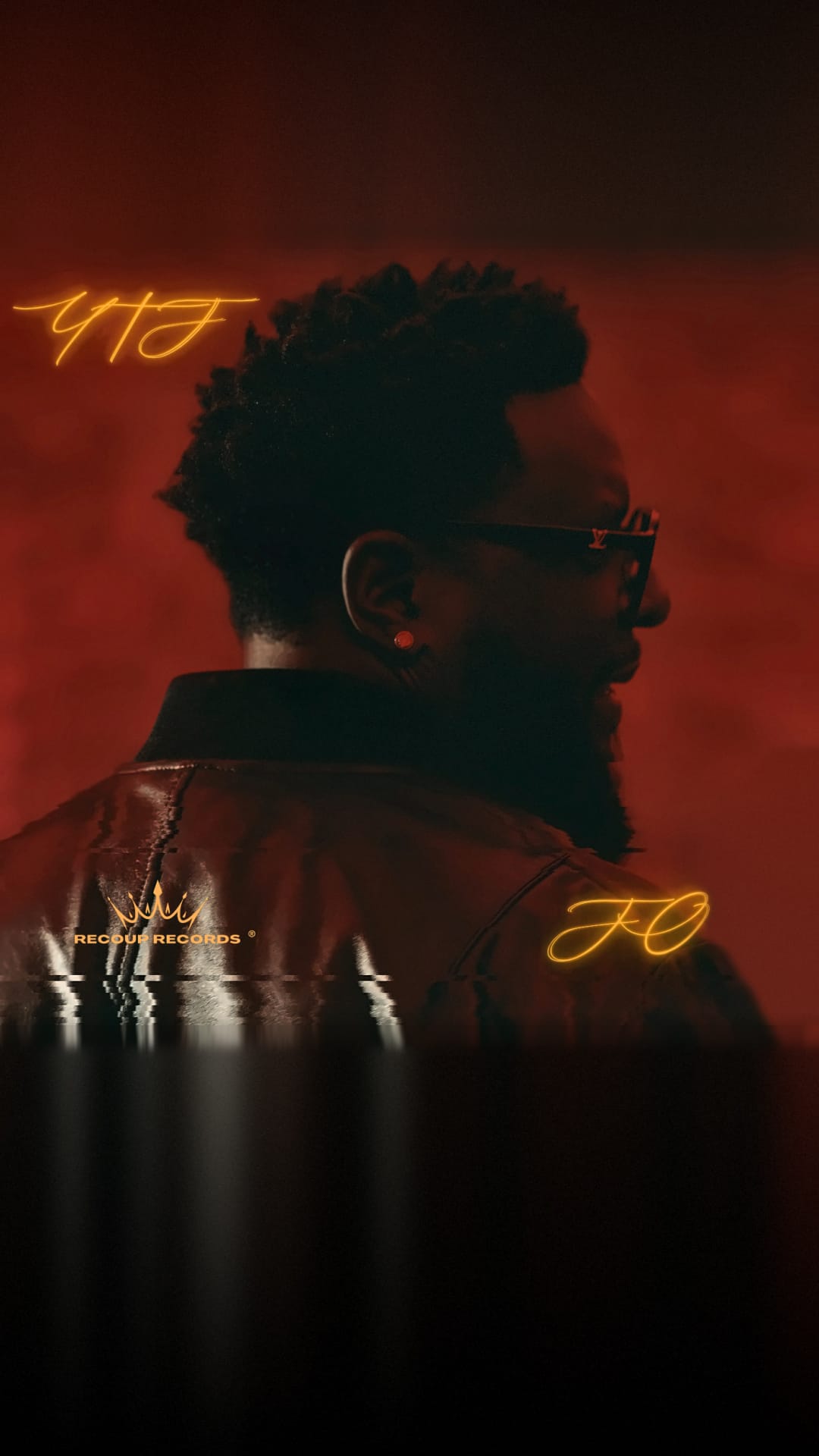

Josh2Funny’s Album Has Fans Talking — But Should He Stick To Music Or Skits? 😂🎶

Nigerian comedian and content creator Josh2Funny has taken his comedy game into music, and Nigerians are definitely having something to say about it.
The comedian released his 15-track album, “On Behalf of Josh,” on July 10, 2026, but instead of fading away after release, the project has continued to generate conversations on X.
And the big question now is:
Should Josh2Funny continue with music or go back to skits? 😂
Fans have been divided. While some listeners openly criticized the album and told him to return to comedy, others found songs they genuinely enjoyed.
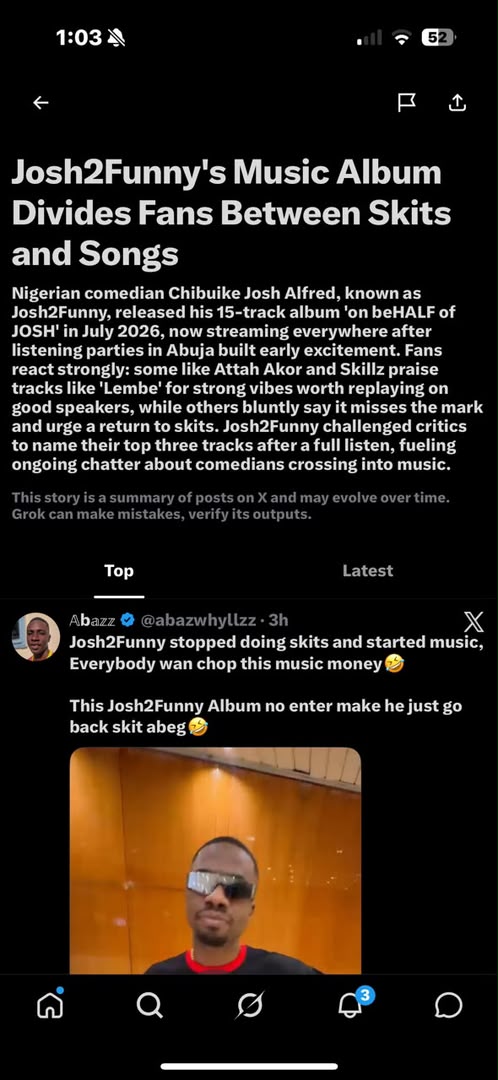
One X user joked:
“Josh2Funny stopped doing skits and started music, Everybody wan chop this music money 😂”
Another simply said:
“This Josh2Funny Album no enter make he just go back skit abeg 😂”
But then came “Lembe.” 🔥
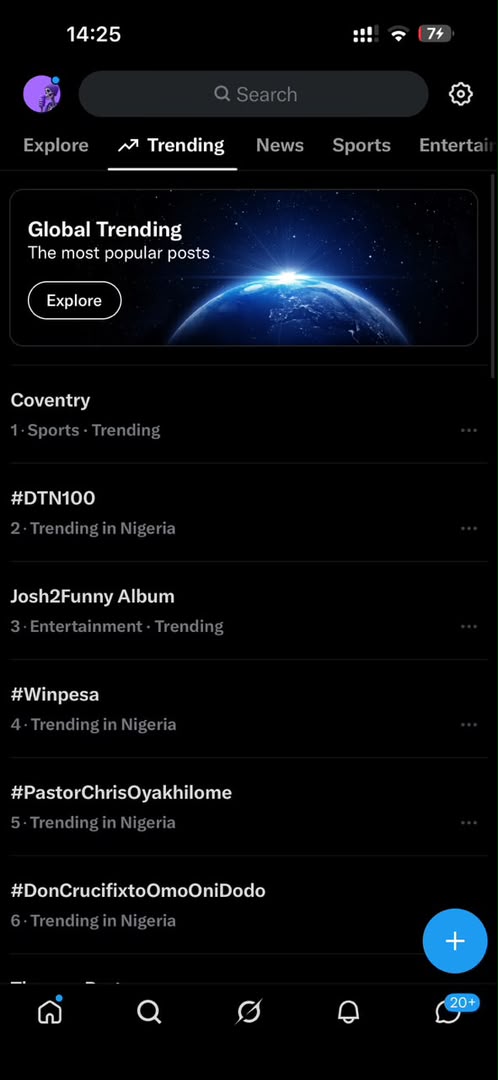
The track caught fire on X and eventually became a trending topic in Nigeria. The #LembeChallenge also gained momentum as creators began jumping on the song.
Josh2Funny later announced ₦1 million for winners of the challenge, giving the song another major push.
And it didn’t stop there.
‘INTERNATIONAL’ FT. ICE PRINCE ALSO TRENDED
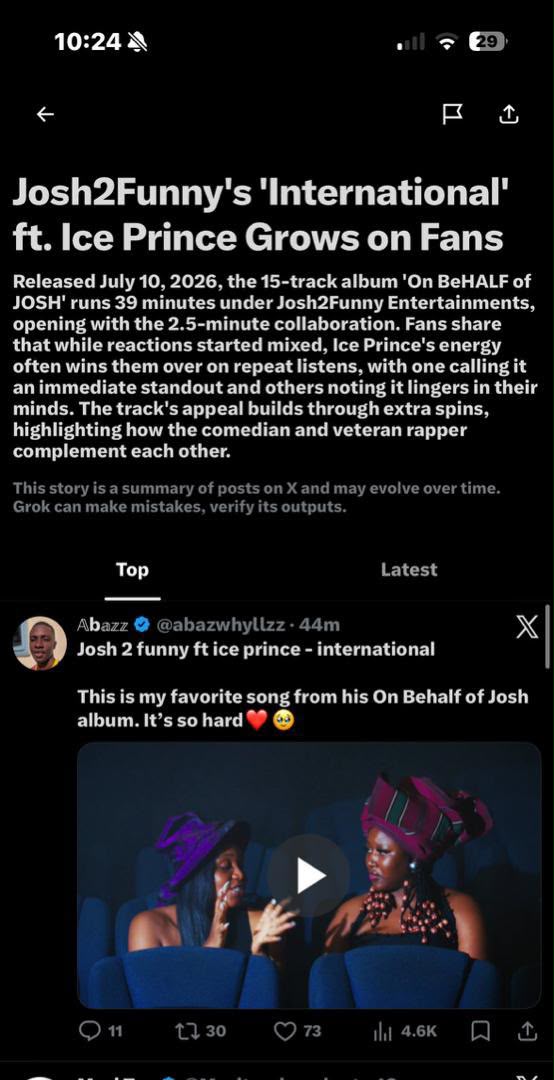
On another day, “International” featuring Ice Prince generated its own buzz on X.
One fan even called it their favourite song from the album, while praising the collaboration. The post itself pulled thousands of views, showing that people weren’t only talking about Lembe.
From album criticism to trending songs and challenges, “On Behalf of Josh” has kept Josh2Funny’s name in the conversation.
Whether you love the album or think he should return to skits, one thing is clear:
Josh2Funny has succeeded in getting Nigerians talking. 😂🔥
So, let’s settle this once and for all:
Should Josh2Funny continue with MUSIC 🎶 or return to SKITS 😂?
Music or Skits? Drop your answer! 👇


East Ham, East London — 8 August 2026: The vibrant Igbo community in the UK came together for an unforgettable evening of entertainment, culture and social connection at Igbotic Game Night, one of the biggest social gatherings celebrating the Igbo community in the United Kingdom.
Among the night’s standout moments was an electrifying performance by Afrobeats artist Obeena, who took the stage and immediately captured the attention of the crowd.
Obeena delivered performances of two of his hit songs, “Wara Wara” and “Banging,” bringing his energetic sound and distinctive stage presence to the event. From the opening moments of his set, fans responded with excitement, singing along, dancing and enthusiastically supporting the artist.

His performance of “Wara Wara” created an instant connection with the audience, while “Banging” took the energy to another level. Obeena’s ability to engage the crowd transformed his set into one of the most memorable entertainment moments of the evening.
Held in East Ham, East London, on 8 August 2026, Igbotic Game Night provided a unique platform for members of the Igbo community to celebrate their heritage while enjoying music, games and social interaction. Events such as this continue to play an important role in bringing together Nigerians and the wider African diaspora in the UK.
For Obeena, the performance was another opportunity to showcase his growing artistry and connect directly with fans. His energetic delivery, stage confidence and ability to command the audience demonstrated why his live performances continue to attract attention.
By the end of his set, Obeena had left the crowd amazed and added another memorable chapter to his journey as an Afrobeats artist. His appearance at Igbotic Game Night was not simply a performance—it was a celebration of Nigerian music, culture and community.
With performances like this, Obeena continues to demonstrate his ambition to take his sound beyond the studio and onto major stages, connecting with audiences through music, energy and an unmistakable African identity.
Igbotic Game Night brought the Igbo community together. Obeena gave them a performance to remember.
-
 Audio10 years ago
Page – Day Break Everywhere Burst
-
 Audio5 years ago
Shadykarz – Forever
-
 Audio10 years ago
Juniorboy ft. 9ice – IRAPADA
-
 Entertainment Gists6 years ago
Ex-Beauty Queen, Sandra Benede Shares Sexy Photo
-
 Audio5 years ago
Simi – Happy Birthday ft. Adekunle Gold, DeJa
-
 Audio5 years ago
Ruger – Bounce
-
 Mixtapes4 years ago
Mixtape: DJ DimpleNipple – The Best Of Amapiano Thrills
-
 Editorials3 years ago
Sa’eedah Imam On Creating Her Imprint In The Nigerian Music Industry As An Emerging Creative Writer