

As Manchester City’s players returned to the home dressing room after January’s exhilarating, exhausting 2-1 win over Liverpool, music shuddered from speakers. A house remix of Gregory Porter’s Liquid Spirit mixed with gleeful shouts as the celebrations began.
But in one corner, three men huddled quietly together.
Ederson and John Stones stared at a big screen as Harry Dunn, a member of manager Pep Guardiola’s backroom staff, zipped through a timeline of the match action to show a replay of Stones clearing the ball off his own goalline, with just 11mm to spare.
By the time they were showered, changed and back in the tinted privacy of their cars, Ederson, Stones or any of their team-mates could open the Hudl app on their phone and watch that moment, along with every other involvement they had in the game.
https://twitter.com/ManCity/status/1081143288302841856
That same orange icon will be on most Premier League players’ screens.
Some will log on after a match to find a similarly comprehensive compilation of highlights (and lowlights). Others will find a selection of clips with complimentary or critical coaches’ notes. Some are even required to put together their own showreel, demonstrating where they felt they did well and could do better.
When it comes to the serious business of deciphering what happened on the pitch, all 20 Premier League sides have a relationship with the American technology firm, which monitors every match from five tactical cameras, as well as the traditional broadcast angle shown on television.
Watching from high in the stands at Etihad Stadium during City’s win over Liverpool, two of the club’s performance analysis department worked furiously on laptops, using the programme to capture the devil in the match’s detail.
Touches, tackles, shots, passes, high presses, deep blocks, set-pieces, slip-ups and much, much more are monitored with about 90 different aspects of the game “coded” live, while the game is going on, to tie incidents to the relevant footage.
Their work can be used to flag things up to the tablet-clutching coaches on the bench and maximise the 15-minute interval.
“At half-time the coaches can see anything they want,” explains Aaron Briggs, Manchester City’s senior first-team performance analyst.
“If they spot an incident at a corner, we can pull the clip, find the best angle to get the coaches’ point across and they will deliver it to the player using the technology.”
But full-time is when the real hard work begins for Briggs and his team.
They will then spend about four hours going back through each City match looking for more subtle tactical cues and formational shifts, focusing on each individual player in turn, coding the footage to produce a deeper level of analysis.
A top-level match contains roughly 2,500 bookmarks, highlighting points of interest to be called up at the touch of a button.

If Guardiola’s performance analysis chief, Carles Planchart, wants to see where City’s attempts to play out from the back are faltering, he can instantly review every time his defenders have been hustled out of possession.
If the Spaniard wants to see how vulnerable an opposition full-back is to a quick switch of play, he can review how they dealt with crossfield balls over the past five seasons.
In April, he described how City had scored a goal after noting and exploiting Chelsea midfielder Jorginho’s tendency to stray out of position as his team pressed high upfield.
The evidence for every tactical theory is ready for review in seconds.
With stats gatherers, such as Opta, providing a raft of raw numbers, and footage from across different continents easily available, analysts can spot trends that previously would take hundreds of hours to chisel out.
In the 1950s, former accountant Charles Reep, sometimes sporting a miner’s helmet to illuminate his notes, would manically scribble down play-by-play diagrams at every Swindon home match to try to find out the most effective playing styles. His recommendation of long-ball route-one football shaped the English psyche for decades to come.
During his time in charge of Argentina, Leeds United boss Marcelo Bielsa would spend 12 hours a day, on his own, spooling through videotapes of matches, laboriously editing clips together and drawing up diagrams. He took a library of 2,000 video tapes for his team to watch to the 2002 World Cup in Japan.

Briggs has his own memories of technology limiting, rather than accelerating, analysis.
“When I first started my career at Preston in 2008, there was a television with a massive back and a small 20-inch screen,” he says.
“Below, it had a double cassette player and you would play the game on the top VHS, stopping, fast-forwarding to find the bits that you wanted to record on to the bottom deck. The whole process would take about a day.
“Then came the era of DVDs. You would be sent the opposition games through the post, the manager would be waiting for it and I would be chasing Royal Mail, trying to find out if it had been tracked and when it would arrive.
“I used to take a nine DVD burner with me for every away trip, put a master DVD in the top and then burn nine copies for the coaches. Now we just stick it on a hard drive and transfer it instantly to whoever we want.”
The hard drives are only getting bigger.
Spatial information is the latest frontier in football’s big data arms race. For the past few years, Premier League matches have not just been filmed but ‘tracked’, with the movement of every player and the ball continuously recorded via optical technology.
“The spatial data is so key because when you look at an individual’s involvement in the game it is normally less than two minutes on the ball,” says Briggs.
“The spatial data is the other 98% of the game that no-one has really looked at previously.”
The technology has revolutionised basketball’s NBA since its arrival in 2013, with teams and players tweaking collective tactics and individual techniques to increase their chances of winning.
Unlocking potential percentage gains in football, a less structured, more fluid sport where scores are relatively few, is trickier.
Premier League frontrunners Manchester City and Liverpool are among those to employ data scientists to crunch the numbers, but, as well as the finest minds, artificial intelligence is also being brought to bear.
Stats Edge is a match preparation tool that was first road-tested by Croatia at last year’s World Cup.
Before their semi-final, team analyst Marc Rochon could instantly call up every set-piece opponents England had delivered in the tournament, seeing the runs made by each attacker, the type of delivery favoured by each taker and which area of the box were most profitable in generating attempts at goal.
Gareth Southgate’s “Love Train” was duly derailed, helping Croatia to a showpiece final against France.
This season is the first that the programme is available to Premier League clubs.
It uses spatial data to detect different phases of play, giving an overview on how teams build from the back, how they counter-attack, how often and how high they press, their reliance and vulnerability to crosses, their deep-lying defensive shapes and how their formation morphs as they move upfield.
If a player is slow in taking up their defensive role, if there is unexploited space between the lines, if a particular forward burst is where a team derives a large number of their chances, the programme remorselessly, objectively exposes it.

“When Marcelo Bielsa did his press conference at Leeds last season, describing his tactical preparation, what he showed was throwing people at analysing formation,” says Dr Patrick Lucey, the company’s chief scientist.
“He took in 51 of Derby’s games and each took four hours – that just reeks of needing disrupting. We need new technology to address that.”
However, if it turns out machines can do the job of a small battalion of analysts, where will that leave Briggs and football’s superpowers?
Will their less well-resourced opponents be able to uncover flaws in City that would have stayed hidden to the unassisted human eye?
Or, by laying every tactical quirk bare, will technology foil whatever ploy they come up with to narrow the gap?
The team behind the AI tool believe machine learning will encourage, rather than stifle, innovation.
Paul Power, AI scientist, points to the way some goalkeepers, such as Julian Pollersbeck at Hamburg, have been deployed well out of their box when their team is in possession, the sort of tactic that would traditionally have been seen as too risky, whatever rewards it might offer.
“Technology and data is information which allow people to make better decisions and evolve the game – because those coaches can see where the ball is lost most often and what the risks are and how to mitigate them,” he says.
“Teams have always had questions, but data has not always had the answer. Now, with the advent of deep learning and modelling dynamic systems, we can start to answer them.”

And this is just the start.
In the future there will be a scouting tool that will flag potential transfer targets, not on how well they are playing for their current team, but on how they would fit the style of their possible buyers.
The aim is to model the delicate alchemy of teamwork, predicting how players move and interact alongside each other, a process they term “ghosting”.
This year, their company is tracking how the very skeletons of college basketball players move, helping teams make miniscule technical adjustments and winkle out “tells” that hint at what an opponent is about to do.
But sometimes, still, whatever the computers say, whatever the analysts can show, the wrong option is the right choice.
Four months after Stones and Ederson had gathered to watch one decisive moment in the Premier League race, another arrived at Etihad Stadium.
With 20 minutes to go and City unable to break down a stubborn Leicester side in the penultimate game of the season, central defender Vincent Kompany stepped forward 25 yards out from goal.
“If you analyse all the centre-backs from across the world, hitting the ball from the distance that Vinnie did, you would tell him not to shoot,” remembers Briggs.
Indeed, boss Guardiola, along with players Sergio Aguero, Gabriel Jesus and Raheem Sterling, admitted afterwards they were willing their captain to do anything but.
“Vinnie felt the moment though, delivered and it was a major reason why City won the Premier League,” adds Briggs.
“There is always going to be the individual talent of the players on the pitch who can decide a game in a moment. It is not going to be computer v computer, the fans don’t want that and I think football would kind of lose its soul if that happened.”







Nigerian artist N8TAN is set to unveil his highly anticipated ‘UPRISING EP’, a body of work that chronicles his journey from the streets to the heights of his musical ambition.
Built around themes of struggle, resilience, ambition, survival, and triumph, UPRISING captures the realities of an artist determined to turn adversity into momentum. The project reflects N8TAN’s experiences, the challenges that shaped him, and the relentless drive that continues to push him forward.
More than a collection of songs, UPRISING is presented as a story of transformation—from navigating the streets and confronting uncertainty to finding purpose, embracing growth, and rising toward the top.
With its blend of raw storytelling, infectious energy, and personal perspective, the EP offers listeners an intimate look into N8TAN’s world while reinforcing his determination to carve out his own place in the music industry.
‘UPRISING EP’ is a statement of elevation: a reminder that where you start does not have to determine where you finish.
As N8TAN continues to build his musical identity, UPRISING marks another significant chapter in his journey—and an invitation for listeners to rise with him.
Josh2Funny’s Album Has Fans Talking — But Should He Stick To Music Or Skits? 😂🎶

Nigerian comedian and content creator Josh2Funny has taken his comedy game into music, and Nigerians are definitely having something to say about it.
The comedian released his 15-track album, “On Behalf of Josh,” on July 10, 2026, but instead of fading away after release, the project has continued to generate conversations on X.
And the big question now is:
Should Josh2Funny continue with music or go back to skits? 😂
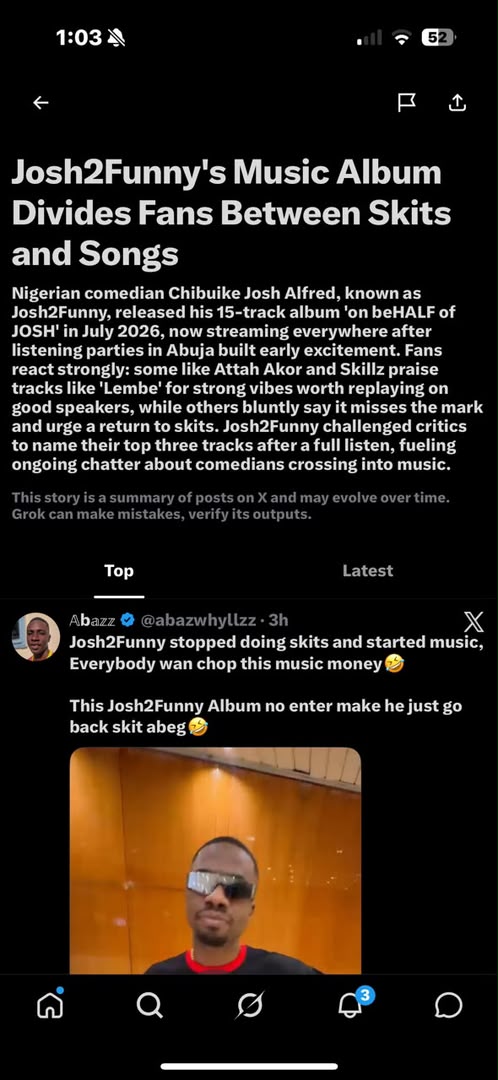
Fans have been divided. While some listeners openly criticized the album and told him to return to comedy, others found songs they genuinely enjoyed.
One X user joked:
“Josh2Funny stopped doing skits and started music, Everybody wan chop this music money 😂”
Another simply said:
“This Josh2Funny Album no enter make he just go back skit abeg 😂”
But then came “Lembe.” 🔥
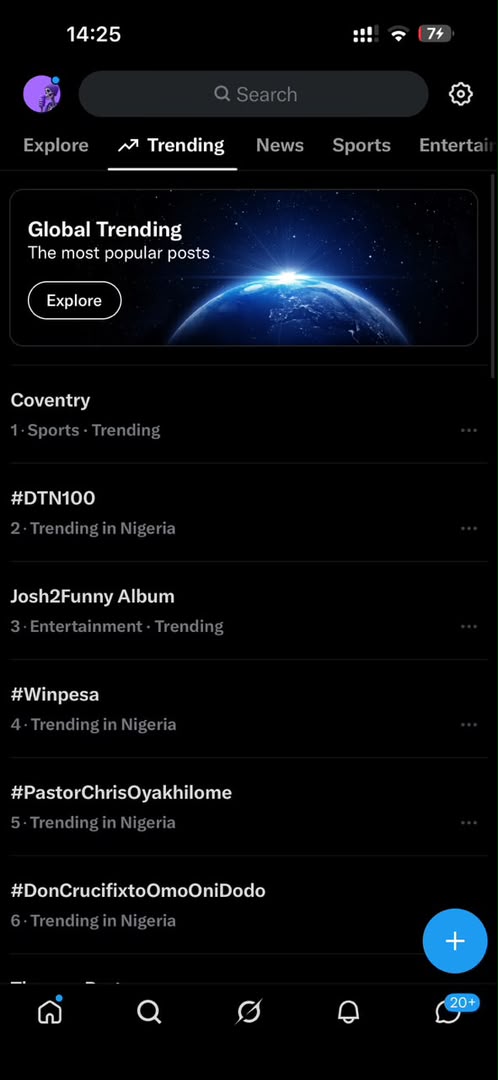
The track caught fire on X and eventually became a trending topic in Nigeria. The #LembeChallenge also gained momentum as creators began jumping on the song.
Josh2Funny later announced ₦1 million for winners of the challenge, giving the song another major push.
And it didn’t stop there.
‘INTERNATIONAL’ FT. ICE PRINCE ALSO TRENDED
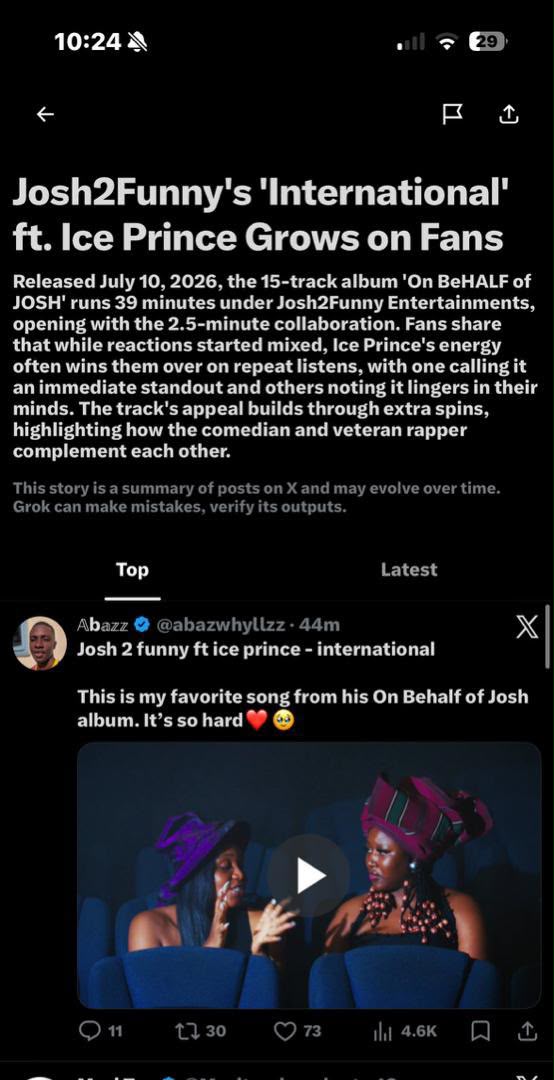
On another day, “International” featuring Ice Prince generated its own buzz on X.
One fan even called it their favourite song from the album, while praising the collaboration. The post itself pulled thousands of views, showing that people weren’t only talking about Lembe.
From album criticism to trending songs and challenges, “On Behalf of Josh” has kept Josh2Funny’s name in the conversation.
Whether you love the album or think he should return to skits, one thing is clear:
Josh2Funny has succeeded in getting Nigerians talking. 😂🔥
So, let’s settle this once and for all:
Should Josh2Funny continue with MUSIC 🎶 or return to SKITS 😂?
Music or Skits? Drop your answer! 👇

RUAN-Badkid.96 is a Nigerian recording artist whose music refuses to live inside a single genre. Blending Afrobeat, Afrofusion, trap, hip-hop, melodic rap, R&B, and global influences, he creates records that move effortlessly between raw street energy, soulful storytelling, and infectious melodies. Whether delivering hard-hitting bars, emotional love songs, or rhythm-driven African records, his sound is defined by authenticity rather than limitation.
Inspired by both African culture and international music, RUAN-Badkid.96 embraces the confidence and ambition of global hip-hop while staying deeply connected to his roots. His lyrics explore love, heartbreak, betrayal, friendship, social injustice, hope, and the everyday realities of life. He doesn’t create music to follow trends, he creates music to reflect truth, emotion, and human experience.
Behind his fearless image is an artist who believes in kindness, equality, justice, and genuine human connection. His appearance may be intimidating, but his message is rooted in compassion and authenticity. Every record carries a piece of his journey, proving that strength and vulnerability can exist in the same voice.
For RUAN-Badkid.96, music is more than entertainment, it’s a language, a testimony, and a lifelong mission to connect with people through honesty, versatility, and unforgettable sound.
-
 Audio10 years ago
Page – Day Break Everywhere Burst
-
 Audio5 years ago
Shadykarz – Forever
-
 Audio10 years ago
Juniorboy ft. 9ice – IRAPADA
-
 Entertainment Gists6 years ago
Ex-Beauty Queen, Sandra Benede Shares Sexy Photo
-
 Audio5 years ago
Simi – Happy Birthday ft. Adekunle Gold, DeJa
-
 Audio5 years ago
Ruger – Bounce
-
 Mixtapes4 years ago
Mixtape: DJ DimpleNipple – The Best Of Amapiano Thrills
-
 Editorials3 years ago
Sa’eedah Imam On Creating Her Imprint In The Nigerian Music Industry As An Emerging Creative Writer