
News
Analysis: In The Red Sea, The US Has No Good Options Against The Houthis


This November 12, 2018 photo shows the USS Carney in the Mediterranean Sea
The US-led maritime force is a half measure that the Houthis will test. But it can’t do more without escalating tensions.
Operation Prosperity Guardian (OPG), the United States Navy-led coalition of the willing intended to allow international shipping to continue navigating safely through the Red Sea, is set to activate within days. Including allies from Europe and the Middle East, as well as Canada and Australia, the operation has been snubbed by three important NATO countries, France, Italy and Spain.
What is the exact task of OPG?
The official line, “to secure safe passage for the commercial ships”, is too vague for any naval flag officer to feel comfortable getting into. Admirals want politicians to give them precise tasks and clear mandates needed to achieve the desired results.
Defining the threat seems easy, for now: antiship missiles and drones of various types carrying explosive warheads have been targeting merchant ships on the way to and from the Suez Canal. All were fired from Yemen, by the Houthi group also known as Ansar Allah which now controls most of the country, including the longest section of its 450km-long Red Sea coast. All missiles were surface-launched, with warheads that can damage but hardly sink big cargo ships.
The Houthis at first announced that they would target Israeli-owned ships, then expanded that to include all those using Israeli ports, ultimately to those trading with Israel. After several attacks where the Israeli connection appeared very distant or vague, it is prudent to assume that any ship could be targeted.
All missiles neutralised by US and French warships so far were shot down by sophisticated shipborne surface-to-air missiles (SAM), proving that the modern vertical-launch systems guided by the latest generation phased array radars work as designed. Many nations earmarked to participate in OPG have ships with similar capabilities. Almost all also carry modern surface-to-surface missiles that can attack targets at sea or land.
If the task of OPG were to be defined narrowly, only to prevent hits on merchant ships, it could be performed using the centuries-old principle of sailing in convoys with the protection of warships.
In a convoy, slow, defenceless commercial cargos sail in several columns at precisely defined distances from each other — led, flanked and tailed by fast warships that can take on any threat. The system is effective, as the United Kingdom, Russia, Malta, and many other countries saved by convoys in World War II can attest.
But every strategy has its limitations. A convoy is big and cumbersome, extending for miles to give behemoth ships a safe distance from each other and to enable them to manoeuvre if needed. Whatever the protective measures taken, huge tankers and container carriers – longer than 300 metres (984 feet) – still present big targets. Captains of commercial ships are generally not trained in convoy operations, and most have no experience operating in large groups or under military command.
Their escorts, even if well-armed, carry a limited number of missiles and must plan their use carefully, allowing for further attacks down the shipping lane and ultimately leaving a war reserve for the defence of the ship itself. Once they expend some of the missiles, they need to replenish them – a task that is possible at sea but done much more quickly and safely in a friendly port out of reach of Houthi missiles.
To clear the critical 250 nautical miles (463km) along the Yemeni coast leading to or from the Bab al-Mandeb strait, advancing at assumed 15 knots (28kmph) — as convoys always sail at the speed of the slowest units — ships would be exposed to even the shortest-ranged Houthi missiles and drones for at least 16 hours.
And before even trying to make the dash, they would be particularly vulnerable in the staging areas in the Red Sea and the Gulf of Aden where ships would spend some time gathering, forming the convoy and setting under way.
The Houthi missile threat is now known to be high, and their arsenal is substantial. Naval planners must be worried by their ability to mount concentrated prolonged attacks simultaneously from several directions.
This was demonstrated in the very first attack, on October 19, when the Houthi launched four cruise missiles and 15 drones at USS Carney, a destroyer that is still operating in the Red Sea and will be part of OPG. The attack, probably planned to test the Houthis’ attack doctrine and enemy response, lasted nine hours, forcing the crew of the target ship to maintain full readiness and concentration for a prolonged period to intercept all incoming missiles.
Every admiral would tell his political superiors that military necessity would call for attacks on Houthi missile infrastructure on the ground in Yemen: fixed and mobile launch sites, production and storage facilities, command centres and whatever little radar infrastructure there exists. A proactive response to the missile threat, in other words, to destroy the Houthi ship-targeting capability, rather than the reactive one limited to shooting missiles down as they come in.
In theory, attacks against Houthi missile infrastructure could be based on satellite and unmanned aerial vehicles (UAV) reconnaissance and carried out by missiles launched from the Red Sea and the Indian Ocean and armed drones from distant land bases. But the only realistic chance at meaningful success would require the use of combat aircraft, bombers based on the two US Navy nuclear carriers in the region.
Attacks against targets in Yemen would have a clear military justification. But they would also carry a clear political risk: that of the West, particularly the US, being seen in the Arab and Islamic world as actually entering the Gaza war on the side of Israel. After all, the Houthis say their attacks on Red Sea ships are aimed at getting Israel to end the war.
Aware of the perils of such a development that could easily cause the conflict to spread, the US has tried to tread carefully, engaging with regional powers, and sending messages that it wants no escalation. It even openly demanded of its ally Israel that it limit civilian suffering and end the conflict as quickly as possible — to no avail.
The White House and the Pentagon are now walking on hot coals. If they do nothing, the Red Sea route will quickly close, causing US, European and Asian economies significant damage. If the half measures they currently propose, just escorting convoys without attacking missile sites on land, fail to secure safe passage, they will have lost face and failed in preventing an economic downturn. And if the US is eventually forced to attack, it will have directly contributed to a dangerous escalation that may be difficult to contain.
Mindful of all these dilemmas, France, Italy and Spain are playing it safe: they will “unilaterally” deploy their frigates to the Red Sea to “protect the ships of their respective nations”. Should the US Navy ultimately attack Yemen, the Europeans will be able to claim that they did not contribute to the intensification of the war, shoving all the responsibility to the US.






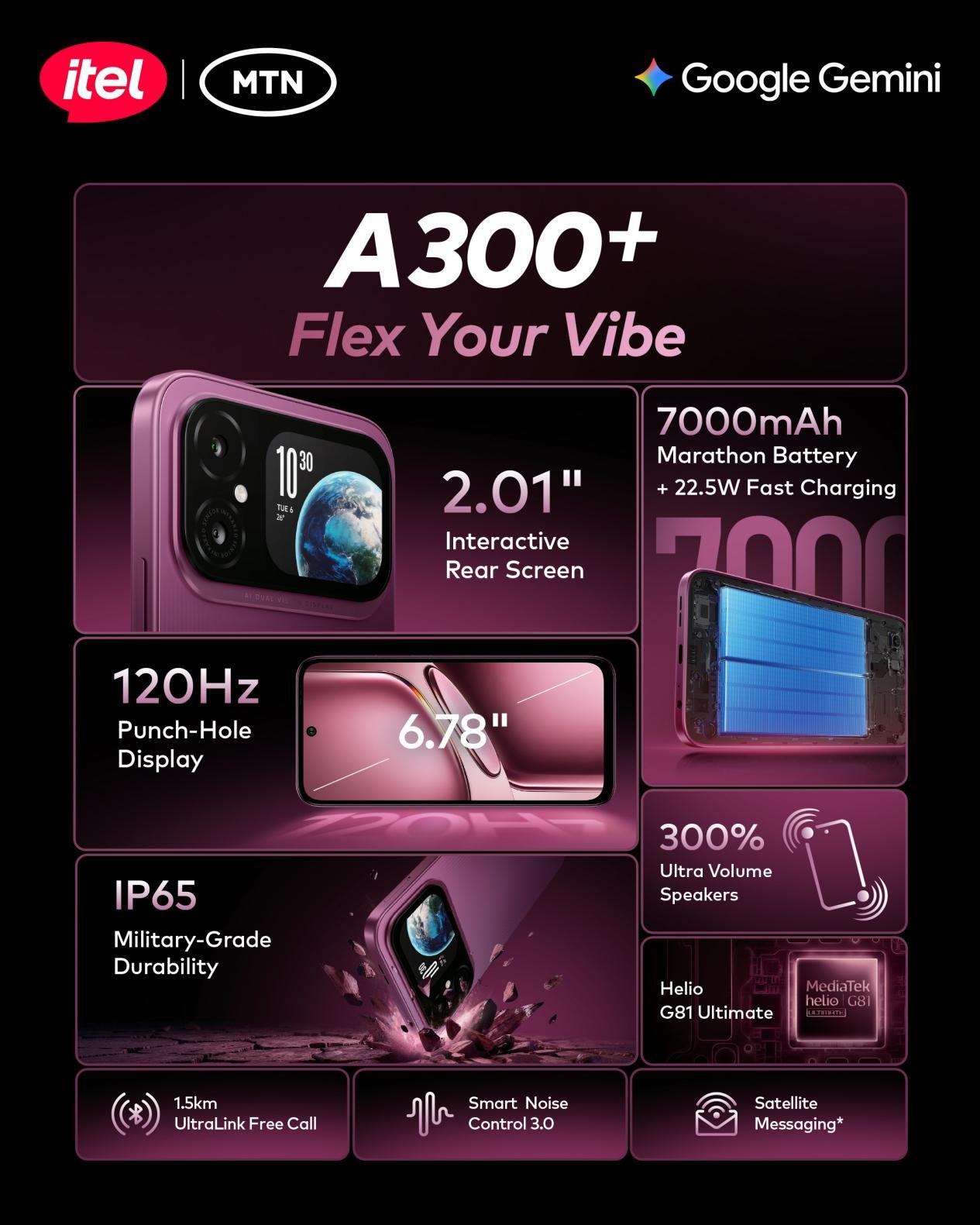
itel, the technology empowerment brand for masses, officially unveiled its new product A300+, brand’s first interactive dual-screen smartphone in its price range. itel A300+ comes with a comprehensive set of features — a 7000mAh marathon battery, IP65 military-grade durability, and satellite communication capability, demonstrating that innovation and complete product strength can coexist at an accessible price point.

A First-of-Its-Kind Rear Screen Experience: Interactive Innovation for a New Generation
itel A300+ coming with an interactive rear display is a rare feature in this price category, designed to deliver a smart entertainment experience for young generations. Far from being a cosmetic gimmick, the rear screen provides practical functions built around real everyday scenarios. Users can frame selfies using the higher-quality rear camera with a live preview on the back screen, glance at incoming messages and alerts without waking the main display, and play, pause, or skip tracks directly from the rear screen. The rear display also supports customizable clocks, photos, and designs, giving users a personal window to express their individual style. Complementing the rear screen, the A300+ features a 6.78-inch immersive punch-hole main display, offering a cleaner, more expansive viewing experience for streaming, gaming, browsing, and social media.
Performance and Value in Balance: Delivering Fresh Technology Despite Industry Pressure
Even amid rising industry costs, itel has chosen to bring fresh technology to its products while continuously improving performance and keeping pricing accessible. The A300+ is powered by a 7000mAh marathon battery engineered for long-term reliability, supporting up to 1,200 charging cycles — far exceeding the industry standard, and designed to retain healthy capacity. AI Charging Protection intelligently manages charging patterns to reduce battery degradation, while Smart Power Management optimizes power consumption across apps and hardware to extend usage time between charges.

The device also features 300% ultra-volume DTS stereo speakers, delivering rich, room-filling sound for music, videos, FM radio, and everyday entertainment. Built to withstand daily life and beyond, the A300+ carries IP65 water and dust resistance certification and meets military-grade durability standards, resisting splashes, dust, and accidental drops. Notably, the A300+ includes satellite communication capability, ensuring users can still send basic messages via satellite when cellular networks are unavailable — a safety net in remote areas, during natural disasters, or in other critical situations, setting it apart in its price segment.

The A300+ is built on a clear product philosophy, rather than relying on a single headline feature, it combines its key strengths into one complete product story. The rear screen captures attention first, while battery life, durability, and practical usability make the overall value proposition convincing. With the A300+, itel once again demonstrates its commitment to using innovation to meet the needs and desire for novelty among young users in emerging markets.
The itel A300+ is available in two variants: the 64GB ROM and 128GB ROM and they are both available in all phone retail stores in Nigeria or via online store HERE


DJ ROBOT teams up with TMP OFFISIAL and FATEOFTHEYOUTH for NDSM DELUXE, a new DJ mixtape that expands the world of NDSM — No Dey Stress Me into a bigger, more energetic listening experience.
Built around DJ ROBOT’s approach to sequencing, mixing, and controlling energy, NDSM DELUXE transforms the NDSM mindset into a full sonic journey. The mixtape explores nightlife, pressure, temptation, confidence, freedom, desire, and the decision to simply refuse to let life overwhelm you.
Bringing together DJ ROBOT’s DJ-driven vision with the creative energy of TMP OFFISIAL and FATEOFTHEYOUTH, the deluxe edition adds new dimensions to the original NDSM message while maintaining its central philosophy: No Dey Stress Me.
Rather than simply extending the original project, NDSM DELUXE is designed as an experience — moving through different moods, rhythms, and moments while allowing each transition to contribute to the story.
For DJ ROBOT, the project represents an opportunity to communicate through energy as much as words.
“The original NDSM had more energy and stories to explore. I wanted to take the ‘No Dey Stress Me’ mindset beyond the song and turn it into a full DJ experience — something that captures nightlife, freedom, pressure, temptation, and the moments when you simply choose to enjoy yourself and live in the present.”
Listen below;

Nigerian artist N8TAN is set to unveil his highly anticipated ‘UPRISING EP’, a body of work that chronicles his journey from the streets to the heights of his musical ambition.
Built around themes of struggle, resilience, ambition, survival, and triumph, UPRISING captures the realities of an artist determined to turn adversity into momentum. The project reflects N8TAN’s experiences, the challenges that shaped him, and the relentless drive that continues to push him forward.
More than a collection of songs, UPRISING is presented as a story of transformation—from navigating the streets and confronting uncertainty to finding purpose, embracing growth, and rising toward the top.
With its blend of raw storytelling, infectious energy, and personal perspective, the EP offers listeners an intimate look into N8TAN’s world while reinforcing his determination to carve out his own place in the music industry.
‘UPRISING EP’ is a statement of elevation: a reminder that where you start does not have to determine where you finish.
As N8TAN continues to build his musical identity, UPRISING marks another significant chapter in his journey—and an invitation for listeners to rise with him.
-
 Audio10 years ago
Page – Day Break Everywhere Burst
-
 Audio5 years ago
Shadykarz – Forever
-
 Audio10 years ago
Juniorboy ft. 9ice – IRAPADA
-
 Entertainment Gists6 years ago
Ex-Beauty Queen, Sandra Benede Shares Sexy Photo
-
 Audio5 years ago
Simi – Happy Birthday ft. Adekunle Gold, DeJa
-
 Audio5 years ago
Ruger – Bounce
-
 Mixtapes4 years ago
Mixtape: DJ DimpleNipple – The Best Of Amapiano Thrills
-
 Editorials3 years ago
Sa’eedah Imam On Creating Her Imprint In The Nigerian Music Industry As An Emerging Creative Writer