
News
I Am Starting To Question Whether We Have Freedom of Speech in Germany

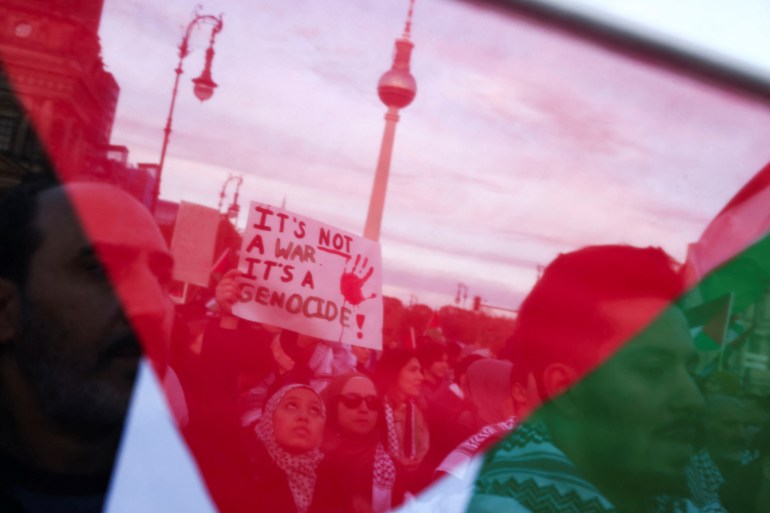
Several protest banners were seized by German police at a pro-Palestinian demonstration in Berlin on November 4, 2022
Officers seized several banners at a recent Berlin protest, fuelling fears that free expression does not extend to the Palestinian cause.
Berlin, Germany – Early-afternoon on Saturday in central Berlin, officers led an elderly German woman away to a police van so her sign could be checked.
She was preparing to attend a march calling for a ceasefire in the Gaza Strip.
Her banner, which said she was ashamed to be German and that there was a “genocide” taking place in the densely populated Palestinian enclave being bombarded by Israel.
Police let her and her sign go, and she joined the march.
Later, as the rally got under way, a group of officers in riot gear readied themselves in front of a crowd of chanting protesters.
An estimated 8,000 to 10,000 people marched in the German capital. About 1,000 police were deployed in part to prevent any anti-Semitic speeches or signage.
Until recently, most pro-Palestinian demonstrations were banned in Berlin because local authorities feared an outburst of violence or anti-Semitism. But the decision was criticised as breaching the democratic right to freedom of assembly.
In the past two weeks, several protests have been permitted, including Saturday’s march.

At about 4pm, police pushed into the crowd and, to calls of “shame, shame”, pulled Monika Kalinowska out.
Her sign, written in red, read, “Israel is a terrorist state.”
“I am really starting to question whether we actually have freedom of speech in Germany,” said Kalinowska, who described the episode as exasperating.
After she was frisked and her identification checked, she was told there was nothing wrong with her sign – even though it was confiscated – and she was allowed to leave. She could pick up the sign the next day, police said.
“But the thing that made me really mad was when the policeman asked me if I identified as a woman,” she said. “I was not saying anything illegal and, I mean, if you don’t respect my freedom of speech, how are you going to respect whether I identify as a man or a woman?”
The officer who briefly removed Kalinowska from the protest told Al Jazeera that there was no formal list or any particular guidelines to follow.
“Really, I just use my intuition,” he said. “If I see something I think is bad, we go and get it.”
In another case, a large poster calling German Chancellor Olaf Scholz and Israeli Prime Minister Benjamin Netanyahu “deadly assassins” was taken away.
A group of young Italians were told to destroy theirs, which said, “Stop the genocide. Stop the apartheid.”
“He told me that if I said these things, I could be arrested,” one of the Italians, who requested anonymity, told Al Jazeera.
“No, I didn’t,” the police officer argued back. “I said you could be arrested if you said those things under certain circumstances.”
Asked what those circumstances might be, the officer told Al Jazeera, “I don’t want to get into this with you.”
“There are certain symbols that are forbidden,” said another officer, referring to Germany’s recent ban on Hamas, the Palestinian group that rules Gaza and was behind the deadly attacks in Israel on October 7.
In a statement to Al Jazeera, police spokesperson Anja Dierschke said officers had acted in line with previously issued guidelines on the Middle East conflict and a public prosecutor had been available in the operations room during the protest to answer any legal questions.
In the end, seven offences related to signage were recorded, police said.
While the job of identifying illegal signs is difficult for police, their measures at protests have a “chilling” effect, lawyers at the European Legal Support Center (ELSC), told Al Jazeera.
“People now wonder if what they wear or say will get them arrested or even deported,” said a spokesperson for the ELSC, which provides legal support regarding Palestinian issues and has an office in Berlin.
“The police are basically deciding the law on the street. They seem to have deployed wide discretionary powers, almost declaring a state of emergency, but without any legal basis. It resembles the practices of an authoritarian regime.”
‘It still has to be tolerated’
Germany has what it calls a “special responsibility” to the Jewish people, to Israel and to combatting anti-Semitism because it was responsible for the Holocaust.
The country mainly uses two laws to prosecute the public expression of hate speech.
Section 130 of the criminal code regards incitement against a certain group of people, which has previously been used to combat the glorification of Nazi Germany, Holocaust denial, and anti-Semitic, racist or homophobic hate speech. Punishment ranges from a fine to up to five years in prison.
Section 140 looks at whether crimes are being condoned in a way that incites further violence or disturbs the peace.
But Michael Wrase, a professor of public law and a constitutional law expert at the Berlin Social Science Center, said it is difficult for police deployed at protests to make decisions on whether certain signs and banners break the law.
“It’s a tightrope that everyone is walking,” he explained.
While raising a Hamas flag, for example, is clearly prosecutable, others acts are not.
“Because with some symbols or signs, the interpretation can be quite different according to who is observing them,” said Wrase.
Ultimately, context is key.
For example, chanting, “From the river to the sea, Palestine will be free,” on October 8, immediately after Hamas attacked Israel, killing more than 1,400 people and kidnapping more than 240, could well be seen as celebrating violence as well as inciting more.
However, chanting the same slogan during a “Ceasefire Now” demonstration a month and more than 10,000 Palestinian deaths later has a different context as do signs that say things like “From the river to the sea, we demand equality.”
In mid-October, Berlin’s public prosecutor said the “river to the sea” slogan would be prosecuted.
But the legalities of that decision have yet to be tested in a German court.
In mid-August, a Dutch court refused to prosecute an activist who had used the rhyme in a 2021 speech, saying such charges were unfounded.
While the situation is heated, the law should – as the saying goes – be blind, said Wrase.
Case law in Germany, all the way to the country’s highest court, indicates that freedom of assembly is a priority and that all protesters should first be given the benefit of the doubt, which is why far-right activists can still hold rallies.
“Even if you don’t agree with what people are demonstrating for, it still has to be tolerated,” said Wrase.
“And as a general rule – this is also set by the Federal Constitutional Court – if you have different possibilities to interpret a certain slogan, you should err on the side of interpreting it to be lawful. You have to give the benefit of the doubt to those exercising their democratic freedoms.”‘
‘Chilling’ effect
Thomas Fischer, a former presiding judge at the Federal Court of Justice, the country’s highest criminal court, agreed with Wrase, saying, “Even if an opinion is morally dubious or just plain wrong, the German constitution says you still have the right to express it.”
“Nobody should be using criminal or civil law to ensure that the only opinions expressed are those the German government agrees with,” he said.
For example, criticising the Israeli government and its actions is not anti-Semitic, Fischer explained.
“It would be ridiculous to equate all Jewish people with the government of Israel. That, would, in fact, be ant-Semitic.”
Over the past month, German politicians have called for changing various laws, including those around the right to demonstrate and freedom of opinion.
The idea of withdrawing citizenship, residency, welfare benefits or funding from anyone accused of making anti-Semitic statements has been floated as well as a plan to only allow “native Germans” to protest.
This week, as community tensions boil across Europe as a result of the Gaza war, German President Frank-Walter Steinmeier called on people of Arab and Palestinian heritage to “speak for yourselves and make a clear stand against terror”, a comment that was decried by some as discriminatory because it singled out minority groups.
“It’s too soon to tell what the impact of these calls from conservative politicians will be in concrete terms,” the ELSC spokesperson said.
“But these are racist policies in action. We still have courts of law in Germany, and if necessary, we will go there in order to protect fundamental rights because this blurred situation is extremely dangerous for our democracy.”







East Ham, East London — 8 August 2026: The vibrant Igbo community in the UK came together for an unforgettable evening of entertainment, culture and social connection at Igbotic Game Night, one of the biggest social gatherings celebrating the Igbo community in the United Kingdom.
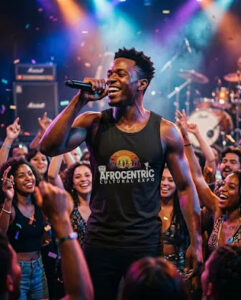
Among the night’s standout moments was an electrifying performance by Afrobeats artist Obeena, who took the stage and immediately captured the attention of the crowd.
Obeena delivered performances of two of his hit songs, “Wara Wara” and “Banging,” bringing his energetic sound and distinctive stage presence to the event. From the opening moments of his set, fans responded with excitement, singing along, dancing and enthusiastically supporting the artist.

His performance of “Wara Wara” created an instant connection with the audience, while “Banging” took the energy to another level. Obeena’s ability to engage the crowd transformed his set into one of the most memorable entertainment moments of the evening.
Held in East Ham, East London, on 8 August 2026, Igbotic Game Night provided a unique platform for members of the Igbo community to celebrate their heritage while enjoying music, games and social interaction. Events such as this continue to play an important role in bringing together Nigerians and the wider African diaspora in the UK.
For Obeena, the performance was another opportunity to showcase his growing artistry and connect directly with fans. His energetic delivery, stage confidence and ability to command the audience demonstrated why his live performances continue to attract attention.
By the end of his set, Obeena had left the crowd amazed and added another memorable chapter to his journey as an Afrobeats artist. His appearance at Igbotic Game Night was not simply a performance—it was a celebration of Nigerian music, culture and community.
With performances like this, Obeena continues to demonstrate his ambition to take his sound beyond the studio and onto major stages, connecting with audiences through music, energy and an unmistakable African identity.
Igbotic Game Night brought the Igbo community together. Obeena gave them a performance to remember.
Audio
KenryWhite Releases “Kilometers” & “The King” A Powerful Double Release Celebrating Faith, Purpose, and the Journey to Greatness


Nigerian Afrofusion artist KenryWhite unveils his compelling two-track release, “Kilometers & The King,” a project that explores the realities of life’s journey while affirming identity, faith, and purpose.
Leading the release is “Kilometers,” an uplifting anthem that reflects on the distance between dreams and fulfillment. Through heartfelt lyrics, captivating melodies, and vibrant Afrobeats production, KenryWhite encourages listeners to embrace the process, remain resilient, and keep moving forward despite life’s challenges.
Complementing the project is “The King,” featuring Wonder J. The record is a bold declaration of confidence, royalty, and divine purpose, blending infectious Afrobeats rhythms with inspiring lyricism. Together, the duo delivers a record that celebrates self-belief, leadership, and the mindset required to overcome every obstacle.
With rich storytelling, memorable melodies, and contemporary African sounds, “Kilometers & The King” showcases KenryWhite’s artistic growth while delivering music that inspires, motivates, and connects with audiences across the globe.
Now available on all major streaming platforms, “Kilometers & The King” invites listeners to embrace the journey, recognize their worth, and walk confidently into their purpose.
-
 Audio10 years ago
Page – Day Break Everywhere Burst
-
 Audio5 years ago
Shadykarz – Forever
-
 Audio10 years ago
Juniorboy ft. 9ice – IRAPADA
-
 Entertainment Gists5 years ago
Ex-Beauty Queen, Sandra Benede Shares Sexy Photo
-
 Audio5 years ago
Simi – Happy Birthday ft. Adekunle Gold, DeJa
-
 Audio5 years ago
Ruger – Bounce
-
 Mixtapes4 years ago
Mixtape: DJ DimpleNipple – The Best Of Amapiano Thrills
-
 Editorials3 years ago
Sa’eedah Imam On Creating Her Imprint In The Nigerian Music Industry As An Emerging Creative Writer