

PEER-TO-PEER FINANCE PROVIDES GREATEST OPPORTUNITY FOR FINANCIAL INCLUSION
As a global digital marketplace that connects buyers and sellers of bitcoin, Paxful has, in its relatively short period of existence, already carved for itself an enviable niche. Operating as a type of escrow service, they keep both parties safe and ensure the integrity of their transactions using blockchain technology. Founded in 2015, the company has offices in New York, Estonia, Hong Kong, and the Philippines —staffed by more than 160 dedicated employees globally.
The story of Paxful’s rise to become a foremost digital wallet through which thousands of people around the world send, receive, and store bitcoin is in many ways the story of Ray Youssef, the co-founder and chief executive officer, himself. It may be hard for most people who have benefitted from the Paxful direct-trade platform to believe, but there was a time when Youssef was eating out of dumpsters and sleeping on park benches. His life experience, which saw him go from victim to champion of cryptocurrency trading, embodies the resilient and optimistic character underlying a company that has become one of the world’s biggest peer-to-peer digital currency exchanges. From its early days as a payment provider for small businesses, street vendors, and independent artists, Paxful has had a record of surmounting numerous challenges—among them being the apathy and incomprehension of the general buying and selling public, even in its home country, the USA, along with maximizing opportunities whenever they presented themselves. It is this same sense of what is possible, this tenacity and belief—especially when circumstances seem to be at their most daunting—that is driving Paxful’s foray into the African marketplace, a venture which, so far, is yielding dividends beyond the imagination of even the most optimistic of Paxful’s legions of exponents and clients.
In a recent conversation, Ray Youssef addressed these opportunities, emerging possibilities, and the capacity of cryptocurrency trading to radically transform African economies.
One of the most positive features of Paxful’s operations in the African marketplace, he says, is the ability of cryptocurrency to operate outside the existing structure of financial institutions—a situation which makes this medium extremely valuable to the unbanked, i.e. people who don’t have a bank account for depositing or sending money. Added to that is the fact that cryptocurrency is far less volatile compared to the fiat currency of some countries that experience high inflation on a periodic basis, driving market uncertainty, which is inimical to progress. This is an advantage that has become apparent to the company’s user base of over 2.5 million customers all over the world, who are able to trade thousands of bitcoin a month, which moves millions of dollars through the Paxful site on a regular basis.
Youssef believes that African markets, by their very nature, are in great need of the financial fluidity that cryptocurrencies have to offer. For example, the average African user of Paxful’s services (and especially ones that run small independent businesses) uses bitcoin as a means of payment. This is unlike their counterparts in the West, who see it purely as a store of value and a way of investing and growing their wealth. As has been the case with other disruptive financial technological innovations, Africa is currently leading the peer-to-peer financial revolution thanks to widespread enthusiasm, especially among the young and upwardly mobile who are tired of being frustrated by a system in which financial institutions are not easily accessible. The peer-to-peer finance system which Paxful embodies provides an opportunity for financial inclusion. Additionally, this system provides for a much lower barrier to entry into the bitcoin market—this is in contrast with traditional currency markets that involve various intermediaries, such as banks.
He goes on to say that nowhere else in the world has this trend gained greater momentum than in Nigeria, which has emerged as the biggest market of any country in terms of the number of Paxful users—a growth which mirrors a general trend across the continent. His organization, Youssef discloses, has learned much from Africa’s young consumers, who are on record as having the most connected 3G population on the planet. For now, Youssef admits, Paxful is playing catch-up trying to meet the growing demand by improving its own mobile capabilities to cater to the widespread use of smartphones throughout the continent.
“We are observing a new generation of young African graduates and professionals making use of peer-to-peer finance as a way to better engage the global financial system,”he says with satisfaction, adding that this phenomenal growth in recent years has largely been driven by users in the 18-30 age group. Paxful, he reiterated, is set to match their commitment to bettering lives and improving communities through education and providing access to global financial services. “We aim to empower the ‘little guys’ in any way our platform can provide,” he assures. He cites the Paxful Affiliate Program, a multi-tier program that gives Paxful affiliates 50% of the collected escrow fee for certain of their referred users’ trades on Paxful, as one of such empowerment methods designed to enable anyone, anywhere in the world, to build their own businesses.
The Paxful CEO is not unmindful of the suspicion and negative perceptions (and sometimes outright fear) that have surrounded the emergence of cryptocurrency as a viable alternative in some quarters, including in Nigeria. But it is a phenomenon that, he says, applies to all industries, especially emerging ones like cryptocurrency. While totally understandable (‘because there will always be people who will take advantage of you,’ he says), he advises cryptocurrency users to make sure that they do their research and all necessary due diligence first, in order to find out what exchange provides the services they need. “Avoid ‘too good to be true’ crypto investment opportunities,” he warns, adding that given the proliferation of scammers these days, you can only protect yourself when you are equipped with the knowledge needed to avoid them. Paxful encourages, and at certain trading levels, requires its users to submit to KYC (Know Your Customer) verification. KYC
There is a type of escrow service that works by safely keeping your funds in a deposit account to protect both the buyer and the seller, locking the bitcoin until the payment has been successfully made by the buyer and received by the seller. This helps keep the transactions more secure by keeping the payment safe until all the terms have been met.
They have well-trained customer support available 24 hours a day, 7 days a week to help users.
A dispute button helps users when they see or suspect that something is going wrong with their trades or when they do not go as planned—in which case a moderator intervenes to settle the trade.
‘Two-Factor Authentication’ (2FA) is also useful, Youssef says. With 2FA, users play a role in keeping their own accounts safe. Activating a 2FA on one’s account can be done through SMS text message or via Google Authenticator, which he recommends above other methods.
Youssef has also decried the ‘uncertain legislation’ prevalent in many jurisdictions in Africa. “We still don’t know the government’s position on crypto assets—if they will be considered assets similar to fiat and will be allowed to be traded and mined freely, or if any ownership and transactions will be forbidden.” He would like to see smarter regulation that accommodates the need of young Africans for financial independence, which is manifested in the side hustles they are engaging in and the remittances they are making on a daily basis. “Africans are using cryptocurrency to satisfy both personal finance needs and entrepreneurial ventures,” he says, adding that there is an emerging generation of Africans buying crypto as investment vehicles into promising blockchain startups, with a relatively small number of them already trading digital currencies speculatively for profit.
Beyond helping Africans make and trade money in a more seamless manner, as well as enabling them to engage more profitably with the global economy, Paxful and its founders have a passion for giving back to society in a way that empowers the vulnerable among us and makes a real difference in their lives. He is already spending a lot more of his time and resources working with charities. Youssef notes with satisfaction that many of these charities are accepting bitcoin donations, which enable them to gain easier access to money in local currencies through Paxful trading.
It is an initiative called #BuiltWithBitcoin, whic
“I encourage people to get behind #BuiltWithBitcoin,” he says, adding that Paxful is looking forward to partnering with organizations that are willing to help broaden the#BuiltWithBitcoin initiativ



News
Zenith Bank Wraps Up TechFair 2026, Reaffirms Commitment to AI development and Innovation in Africa

The virtual event featured global AI experts, government officials, technology executives and emerging innovators, with discussions centred on artificial intelligence, digital payments and Africa’s digital transformation.
LAGOS, NIGERIA – November 5, 2026: Zenith Bank Plc has successfully concluded the sixth edition of its flagship Zenith Bank Tech Fair, tagged Future Forward 6.0, bringing together global technology experts, policymakers, business leaders, entrepreneurs and innovators to examine the growing influence of artificial intelligence on businesses, financial services and the global economy.
Held on Thursday, November 5, 2026, the event adopted the theme “AI: Embrace or Extinct,” highlighting the growing importance of artificial intelligence and the need for individuals, businesses and institutions to adapt to the rapidly changing technological landscape.
The 2026 edition marked a significant milestone for the annual technology gathering as it moved to a virtual format for the first time, expanding opportunities for participation beyond the traditional physical event.
Global Technology Leaders Take Centre Stage
The event featured prominent international technology personalities, including Zack Kass, former Head of Go-to-Market at OpenAI, who delivered a keynote presentation titled The Next RenAIssance, examining the opportunities emerging from advancements in artificial intelligence.
Also featured was Megan Caywood Cooper, Founder and Chief Executive Officer of Caywood, whose presentation, Agentic AI in Finance – Closing the Capability Overhang, explored the potential of autonomous AI systems to transform financial services and business operations.
Other notable personalities featured in the programme included Kashifu Inuwa Abdullahi, Director-General of the National Information Technology Development Agency (NITDA), and Eleni Giokos, CNN anchor and correspondent, who hosted the panel discussions.
The opening session featured a welcome address by Dame Dr Adaora Umeoji, OON, Group Managing Director and Chief Executive Officer of Zenith Bank, followed by a founder’s message from Jim Ovia, CFR, Founder and Chairman of the financial institution.
The event also featured goodwill messages from Vice President Kashim Shettima and Lagos State Governor Babajide Sanwo-Olu.
Discussions Focus on Agentic AI and Africa’s Digital Future
A major highlight of the fair was the panel session titled Agentic AI Evolution – Intelligent, Disruptive and Inclusive, which examined how increasingly autonomous artificial intelligence systems could reshape industries, financial services and business operations.
The session featured Kashifu Inuwa Abdullahi; Chinwe Uzoho, Regional Managing Director, West Africa, Network International; Ehia Erhaboh, Co-Founder and President of AI in Nigeria; Tolu Flosbach, Head of Artificial Intelligence at PwC; and Dr Ikpenmosa Uhumuavbi, Research Centre Lead and Reader in Law at the University of Greater Manchester.
Another major discussion, Scale, Secure, Sustain – Engineering Africa’s Digital Future, brought together industry professionals to examine the infrastructure, cybersecurity and policy requirements necessary to support Africa’s growing digital economy.
Among the participants were Jane Nkechi Egerton-Idehen, Managing Director and Chief Executive Officer of NIGCOMSAT; Dr Rita I. Sike, Director of the Financial Policy and Regulation Department; Fashola Shamsideen, Founder of Xdigital Services Limited; Abiola Laseinde, Convener of CIO & C-Suite Awards Africa; and Habibah Waziri, Managing Director of BGR Consulting.
Digital Payments and Financial Innovation in Focus
Beyond artificial intelligence, the 2026 Tech Fair placed considerable attention on the future of digital payments and financial infrastructure across Africa.
Mike Ogbalu III, Managing Director and Chief Executive Officer of the Pan-African Payment and Settlement System (PAPSS), delivered a presentation on Pan-African Payment Infrastructure & Trade Acceleration.
Deniz Oran, Head of Payment Partnerships at Google for Europe, the Middle East and Africa, was also featured in a session examining next-generation agentic and digital payment partnerships.
Another major programme highlight was the unveiling of Finopay, Zenith Bank’s flagship digital payment innovation platform, scheduled to feature a live interactive demonstration.
The discussions highlighted the importance of developing secure, efficient and accessible payment infrastructure to support cross-border trade, financial inclusion and the growth of businesses across the continent.
Zecathon and Young Innovators Highlight Startup Opportunities
The event also provided opportunities for emerging technology entrepreneurs through Zecathon, Zenith Bank’s innovation and startup competition.
The programme featured a business pitch competition for early-stage startups, a hackathon challenge showcasing technology prototypes, and a Junior Innovators Challenge designed to spotlight young technology talents and student innovators.
The initiative builds on Zenith Bank’s continued support for innovation and entrepreneurship through funding, mentorship and opportunities for promising startups to develop scalable solutions.
The event also featured specialised masterclasses covering AI governance, model risk, ethics and accountability, cybersecurity in the AI age, AI infrastructure, future payment technologies, fintech and traditional banking, as well as cloud infrastructure and data residency.
Zenith Bank Reaffirms Commitment to Technology and Innovation
Conceived by the bank’s Founder and Chairman, Jim Ovia, the Zenith Bank Tech Fair has evolved into an annual platform connecting technology professionals, entrepreneurs, investors and industry stakeholders to discuss emerging technologies and their impact on society.
Through Future Forward 6.0, Zenith Bank reinforced the importance of embracing technological innovation, developing local talent and creating opportunities for African businesses to compete in an increasingly technology-driven global economy.
Following the conclusion of the event, Zenith Bank expressed appreciation to attendees for participating in the 2026 edition and contributing to conversations shaping the future of technology.
The bank also looked ahead to the next edition, announcing its anticipation of welcoming participants again in 2027.
As artificial intelligence continues to redefine industries, the conversations and innovations showcased at Future Forward 6.0 underscore the growing importance of preparing Africa’s workforce, businesses and institutions for the next phase of digital transformation.

Building Opportunities. Inspiring Impact. Creating a Legacy.
Introduction
Jane Michael Ekanem is known for her work in fashion, styling, and creative direction. But beyond the creative industry, there is another part of her story: a growing commitment to girls’ education.
In 2016, Jane supported a student’s education at her alma mater. What began as an individual act of support became the starting point of a larger vision, one that would eventually take shape as the JaneMichael Ekanem Foundation.
In this conversation, we explore the woman behind that decision, the importance of girls’ education, and what it means to turn a personal conviction into work that can make a lasting difference.
Jane, thank you for sharing the story and vision behind the JaneMichael Foundation.
The work ahead is about turning a belief in girls’ education into meaningful, sustained opportunities. And as this conversation reminds us, making a difference doesn’t always begin with something grand. Sometimes, it begins with the decision to show up.
To learn more about the Foundation, visit thejanemichael.com/foundation.
1. You’ve built a career in an industry that demands creativity, resilience, and constant reinvention. As you look back at your journey so far, what experiences have shaped the person you are today, beyond your professional achievements?
My journey has taught me that success is not just about what you build; it is also about who you become in the process. I have experienced seasons that required resilience, self-reflection, and the courage to begin again.
Growing up, I also understood how financial circumstances could affect access to opportunities. That experience has stayed with me.
Today, I think beyond personal achievement. I ask myself what I can do with what I have learned and how my experiences can become useful to someone else. For me, that is an important part of growth.
2. People often see the finished work — the brand, the projects, the public moments. What is something about your personal journey that you think people might not immediately understand, but that has influenced the way you see responsibility and giving back?
People do not always see the circumstances behind a person’s journey. I understand that having potential does not always mean having the resources or support to fulfil it.
That understanding has influenced how I see giving back. I do not believe support should make anyone feel inferior or indebted. It should help people move forward with their dignity intact.
Sometimes, what someone needs is not for another person to solve every problem, but for someone to help remove a barrier standing between them and an opportunity.
I am also a firm believer of winning as a community irrespective of the tribe, race or religion.
3. In 2016, you made the decision to support a student’s education at your alma mater. What did that support actually make possible, beyond the immediate financial help? And what did the experience teach you about the difference one opportunity can make?
In 2016, I returned to Girls Senior Academy, my alma mater, to support one deserving student. The initiative was guided by good character, academic commitment, and financial need.
Years later, the beneficiary went on to purchase JAMB forms for other students. That stayed with me because it showed how an opportunity can travel beyond the person who first receives it.
The church helped me, then I helped one student, and then she went on to help others. It reminded me that we may never fully know the impact of our actions. Sometimes, the most meaningful part of giving is what happens long after we have moved on.
4. Was there a particular moment when you realised that this was something you wanted to pursue beyond that first act of support? Or did the idea of building something larger develop gradually?
The vision developed gradually. In 2016, I was responding to an immediate need, without clarity on understanding how to establish a foundation.
But the experience stayed with me, particularly when I saw how the beneficiary extended the opportunity to others. I began thinking about what it would mean to make this kind of support more sustainable.
Life brought its own challenges, and I could not continue the initiative as consistently as I wanted. Eventually, I realised that if the vision was going to endure, it needed more than good intentions. It needed structure. That understanding helped lead to the establishment of the JaneMichael Ekanem Foundation.
5. Looking back at the woman you were when you made that first decision, if you could design an outfit for her today, what would she be wearing — and what would you want that version of yourself to know?
I would give her something beautifully tailored, timeless, and quietly confident, a little more modest and audacious with one unexpected detail. Something that says you can be intentional without having everything figured out.
I would tell her not to underestimate a small beginning simply because she cannot yet see where it will lead.
I would also remind her that building something meaningful takes time. The vision may come first, but the capacity to sustain it must be developed along the way.
Most importantly, I would tell her to keep going, keep learning, and trust that not every meaningful beginning will reveal its full purpose immediately.
6. Why is girls’ education a cause you have chosen to stand behind? What do you believe becomes possible when a girl has the opportunity to learn, develop her abilities, and make choices about her future?
Education expands choices. It gives a girl the opportunity to develop her abilities, discover her potential, and make informed decisions about her future.
My interest is also personal. I understand how financial circumstances can interfere with a young person’s education, regardless of their ability or determination.
Through the Foundation, our current focus is supporting deserving girls as they transition from secondary school into higher education. Our broader mission includes young girls and boys from financially challenged backgrounds.
I believe every young person deserves the opportunity to pursue their potential, and financial difficulty should not automatically determine how far that person can go.
7. Education is often discussed in terms of school fees and access to classrooms. Beyond getting a girl into school, what do you think she needs to have a genuine chance to learn, grow, and continue her education?
Every girl needs support that considers the realities of her educational journey. Beyond school fees, there may be examination expenses, registration fees, admission costs, learning materials, and other requirements that can become barriers. But most importantly, every girl and boy needs exposure and solid foundation in education is a drive way to that path.
The transition from secondary school to higher education is particularly important. A student may complete one stage successfully but struggle to move forward because of the cost of taking the next step.
She also deserves dignity, encouragement, and access to useful guidance. At the Foundation, we consider good character, academic commitment, and genuine financial need. As we grow, I want us to keep asking not only how we can help a student gain access, but how we can help create opportunities for her to continue.
8. Your late father used to say, “A good name is better than silver or gold.” Now that you’re building something intended to serve others, do you find yourself understanding those words differently? What does living up to them look like for you today?
There is a part of my story where I completely lost it all… the fame, the money, my house and business but what journeyed me back to building again were the good relationships I had built while climbing at the time. So yes, I understand those words differently now because I now see a good name as something that must also be demonstrated through action.
Building the Foundation means taking responsibility for more than my personal intentions. It means being honest about what we can do, managing resources responsibly, and ensuring that our decisions remain connected to our purpose.
It also means respecting the dignity of the students we support. I do not want the Foundation’s name to represent generosity alone; I want it to represent integrity and trust.
For me, my father’s words are a reminder that legacy is not just about what you leave behind, but the values your work continues to demonstrate.
9. Turning a personal act of giving into a foundation comes with a different level of responsibility. What has that transition made you think about in terms of consistency, accountability, and the kind of impact you want the Foundation to have?
It has taught me that good intentions are only the beginning. If you want an initiative to continue, you need structure, consistency, and responsible management.
The Foundation must be clear about its priorities, the resources available, and what it can realistically deliver. I also believe growth should be measured by more than the number of students supported. We must consider the quality of the support and our ability to sustain it.
I want to build an organisation that can continue creating educational opportunities beyond individual acts of generosity. That requires patience, planning, and the willingness to learn as we grow.
10. In a highly visible industry like yours, people can sometimes question whether an act of giving is genuine or performative. Have you ever had to think about that perception, and how do you make sure the work speaks for itself?
I think the most important thing is to stay true to the reason you started. When you are in a visible industry, people will always have their interpretations, and I have come to understand that you cannot build your life around trying to manage everyone’s perception of you.
For me, giving back is personal. It comes from my own experiences and an understanding of what access to an opportunity can mean to someone. I don’t believe every act of kindness needs an audience to be meaningful.
With the Foundation, my focus is on building something that can stand on its own values: integrity, accountability, and a genuine commitment to education. I want the work to speak through the opportunities we create, the way we treat the people we serve, and our consistency over time.
Ultimately, I believe intention may start the work, but integrity and consistency are what give it credibility.
11. For people who want to support the Foundation, what should they understand about its focus and the kind of contribution that would be most meaningful? How can someone help without assuming that impact always has to be financial?
The Foundation supports young girls and boys from financially challenged backgrounds, with a current focus on helping deserving girls transition from secondary school into higher education.
Financial contributions can help us provide educational assistance, but support can also come through relevant expertise, educational resources, professional guidance, and partnerships with organisations that share our mission.
I believe meaningful collaboration begins with understanding the need and being clear about what each party can contribute. We are building the Foundation thoughtfully, with the intention of developing its capacity over time.
This also an open call to anyone who believes in educational opportunity to learn about our work and explore how they might contribute meaningfully.
12. When you imagine the Foundation several years from now, what would make you feel that it is doing meaningful work? What would you want to be able to point to beyond the existence of the organisation itself?
I would want to see a Foundation that has grown in its ability to support students consistently and responsibly.
Beyond the number of beneficiaries, I would look at whether we are helping students navigate important educational transitions, building trusted relationships with schools, managing resources responsibly, and developing the capacity to sustain our work.
I also want us to think beyond individual scholarships. How can educational support become more consistent? What initiatives could help students and their wider school communities over time?
For me, success is not simply establishing an organisation. It is building one that can remain faithful to its purpose and continue creating opportunities as it grows.
13. Sometimes, people wait until they have more money, more influence, or more time before they help someone else. What would you say to someone who has the ability to make a difference today but keeps waiting for the “perfect” time?
I would say, start with what you can responsibly do today.
We sometimes imagine that making a difference requires significant money or influence, but contribution can take many forms. It could be sharing knowledge, making an introduction, providing a resource, teaching a skill or helping someone access an opportunity.
Of course, we must be realistic about our own responsibilities. But we should not assume that meaningful action must wait until we have everything we want.
My own journey with the Foundation began with one student, long before it became an established organisation. The vision grew over time.
You do not need to see the entire journey before taking the first step. Sometimes, you discover what is possible by beginning.
14. Your work in fashion involves imagining what something could become before others can see it. Do you approach the Foundation in a similar way — by holding on to a vision of what is possible, even when the steps to get there are still taking shape?
Yes. In creative work, you learn to imagine what something could become before it exists. But you also learn that a vision requires planning, execution, and the capacity to bring it to life.
I approach the JME Foundation with that understanding. I believe in what it can become, but I also recognise that good intentions must be supported by structure, resources, and meaningful partnerships.
I want to build something that can grow without losing sight of why it exists. For me, the challenge is not simply to imagine a future for the Foundation, but to develop the capacity to make that future sustainable.
Vision gives you direction. The work is in building what is required to get there.
15. If someone encounters the JaneMichael Ekanem Foundation for the first time through this conversation, what is the one thing you hope they understand about why it exists — and what would you like them to do with that understanding?
I want people to understand that the Foundation began with one person’s educational need, but its vision extends beyond one student or one moment.
We exist to create educational opportunities for young people who need support, and to build an initiative that can continue doing so responsibly over time.
The experience that began in 2016 reminded me that opportunity can travel. We are a system that believes in the power of positive ripple effects. We also believe in the power of community. We have to come together and create a lasting solution.
For those who believe in this vision, I invite you to read about the Foundation and explore how you can support through relevant expertise, resources, or partnerships.
The vision started with one person, but I do not want the story to end with me.
The JaneMichael Ekanem Foundation is committed to creating educational opportunities, inspiring impact, and building a lasting legacy.
Because sometimes, one opportunity is where a much bigger story begins.
Visit thejanemichael.com/foundation to learn more.
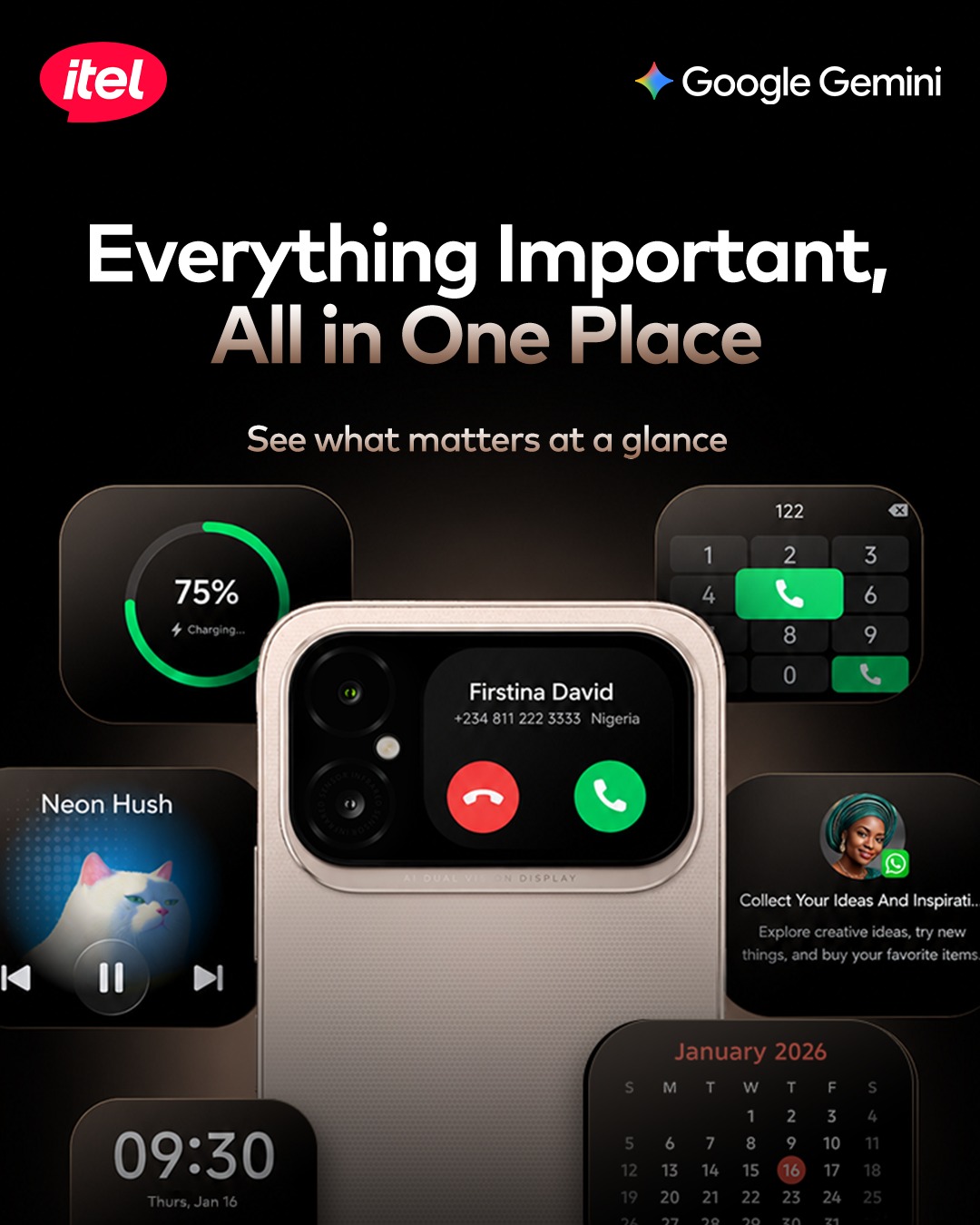
For today’s students and Gen Zs, a smartphone is more than just a communication device—it’s a study partner, entertainment hub, camera and productivity tool. From attending virtual classes and researching assignments to creating content and staying connected with friends, students need a phone that can keep up with their fast-paced lifestyle.
The itel A300+ is designed to do exactly that. Combining a 2.01-inch Smart Secondary Screen, a 7000mAh Ultra-Large Battery, and IP65 dust and water resistance, it delivers practical features that make everyday student life easier.
Power through every lecture and moment
Whether you’re moving between lecture halls, spending hours in the library or commuting across town, battery life matters. The 7000mAh battery keeps you connected throughout the day!
Smart convenience at a glance
The itel A300+’s standout feature is its 2.01-inch Smart Secondary Screen. It lets you quickly view notifications, control your music, personalise watch faces and even preview selfies using the rear camera—all without constantly unlocking your phone.
It’s a smarter, faster way to stay connected while keeping distractions to a minimum.

Built for everyday Life
Life can be unpredictable. From rushing between classes to unexpected rain showers, students need a phone that can handle everyday challenges. With IP65 dust and water resistance, the itel A300+ is built to offer added confidence wherever the day takes you.
When it’s time to relax, the hole-punch display and dual speakers provide an immersive experience for streaming, gaming and enjoying your favourite content.
Get the itel A300+ Now
Whether you’re preparing for a new semester or simply looking for a smartphone that can keep up with your daily routine, the itel A300+ offers the right balance of innovation, performance and convenience.
Visit your nearest itel Home Store today, Click HERE or check out a retail store near you and experience the itel A300+. Plus, enjoy FREE 1GB on your MTN line and 50% bonus data on every recharge for the next six months when you purchase the device.

-
 Audio10 years ago
Page – Day Break Everywhere Burst
-
 Audio5 years ago
Shadykarz – Forever
-
 Audio10 years ago
Juniorboy ft. 9ice – IRAPADA
-
 Entertainment Gists6 years ago
Ex-Beauty Queen, Sandra Benede Shares Sexy Photo
-
 Audio5 years ago
Simi – Happy Birthday ft. Adekunle Gold, DeJa
-
 Audio5 years ago
Ruger – Bounce
-
 Mixtapes4 years ago
Mixtape: DJ DimpleNipple – The Best Of Amapiano Thrills
-
 Editorials4 years ago
Sa’eedah Imam On Creating Her Imprint In The Nigerian Music Industry As An Emerging Creative Writer